
Introduction
Most businesses spend months optimizing their pricing strategy. They obsess over discounts, comparison pages, and competitive positioning. They run A/B tests on landing pages and spend hours crafting the perfect sales pitch. And yet, a competitor across town—with the same price, same product, and often fewer features—keeps winning.
The reason is almost never what they expect.
It isn't price. It isn't branding. It isn't even product quality. It's response time.
When a potential customer sends a message, fills out a form, or starts a chat—they aren't waiting patiently. They're already deciding. The business that replies first doesn't just get attention. It earns a psychological advantage that almost nothing can undo.
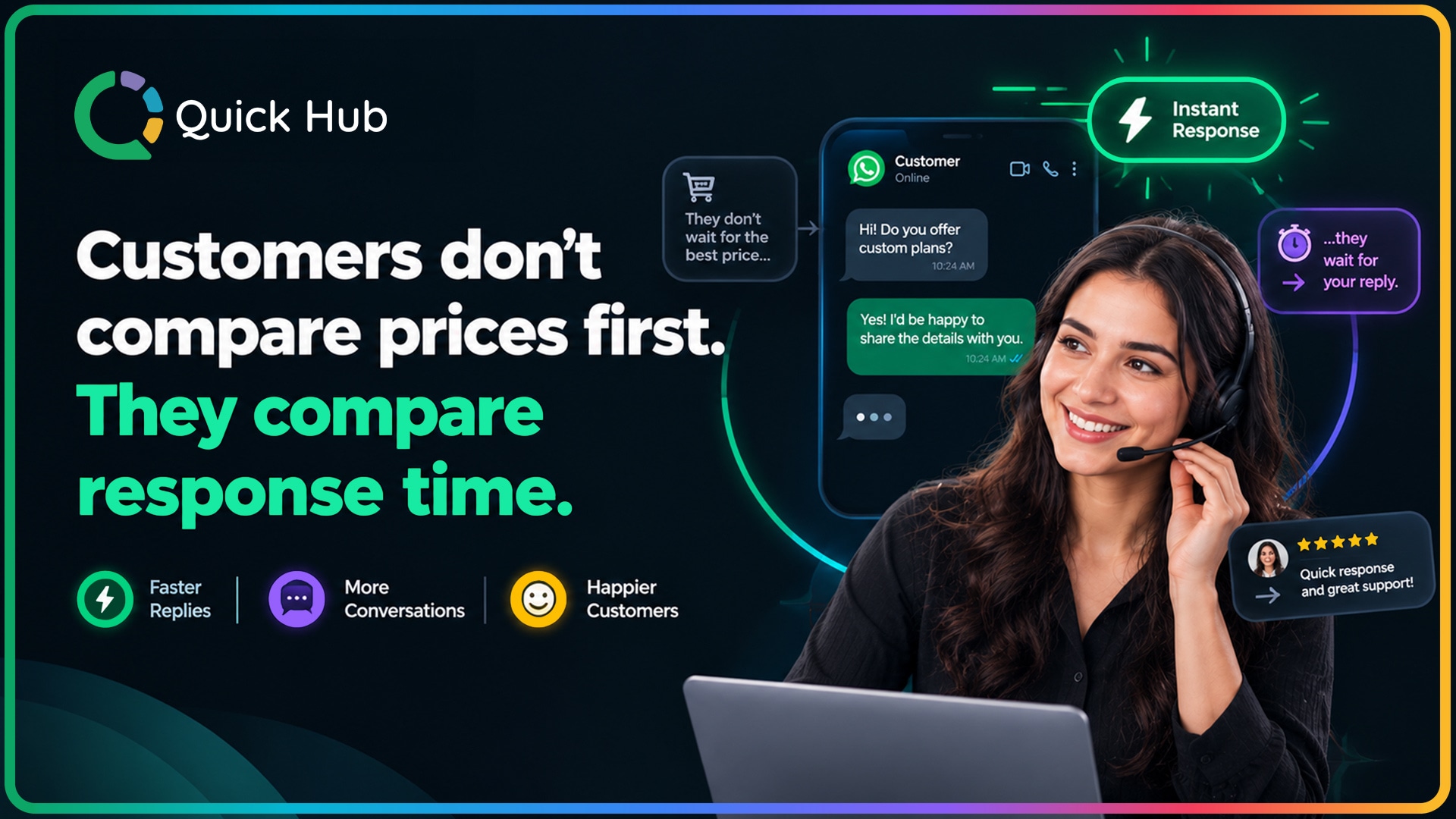
Customers don't compare prices before choosing who to trust. They compare how fast you made them feel seen. And in that gap—between their inquiry and your reply—every second either builds confidence or quietly hands the lead to someone else.
This is the competitive reality most small businesses haven't fully absorbed yet. But the ones that have? They're not working harder. They're responding faster. And faster isn't just a communication style anymore. It's a business strategy.
The Psychology Behind Speed and Trust

The brain doesn't process speed intellectually. It processes it emotionally—and instantly.
When someone reaches out to a business and receives a response within seconds, their brain registers one thing above everything else: this business is present. And presence triggers trust in a way that no amount of social proof, credentials, or persuasive copy ever fully can.
This isn't anecdotal. It's behavioral. Research in consumer psychology consistently shows that response time is one of the strongest predictors of whether a customer will convert—stronger than price, stronger than reviews, and in many categories, stronger than brand recognition.
Here's why this happens at a neurological level:
Speed removes uncertainty. When customers inquire about a product or service, they're in a state of unresolved attention. Their mind is scanning for signals of reliability. A fast response collapses that uncertainty faster than any follow-up message or persuasive selling technique. It says, without words: we're reliable, we're here, and we care.
Speed signals capacity. A business that responds slowly—even if it eventually gives a brilliant answer—signals that it's either overwhelmed, disorganized, or indifferent. None of those associations help conversion.
Speed creates commitment. Once a customer has engaged in a live conversation, they've invested mentally. That investment makes them dramatically less likely to simultaneously engage with a competitor. The first responder doesn't just answer the question. It claims the attention.
Understanding this changes how you should think about your response time. It's not a customer service metric. It's your first sales move.
What Actually Happens When You're Slow to Respond
Most businesses assume that a delayed response is just a minor inconvenience—something a customer will forgive if the eventual reply is good enough. That assumption is expensive.
The reality is that the customer's intent doesn't pause while they wait for your reply. It decays.
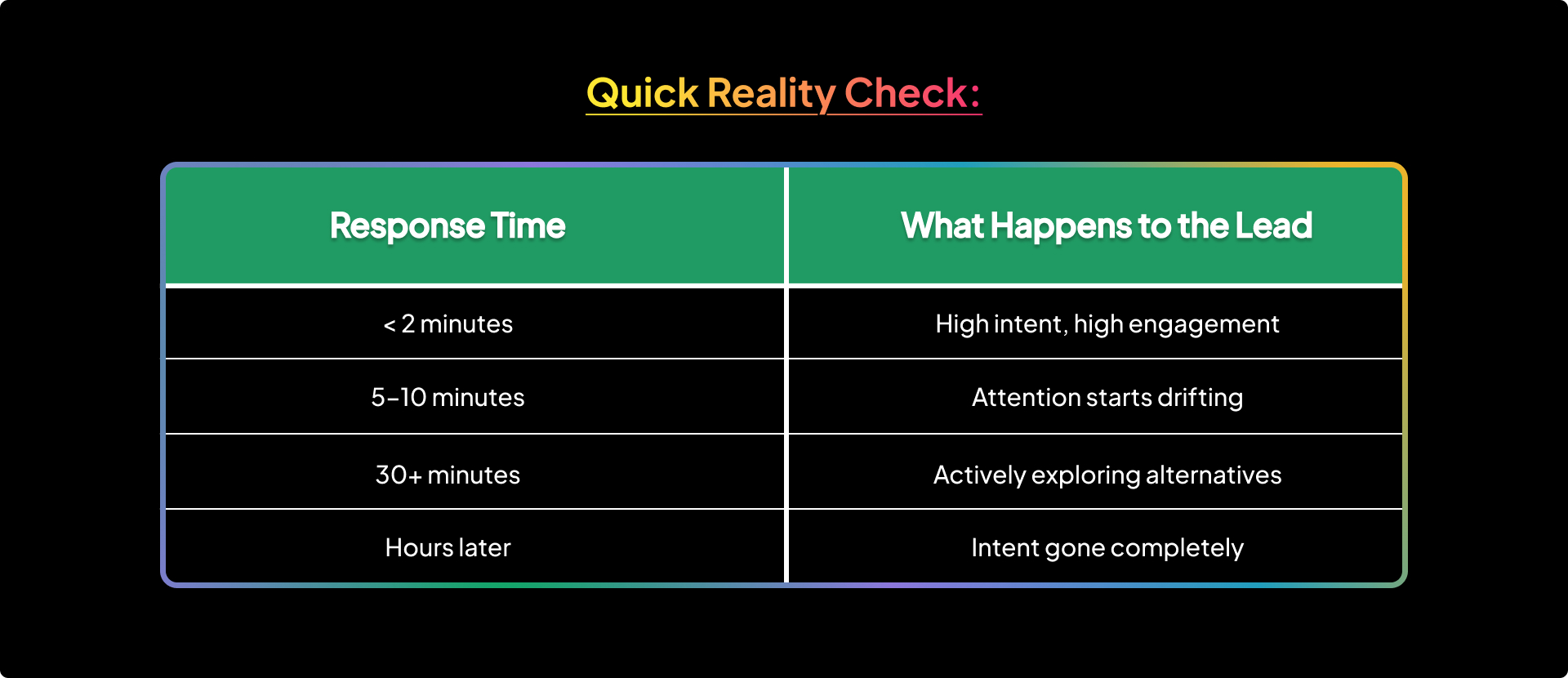
The table above isn't theoretical. It's a pattern observed across industries, from e-commerce to professional services to local retail. Within two minutes, customers are highly engaged—their intent is fresh, their attention is locked, and converting them requires nothing more than a relevant response. By five to ten minutes, attention begins splitting. They've opened another tab, sent another inquiry, or started browsing alternatives.
By thirty minutes, they're actively exploring competitors. Not because they gave up on you—but because the emotional window closed, and they moved on naturally.
And by the time hours have passed? The lead is often gone entirely. Not because they found a dramatically better product. Because someone else was simply faster.
This is where most businesses hemorrhage leads silently. They never know which inquiries went cold. They don't see the moment a customer lost interest. There's no notification when a potential buyer chose a competitor. The loss is invisible—which is exactly what makes it so dangerous.
The First Reply Doesn't Need to Be Perfect. It Needs to Be Fast.
This is one of the most common misconceptions in customer communication: that quality and speed are in tension. That replying fast means replying poorly. That thoroughness requires time.
That belief causes more lost deals than almost any other sales assumption.
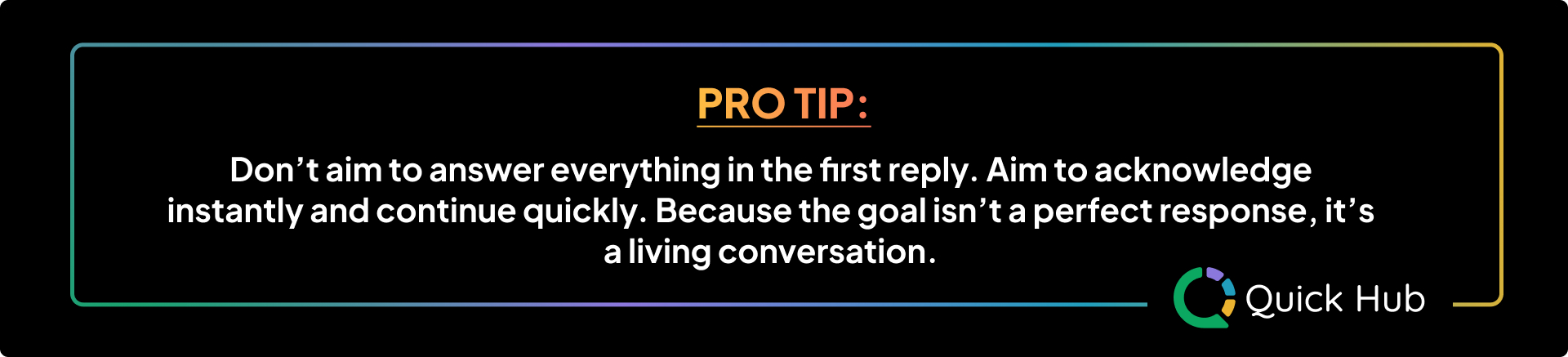
The goal of the first reply isn't resolution. It's acknowledgment. It's establishing presence. It's signaling that a real business is on the other side of that conversation, paying attention, and ready to help.
Consider two scenarios:
Scenario A: A customer messages at 2:14 PM asking about pricing. You send a thorough, detailed, perfectly formatted response at 2:49 PM with full package breakdowns, FAQs, and a personal note.
Scenario B: A competitor sends: "Hi! Thanks for reaching out. I'd love to share our pricing details—can I ask a quick question first about what you're looking for?" at 2:15 PM.
Who wins the conversation?
Scenario B does—almost every time—because by 2:49, the customer's attention is already invested in the competitor's dialogue. The quality of your delayed response becomes largely irrelevant.
The most effective first reply is short, human, and immediate. It doesn't need to solve everything. It needs to hold the moment—to keep the customer in your conversation while you prepare the fuller response.
This isn't lowering standards. It's understanding that the conversation is the product, not the single message you send.
Why Manual Response Systems Always Break Under Pressure
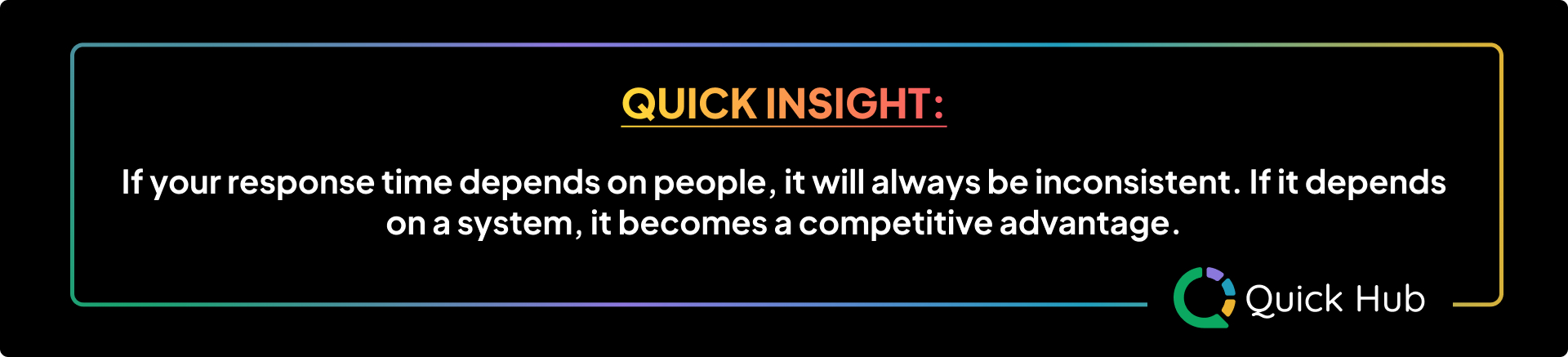
Here's the uncomfortable truth about response time for most small businesses: it's entirely dependent on people.
Someone has to see the notification. Someone has to be free to reply. Someone has to remember to follow up if the first message gets buried. Someone has to maintain their focus and energy across every inquiry, every shift, every busy period.
And people—no matter how dedicated, skilled, or motivated—are inconsistent by nature.
This isn't a character flaw. It's human reality. When a business is busy, messages get missed. When a team is stretched, response times slip. During lunch hours, evenings, weekends, and holiday periods, the gap between inquiry and reply widens exactly when it should be tightest—because those are often the highest-intent moments.
The result is a pattern that almost every business recognizes:
- Excellent response time on quiet Tuesdays
- Catastrophic response time on peak Friday afternoons
- Followed up consistently when staffed well
- Forgotten during handoffs or team changes
When response time fluctuates like this, it doesn't just hurt individual leads. It creates inconsistent brand perception. Customers who happened to message during a slow period think you're incredibly responsive. Customers who messaged during a rush think you don't care. The same business feels completely different depending on when someone reaches out.
That inconsistency quietly erodes trust at a brand level—not dramatically, but steadily. And no amount of great product or strong team culture can fully compensate for a reputation built on unreliable responsiveness.
The fix isn't hiring more people to monitor messages. It's removing the human dependency for the first response.
How Automation Holds the Moment Without Replacing the Conversation
A common fear among business owners considering automation is losing the personal touch. And that fear is legitimate—because a generic, robotic interaction can damage a brand faster than a delayed response.
But this fear misunderstands what automation is designed to do in high-performing businesses.
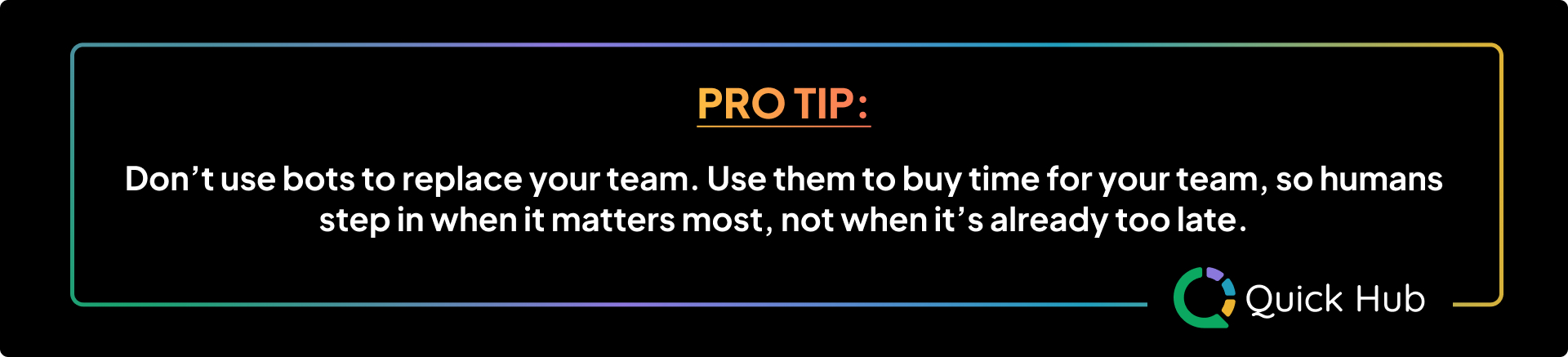
Automation isn't a replacement for human conversation. It's a bridge. Its job is to hold the moment—to acknowledge the customer, establish presence, and buy time so your human team can step in with full context when they're ready.
Think of it like this: when a customer walks into a physical store and an employee is busy, a good business doesn't make them stand in silence staring at the ceiling. Someone acknowledges them. "Hi, I'll be with you in just a moment." That acknowledgment changes everything. The customer relaxes. Their intent is sustained. They wait because they feel seen.
Automation does exactly this for digital conversations—but at scale, across every channel, at every hour.
Here's what a smart automated first response accomplishes:
- Instant acknowledgment: The customer knows someone received their message
- Expectation setting: They understand when a full response is coming
- Initial qualification: Basic questions can be answered automatically, saving time for both sides
- Lead capture: Contact details, inquiry type, and intent can be gathered before a human joins
- Context passing: When your team does step in, they have everything they need
The best businesses don't choose between speed and personalization. They use automation to achieve both: speed at the moment of contact, personalization when it counts most.
The Three Questions That Reveal Your Speed Problem
Most businesses that have a response time problem don't know it. Not because they aren't paying attention—but because slow responses don't generate complaints. They generate silence. And silence is easy to misread as satisfaction.
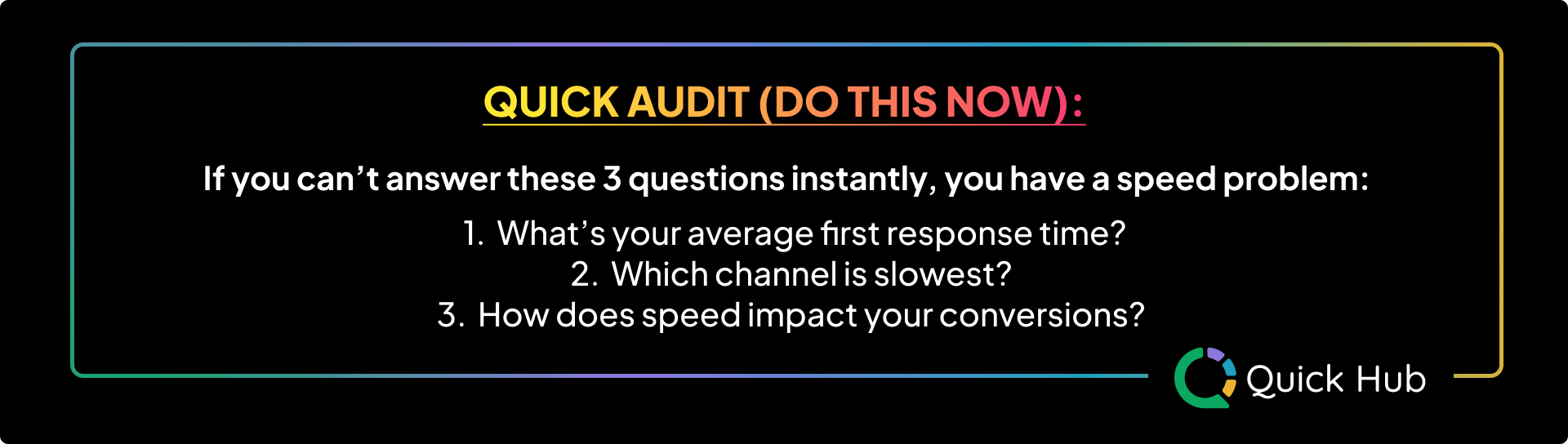
Here are three questions that cut through the ambiguity:
1. What's your average first response time across all channels?
Not your best-case response time. Not when a team member happens to be available. Your actual average, across WhatsApp, website chat, social media, email—wherever customers reach out.
If you can't answer this immediately with a real number, that's itself the answer. You don't have visibility into a metric that directly determines how many leads convert.
2. Which channel is consistently the slowest?
Every business has one. It's often the channel that feels less "official"—Instagram DMs, WhatsApp messages from referrals, contact form submissions that get buried. Whatever it is, that channel is where leads are quietly slipping away without generating any visible signal.
3. How does your response time correlate with your conversion rate?
This is the question most businesses have never asked—because they've never connected these two data points. But when you look at the customers who converted versus those who inquired but didn't buy, response time is almost always a distinguishing variable.
Businesses that can answer all three of these questions confidently are already operating with a systems-level view of their customer communication. The ones who can't are running on assumptions—and assumptions are exactly where leads go to disappear.
What Happens When You Customize the Experience, Not Just Automate It
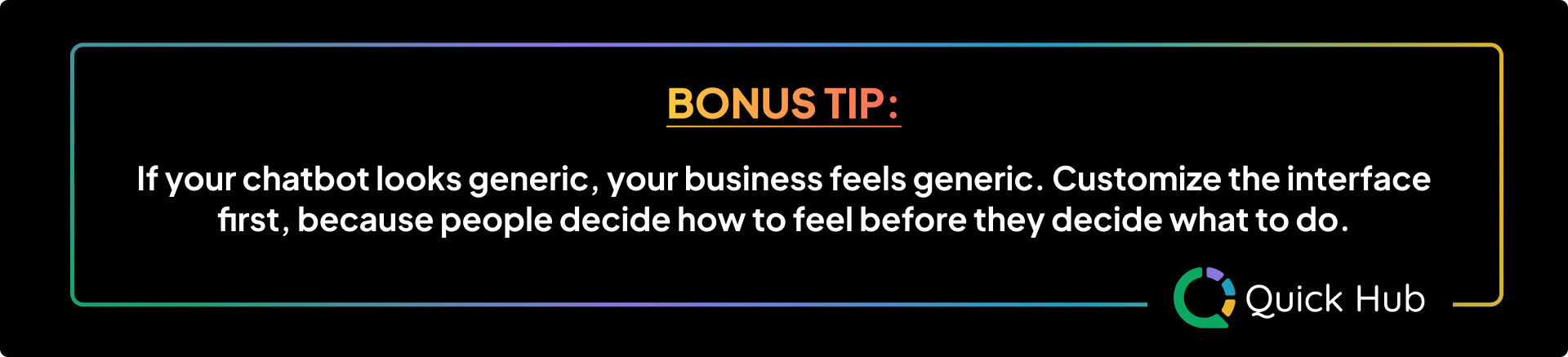
Speed gets customers into the conversation. But the quality of what they experience inside that conversation determines whether they stay.
This is where customization becomes critical—not as a cosmetic upgrade, but as a trust signal.
When a customer opens a chat and sees a generic interface—no name, no brand personality, no context-aware responses—they make an unconscious judgment: this business hasn't thought about me specifically. And that feeling is correct. Generic tools produce generic experiences. And generic experiences don't differentiate you.
Contrast that with a chat experience that:
- Opens with your business name and tone
- Greets customers in a way that matches your brand personality
- Offers quick replies that reflect your actual services
- Addresses common questions with accurate, specific information
- Transitions smoothly from automated response to human conversation
That experience doesn't just feel better. It sells. Not through persuasion, but through professionalism. Customers decide how to feel about a business before they decide what to do. A personalized, polished response experience signals capability, attention to detail, and trustworthiness—often before a human team member has said a single word.
The businesses winning on response time aren't just fast. They're fast and professional. Fast and personal. Fast and brand-consistent. Because speed without quality holds the moment, but quality is what closes the sale.
Building a Response System That Scales With Your Business
Complexity is the enemy of consistency. If your response system requires hours to configure, ongoing technical management, and a dedicated person to maintain it—it will eventually break down. Not dramatically, but gradually, as other priorities crowd in.
The most effective response systems share three characteristics:
They're simple to set up. A system that takes days to configure will be configured incorrectly, partially, or not at all under real operational pressure. The best tools are live within minutes, not weeks.
They're automatic by default. The first response should never require a human decision. That automation layer handles the predictable—acknowledgment, routing, FAQ answers—so humans only engage when judgment, nuance, or relationship is required.
They improve with data. Over time, a good system surfaces patterns: which channels get the most inquiries, which hours see the highest volume, which automated responses lead to conversions versus drop-offs. That data makes the whole system sharper without adding manual work.
QuickHub is built around exactly this model. Businesses connect their WhatsApp, website chat, and other channels into a single inbox. Automated responses handle the first touch—instantly, consistently, and on-brand. Then when a lead is qualified and warmed up, the team steps in with full conversation history and context. The result is a response experience that feels personal to the customer and systematic to the team.
That combination—instant automation followed by informed human engagement—is what turns response time from a weakness into a weapon.
The Compounding Effect of Getting This Right
Response time improvements don't just recover lost leads. They compound.
When your business responds faster:
-
Conversion rates improve immediately. Leads that previously went cold now convert. Inquiries that previously felt like dead ends now become sales conversations.
-
Customer satisfaction scores rise. Customers who felt heard and responded to quickly report significantly higher satisfaction—even when the eventual answer is "we can't help with that."
-
Review quality improves. Speed is one of the most common positive mentions in customer reviews. "They responded so quickly" appears again and again in 5-star feedback. That review content attracts the next high-intent customer.
-
Team morale increases. When a system handles the first touch, your team isn't spending their day in reactive fire-fighting mode. They engage with warmer leads, more meaningful conversations, and fewer cold-inquiry dead ends.
-
Referral rates increase. Customers who experienced fast, professional responses refer more frequently—because "they're so responsive" is one of the easiest things to say about a business when recommending it.
Each of these effects reinforces the others. Faster response → more conversions → better reviews → more inbound inquiries → more opportunities for fast response → stronger brand reputation. The loop feeds itself.
Bonus Insight: Speed Is the Minimum. Clarity Is What Converts.

Here's the nuance most discussions about response time miss: speed is necessary, but it isn't sufficient.
The fastest response in the world still loses if it increases confusion. Customers aren't looking for the fastest message—they're looking for the fastest resolution of uncertainty. Those are related, but not identical.
A message that arrives in 30 seconds but says "Hi! Let me check on that for you" is fast—but it doesn't remove uncertainty. A message that arrives in 45 seconds and says "Yes, we have that available in both sizes, and delivery takes 2-3 days" removes uncertainty and moves the customer toward a decision.
The goal isn't to optimize message speed in isolation. It's to optimize how quickly your response makes the customer feel confident, informed, and ready to take the next step.
This is where automation and personalization work together:
- Automation handles the speed, ensuring no inquiry goes unacknowledged beyond the first few seconds
- Smart response design ensures that automated messages are genuinely useful, not just acknowledged receipts
- Human follow-through brings nuance, context, and closing capability when the automated first touch has done its job
Businesses that master all three levels—speed, clarity, and human depth—don't just win individual leads. They build the kind of customer experience that makes competitors feel slow by comparison.
Conclusion
The conversation has already started. The question is whether you're in it.
Every day, potential customers reach out to businesses across every channel—WhatsApp, website chat, social media, email—and make a decision based on what happens in the next few minutes. Not the next few days. Not after they've reviewed your proposal. In the minutes immediately following their first message.
Response time isn't a back-office efficiency metric. It's the front line of your sales process. It determines trust before trust has been consciously decided. It influences choice before comparison has been made. And it separates businesses that feel present from businesses that feel unavailable—even when the product, price, and team are identical.
The businesses that understand this aren't just faster at replying. They've rebuilt their entire customer communication approach around this insight: speed is the first impression, and first impressions convert.
If your response time depends on who's available, what day it is, and how buried the inbox gets—it will always be inconsistent. If it depends on a system designed for instant response, it becomes a competitive advantage that compounds over time.
QuickHub helps businesses build that system: instant automated first responses, unified multi-channel inbox, and the tools to make every conversation feel fast, personal, and professional. Because your next customer isn't waiting. And neither should you.
Want to see how fast your business can respond? Start with QuickHub today and close the gap between inquiry and conversion—before your competitor does.