
Introduction
For years, small businesses were told that a good website and a few social media pages were enough to stay visible online. Build a homepage, post on Instagram, maybe run some ads, and your digital presence was considered “handled.”
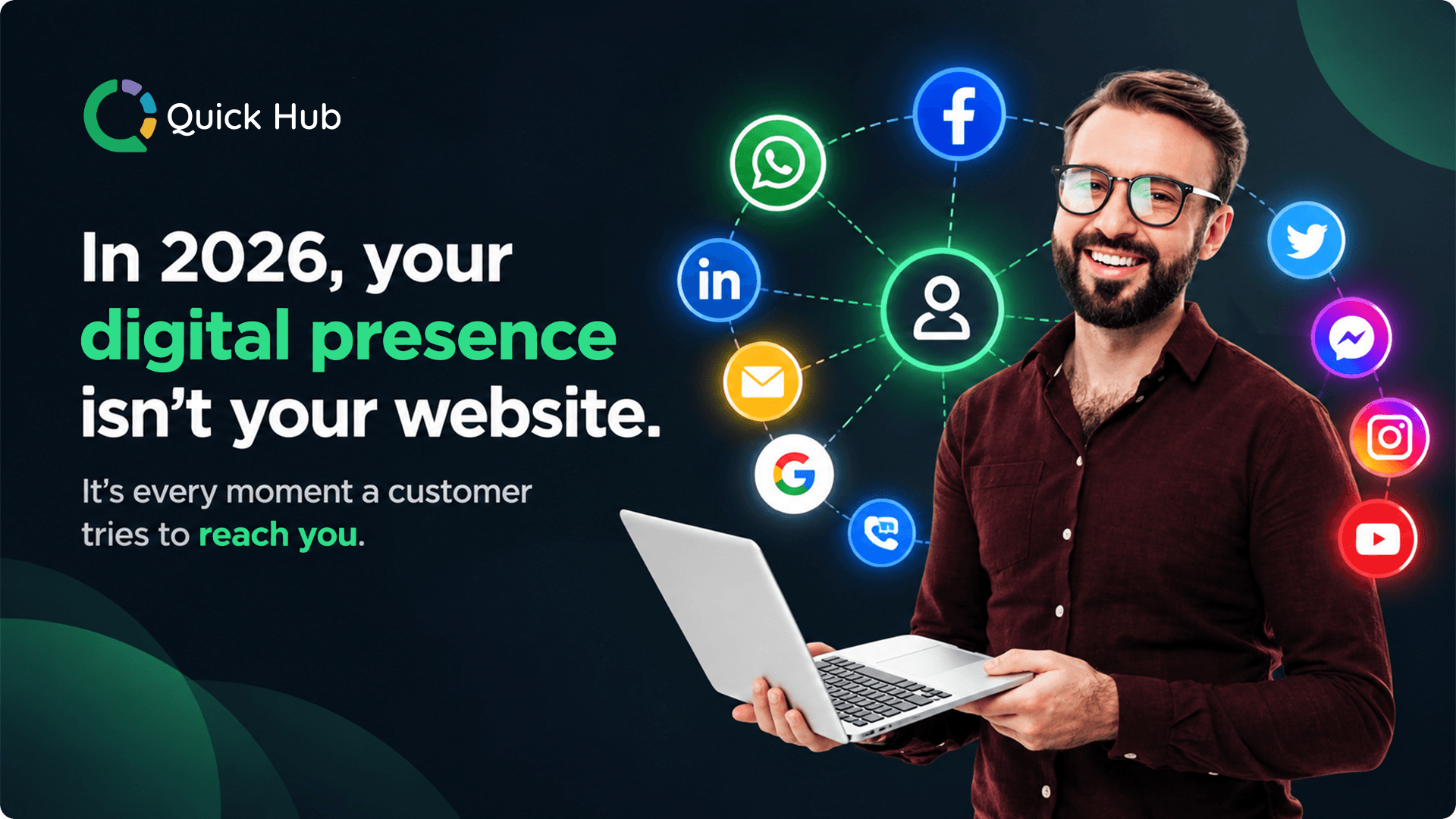
That logic no longer holds. Today, customers don’t follow neat funnels. They jump between Google search, WhatsApp, Instagram DMs, website chat, email, and review platforms, sometimes within the same hour. For small businesses, digital presence has become a real-time, always-on experience that spans every channel where customers ask questions, book services, leave feedback, and expect instant responses.
And here’s the uncomfortable truth: Most small businesses are technically “present” everywhere, but operationally connected nowhere.
They have tools for marketing. Tools for messaging. Tools for bookings. Tools for reviews. But those tools for small business don’t talk to each other. Which means customers get fragmented experiences, teams lose context, and growth depends more on manual effort than on systems. This is why omnichannel customer experience and unified digital presence for small businesses are no longer buzzwords in 2026. They are survival requirements.
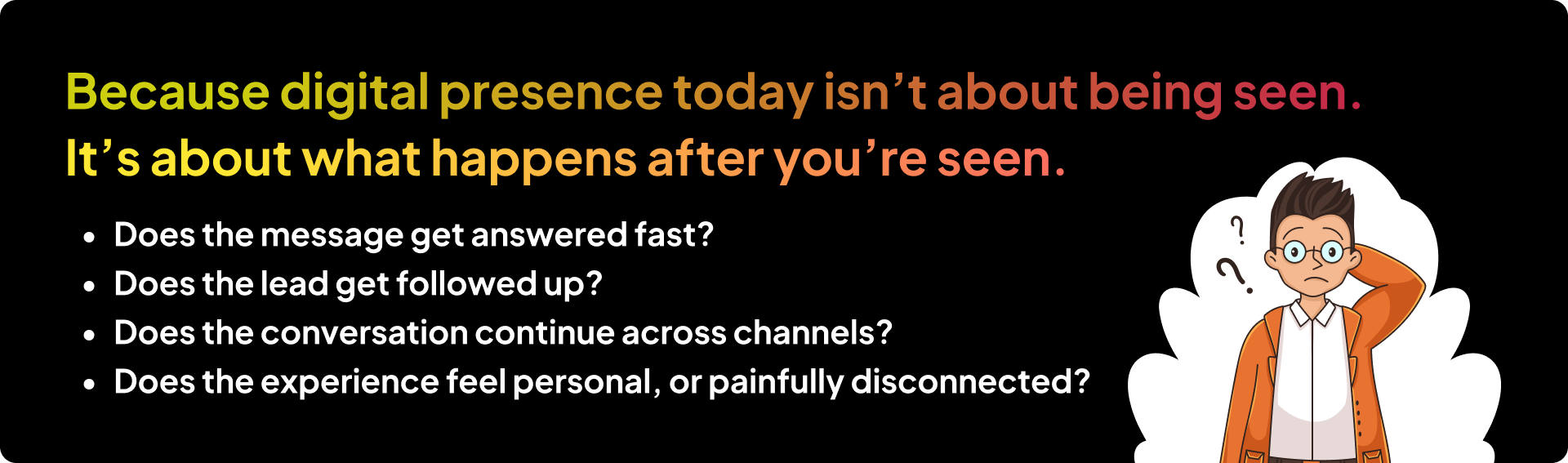
In an era of AI-driven discovery, conversational commerce, and intent-based engagement, visibility without execution is useless. Customers don’t reward brands that look good online. They reward brands that respond, remember, and act fast.
Which brings us to the real shift happening right now: Small businesses don’t have a marketing problem. They have a system problem. And in 2026 and beyond, the future of digital presence won’t be built on more apps, more dashboards, or more disconnected software. It will be built on one unified system that manages the entire customer journey, from first click to loyal customer.
That’s the new baseline. And it’s already separating the businesses that grow… from the ones that just stay visible.
The Hidden Cost of Fragmented Tools
“Most small businesses aren’t underperforming. Their systems just don’t talk to each other.”
On the surface, everything looks fine. Posts are going out. Leads are coming in. Messages are getting replies. Campaigns are being sent. But behind the scenes, most small business digital ecosystems are stitched together from disconnected apps that were never designed to operate as one.
That’s what tool sprawl in small businesses actually looks like:
- A social media scheduler for posting.
- A CRM for storing leads.
- WhatsApp for real conversations.
- A spreadsheet to track follow-ups.
- An email platform for campaigns.
Each tool does its job. None of them understand the full customer story. And that’s where the real damage begins. When data is scattered, teams lose context. A lead clicks an ad, but the chat agent doesn’t know which offer they saw. A customer messages again, but the previous conversation isn’t visible. A campaign goes out, but sales has no idea who engaged. The result is a fragmented customer experience where every interaction feels disconnected, even if the brand is visible everywhere.
This is why follow-ups slip. Why customers repeat themselves. Why responses feel generic. And why brand voice changes from channel to channel. More importantly, it breaks momentum. Every handoff becomes manual. Every decision depends on memory. Every update requires switching tabs. What should be a smooth journey becomes a series of small delays, and in digital-first markets, delay is the fastest way to lose attention and trust.
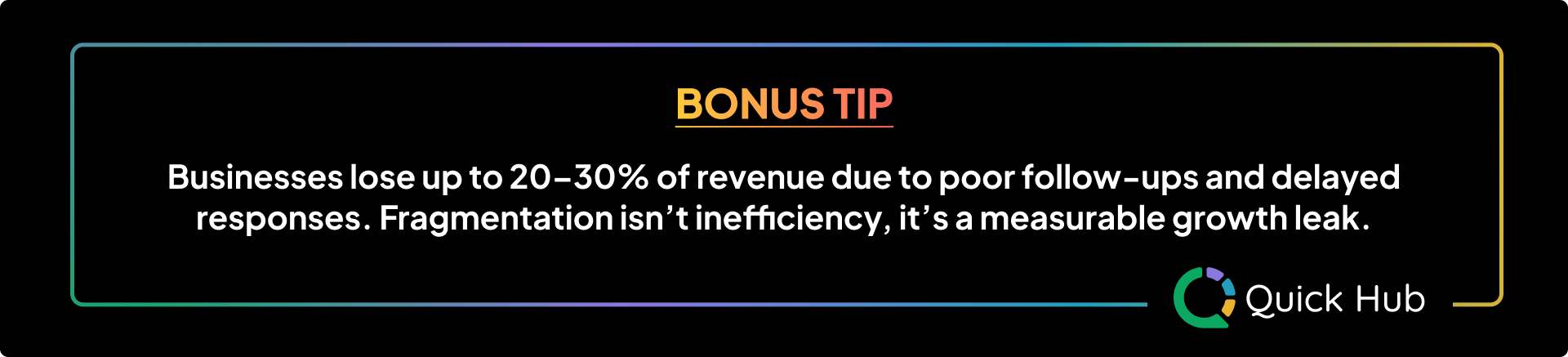
Key Insight: Fragmentation doesn’t just slow teams, it breaks customer journeys and quietly leaks revenue through missed context, delayed responses, and inconsistent engagement.
When execution depends on juggling tools instead of flowing through systems, growth doesn’t just slow down—it becomes unpredictable.
Customers Don’t See Channels, They See One Brand
“Your customer doesn’t care which app you use. They care whether you reply.”
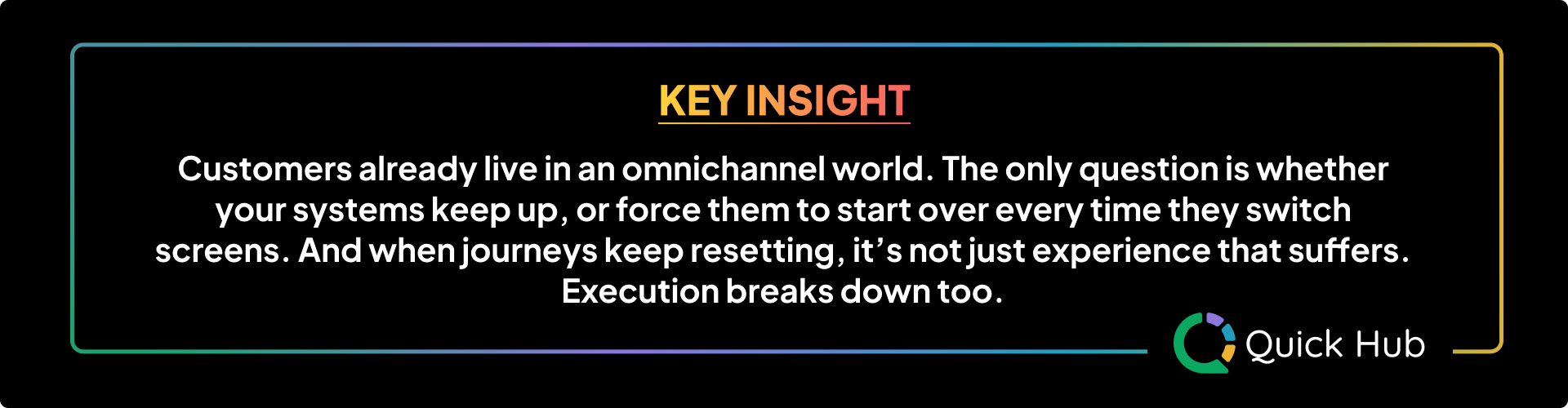
From the customer’s point of view, there is no such thing as “channels.” There is only the brand, and how easy (or painful) it feels to interact with it. In 2026, customer behavior is completely fluid. People move naturally from search to social, from social to chat, from chat to in-store, and back to reviews without thinking twice. That’s the new baseline for conversational commerce in SMBs and modern buying journeys.
But expectations have shifted along with behavior.
Customers now assume:
- Context should follow them across touchpoints.
- History should be remembered without repetitive questions.
- Conversations should continue, not restart every time they reach out.
- Service should feel like one continuous experience.
This is the new definition of a unified customer experience, and it’s quickly becoming the standard, not a premium feature. QuickHub exists precisely because this continuity is no longer optional; it’s expected.
Here’s the disconnect: most small business systems still treat every channel as a fresh start.
The Fragmented Conversation Breakdown:
- A customer explains an issue on Instagram.
- Then they message on WhatsApp and have to repeat everything.
- Then they call and start from zero again.
To the business, these are three separate interactions. To the customer, it feels like the brand isn’t listening. And every time context resets, trust takes a hit.
This is why omnichannel expectations in 2026 aren’t about being present everywhere—they’re about being consistent, informed, and fast across all touchpoints. Presence without memory doesn’t feel modern. It feels careless. Fragmented conversations don’t just hurt experience; they quietly kill conversion.
When sales teams can’t see prior intent signals, offers miss the moment. When support teams lack purchase history, resolution slows. When marketing can’t see live conversations, campaigns lose relevance. Momentum disappears in the handoff between tools, the exact problem unified systems like QuickHub are designed to eliminate.
Why Point Solutions Are Failing Modern Small Businesses
“Adding more tools used to feel like progress. Now it just adds more tabs.”
For years, small businesses were told to solve problems one tool at a time:
- Need email? Add an email platform.
- Need to chat? Add a chatbot.
- Need a CRM? Add another CRM dashboard.
- Need ads? Yet another login.
Each point solution promises to fix one specific pain. And individually, many of them work fine. But here’s the problem: customers don’t move in pieces. They move in journeys.
And point tools are terrible at managing journeys. Each system captures a sliver of the customer story, but none of them see the whole picture. Leads live in one place. Conversations in another. Campaigns in a third. Reviews in a fourth. Teams end up acting on fragments instead of flow. This is where SMB tech stack complexity quietly turns into an operational tax. Because when systems don’t connect, people have to.
That means manual coordination between teams, copy-pasting data across platforms, constant status checks, and decisions made on partial information. The more tools you add, the more staff-dependent execution becomes. Growth starts relying on memory, heroics, and hustle instead of repeatable systems. This is exactly the gap unified platforms like QuickHub are designed to close, not by adding more features, but by connecting the ones that already exist.
The Strategic Ceiling of Single-Purpose Tools
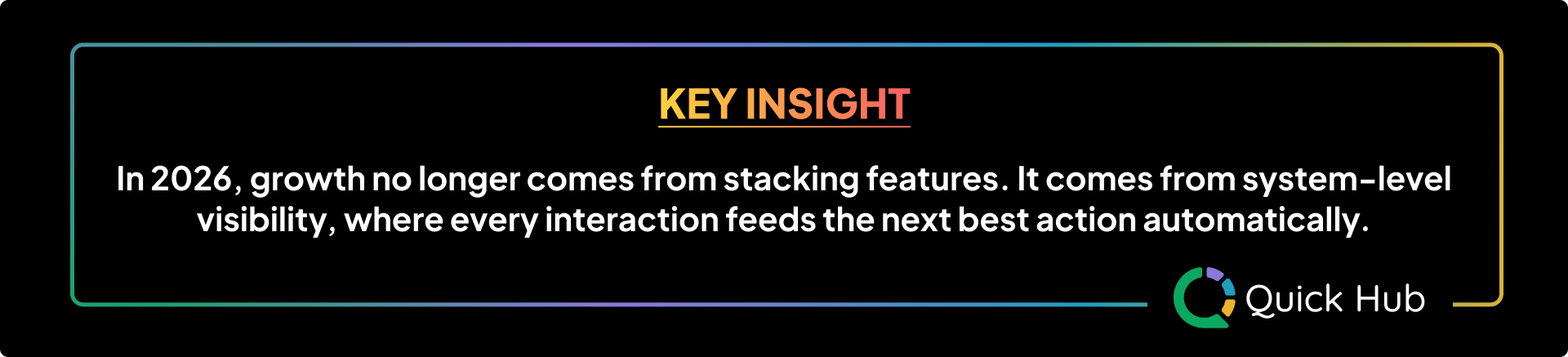
Modern marketing automation and AI can only optimize what they can actually see. If customer data, behavior, and conversations are scattered, automation has no clear signal to act on. It can trigger tasks, but it can’t improve outcomes. That’s the hidden ceiling of single-purpose tools:
- They automate actions, not decisions.
- They report activity, not momentum.
- They track steps, not success.
This is why so many small businesses feel busy but stuck. They’re running dozens of tools, yet no system is actually running the business. A connected operating layer, powered by AI marketing for small businesses like QuickHub, changes that by turning fragmented activity into continuous, visible flow.
And once businesses realize features can’t fix broken flow, the next question becomes unavoidable: What should a modern digital system actually look like?
The Shift Toward Unified Business Systems
“The next evolution of SMB tech isn't smarter tools. It’s smarter systems.”
After years of stacking apps, small businesses are starting to ask a better question: Why are we managing software… instead of running the business?
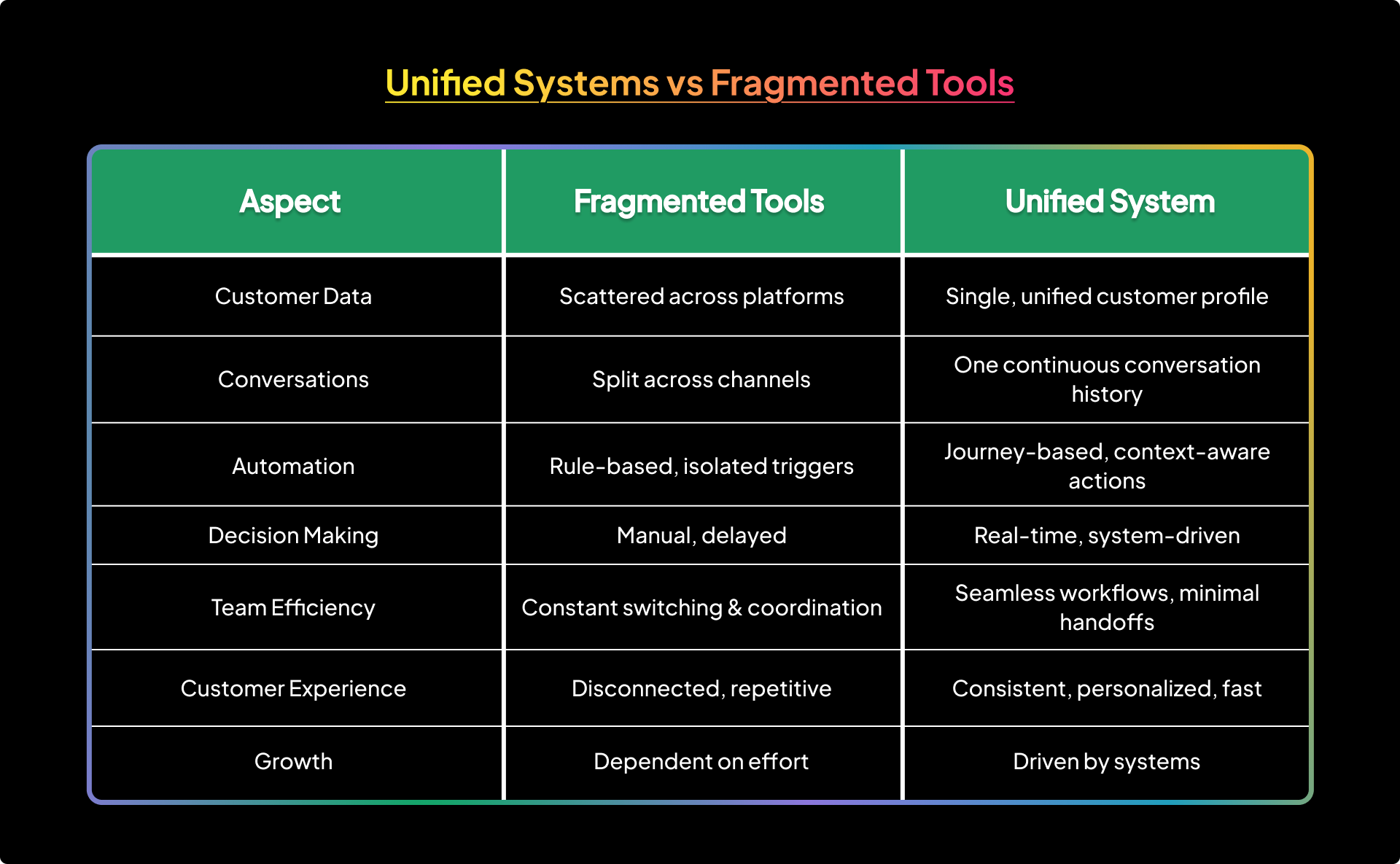
This is where the idea of a unified business platform takes over. Not a bundle of features. Not a marketplace of integrations. But a true business operating system for SMBs, where every customer interaction, workflow, and follow-up runs on the same foundation.
What “Unified” Actually Means in Real Terms:
- One customer profile — Not copies scattered across tools.
- One conversation history — Across chat, email, SMS, and social.
- One workflow engine — That moves leads, tasks, and follow-ups forward.
- One analytics layer — That connects actions to outcomes.
When all of this lives inside the same system, something powerful happens: Automation stops being reactive… and starts becoming journey-based.
| Traditional Task Automation | Unified Journey Automation |
|---|---|
| “If a form is submitted, send an email.” | “If high-intent lead asks pricing → prioritize response → schedule follow-up → trigger reminder if no reply → notify owner if deal stalls.” |
| Disconnected triggers | End-to-end orchestration |
| Calendar timer schedules | Context-aware engagement |
| Isolated activity reports | Revenue outcome visibility |
It also unlocks context-aware engagement. Messages don’t fire just because time passed. They fire because behavior happened. Because interest spiked. Because silence signaled risk. And once systems see full journeys, predictive actions become possible: who’s likely to book, who’s about to drop off, and who needs attention now, not tomorrow.
This is the real shift: Tools respond to events. Systems orchestrate outcomes.
And in 2026, orchestration is what separates businesses that scale from those that simply stay busy.
But when everything runs through one system, it raises an even bigger question: who, or what is actually driving those decisions inside the workflow?
Automation Only Works When Systems Are Connected
“You can’t automate a journey if your data is trapped in silos.”
Most small businesses don’t lack automation. They lack connected automation. Right now, triggers usually live inside individual tools: email automates email, chat automates chat, and ads automate lead capture. But none of them understand what happens before or after. That’s why so much automation today feels busy… but not effective.
Why Automation Fails in Disconnected Systems:
- Triggers only see single-channel activity.
- No visibility into the full funnel.
- No awareness of intent across touchpoints.
- No link between conversations and conversions.
So workflows fire on schedules, not on signals. And when automation can’t “see” the whole customer journey, it can’t optimize it.
Now compare that with what happens when systems share the same data layer. This is where intelligent automation workflows become possible.
Connected systems can detect behavior (not just events), switch channels based on response patterns, prioritize leads using real engagement signals, and trigger actions tied to revenue stages (not just form fills). This is the difference between automation that reacts… and automation that adapts.
Real-World Connected Workflow Examples:
- Email bounce or unread ➔ The system automatically switches to WhatsApp with contextual follow-up.
- Pricing page visited twice ➔ Sales rep gets notified with full intent history instantly.
- No reply after booking inquiry ➔ Follow-up escalates automatically instead of expiring silently.
That’s cross-channel marketing automation for small business that actually protects opportunity instead of just pushing messages.
The Critical Shift: Automation is not about doing more. It’s about doing the right next action, at the right time, on the right channel. That only happens when data, conversations, campaigns, and outcomes live inside the same system.
And once systems are finally connected, the next evolution isn’t more rules, it’s letting AI help decide what should happen next.
Unified Systems Are Becoming Revenue Infrastructure
“In 2026, digital presence isn’t marketing. It’s sales, service, and retention combined.”
For years, digital tools were treated as promotion engines. Post more. Email more. Advertise more. But in 2026, growth isn’t decided by who shouts the loudest. It’s decided by who responds the fastest, follows up the smartest, and remembers the customer the longest. That’s why unified platforms are no longer just productivity tools. They are becoming revenue automation platforms.
Because this is where revenue is actually won or lost now:
- Response speed after an inquiry.
- Consistency of automated follow-ups.
- Review velocity and reputation signals after service.
- Re-engagement when customer interest drops.
Not in vanity impressions. Not in open rates. But in execution speed and continuity. And fragmented tools can’t protect any of that.
When CRM, chat, campaigns, and automation live in separate systems:
- Sales doesn’t see marketing context.
- Support doesn’t see purchase history.
- Marketing doesn’t see service outcomes.
So every team optimizes their own dashboard… while revenue leaks between handoffs. Unified systems change that dynamic completely. With one data layer and one workflow engine, businesses can finally manage the entire customer lifecycle:
Inquiry ➔ Conversation ➔ Booking ➔ Service ➔ Review ➔ Repeat Visit
All visible. All connected. All measurable. This is what modern customer lifecycle management for SMBs actually looks like.
Measurable Business Impact:
- Higher conversion rates because customer intent is acted on immediately.
- Higher customer lifetime value (LTV) because re-engagement is triggered automatically.
- Superior operational efficiency because teams stop duplicating work across multiple tools.
Key Insight: Digital presence has crossed a line: it’s no longer a branding layer. It’s now core growth infrastructure.
The brands that win in 2026 won’t be the ones with the most creative ads. They’ll be the ones with the tightest execution loops. Because when systems are unified, every interaction becomes a chance to move revenue forward, not just record activity.
What High-Growth SMBs Are Doing Differently (System Thinking)
“They don’t ask: which tool should we buy? They ask: where does the journey break?”
High-growth small businesses don’t chase software features. They chase flow. Instead of stacking apps, they map the customer journey end to end and look for one thing:
- Where does momentum slow down?
- Is it after the first message?
- During follow-ups?
- Between booking and service?
- After the sale, when reviews and repeat visits should happen?
This is a system-based growth strategy in action, not tool-based marketing.
Their Core Focus Stays on 3 Pillars:
- Customer Flow Mapping: Understanding how people actually move from interest to loyalty across channels.
- Bottleneck Elimination: Systematically removing delays, manual handoffs, and duplicate steps.
- End-to-End Accountability: Ensuring every stage has a clear owner and workflow trigger.
Because they think in systems, not apps, their technology choices prioritize fewer platforms with deeper integrations and clear automation ownership so no lead or task floats without responsibility. This is what real automation maturity in SMBs looks like: reliable execution that doesn't depend on someone remembering what to do next.
3 Growth Killers High-Performing SMBs Avoid:
- App hopping between disconnected dashboards.
- Manual reconciliation of data across spreadsheets and apps.
- Channel silos where marketing, sales, and service operate blind to each other.
Strategic Playbook: How to Build a Unified Digital Presence
“Unification isn’t a tech project. It’s a workflow decision.”
Most small businesses don’t fail at digital because they lack tools. They fail because no one ever designed how work should flow between them. A unified digital presence strategy starts with fixing execution, not buying software.
Here’s what that looks like in practice:
Step 1: Map the Real Customer Journey
Map the actual customer pathway—from the first ad click or WhatsApp message, to booking, service delivery, follow-up review, and repeat purchase. Momentum drops wherever handoffs depend on manual human memory. Modern business OS platforms like QuickHub are designed around this exact journey logic.
Step 2: Centralize Conversations
Customers don’t think in platforms; they message where it’s easiest. Unified communication requires: one inbox, one customer profile, and one conversation history. When WhatsApp, website chat, social DMs, and lead forms land in the same workspace, teams respond with full context.
Step 3: Connect Marketing to Sales Actions
Campaigns should never end at message delivery. A message click should auto-route to a sales rep. A form fill should start an adaptive follow-up sequence. A missed reply should escalate automatically.
Step 4: Add AI Where Humans Slow Down
AI works best at operational friction points: drafting instant replies, prioritizing high-intent leads, routing conversations, and flagging churn risks. Embedded AI inside unified systems increases response velocity without adding headcount.
Step 5: Measure Revenue, Not Activity
High-performing businesses stop asking "How many emails were sent?" and start asking:
- How fast did we respond to inquiries?
- How many conversations converted into bookings?
- How many customers came back for repeat service?
Frequently Asked Questions (FAQ)
What is an all-in-one business management platform?
An all-in-one business management platform is a unified software system that consolidates core customer operations—including CRM, multi-channel messaging (WhatsApp, SMS, live chat, social DMs), marketing campaigns, ad management, review generation, and workflow automation—into a single operating layer and shared database.
What are the best business tools for a small business?
The best business tools for small businesses in 2026 are unified operating systems that connect customer communication, sales pipeline management, marketing automation, and reputation into one platform (such as QuickHub) rather than maintaining 5–10 separate subscriptions.
Which is the best all-in-one marketing platform?
The best all-in-one marketing platform combines conversational commerce, CRM data, automated email/SMS/WhatsApp outreach, and AI-driven workflow execution. Platforms like QuickHub enable SMBs to manage discovery, conversion, and retention under a single login.
How do I automate my marketing?
To automate your marketing effectively:
- Centralize your contact database and customer interaction history in one CRM.
- Set up behavioral triggers (e.g., instant auto-replies to inquiries, automated follow-ups for unread messages).
- Connect multi-channel campaigns (WhatsApp, email, SMS) to sales workflows.
- Deploy AI assistants to qualify leads and draft personalized responses around the clock.
What is the price of an all-in-one marketing platform?
All-in-one marketing platform pricing typically ranges from $99 to $499 per month depending on contact volume, message throughput, and AI agent capabilities. Consolidating into a unified platform typically saves small businesses 40–60% compared to paying for separate CRM, email marketing, chatbot, SMS, and scheduler subscriptions.
Final Takeaway: Why Unified Systems Will Define SMB Winners
“In the next phase of digital competition, visibility won’t matter if execution is broken.”
For years, digital success meant being seen. More ads. More posts. More platforms. But in 2026 and beyond, that playbook is losing power. Because attention without action doesn’t grow revenue. And reach without response doesn’t build loyalty.
Today’s reality is simple and unforgiving:
- Customers expect instant responses, not “we’ll get back to you.”
- They expect seamless handoffs, not repeating themselves across channels.
- They expect consistent experiences, whether they start on search, social, chat, or in-store.
That’s why the new winning formula for small businesses isn’t more apps. It’s one connected growth system where conversations, campaigns, follow-ups, and customer data move together seamlessly.
This is where platforms like QuickHub change the game—acting as a true business operating system for SMBs where CRM, unified chat, campaigns, ads, reviews, and AI agents operate on the same data and execution logic.
Ready to Unify Your Business Presence?
If your business is struggling with tool sprawl, delayed lead follow-ups, or disconnected customer conversations, it's time to upgrade from fragmented apps to a unified execution system.
Book a free QuickHub demo and discover how modern small businesses use unified automation, AI workflows, and cross-channel messaging to scale with clarity and control.