
Introduction
Your happiest customers could be your loudest advocates. So why is your Google review count still silent?
Most small businesses assume they don’t get enough Google reviews because customers are busy, uninterested, or unwilling to help. That assumption is wrong. In reality, most customers are satisfied, and many are even delighted. But reviews don’t happen automatically. Without a clear trigger, even extraordinary experiences fade into the background. The intent exists; the action doesn’t.
This is where review collection breaks. For most businesses, it depends on manual effort:
- Someone remembering to ask at checkout.
- An owner awkwardly requesting a favor.
- A manual follow-up sent days later, if at all.
That’s not a strategy. That’s hope. Manual review strategies fail because they rely on human consistency—and humans are rarely consistent when busy running day-to-day operations. Even when customers want to help, delays kill momentum. The longer the gap between the experience and the ask, the lower the chance a review ever gets written.
That’s why businesses struggle with Google reviews despite delivering exceptional service. The problem isn’t quality; it’s timing and structure. When reputation depends on memory or mood, results become unpredictable. Customers move on. The moment passes. The opportunity disappears.
High-performing businesses understand this early: If review collection is manual, it will always be inconsistent. That’s why modern teams use systems, not reminders. Platforms like QuickHub remove randomness by making review requests part of the customer journey, not an afterthought. Reviews are triggered automatically, sent at the peak emotional moment, and followed up without chasing.
This is what actually fixes the problem. Not asking more. Not asking harder. But replacing manual hustle with an automated system that delivers consistent reviews over time.
Why Begging for Reviews Backfires (And Hurts Trust)
When businesses don’t have a system, they default to begging. They say things like:
- “Sir, please leave us a review.”
- “Can you give us five stars?”
- “It will really help our business out.”
It sounds harmless. It isn’t. Pressure fundamentally changes how customers feel. Instead of leaving reviews because they want to share their satisfaction, they feel like they owe you a favor. The request shifts from sharing an authentic experience to doing unpaid emotional labor. And that subtle shift weakens trust.
Begging Creates Unnecessary Discomfort:
- Customers feel put on the spot.
- They don’t want to disappoint you in person.
- They feel pushed toward an artificial rating.
So they delay. Or avoid it entirely. Some leave rushed, low-effort reviews just to move on. None of this builds strong social proof. Over time, repeated asking signals something far worse: insecurity.
Customers start wondering:
- Why are they trying so hard?
- Are they struggling to get business?
- Can these reviews even be trusted?
That’s where credibility starts to slip. Social proof only works when it feels organic and uncoerced. The moment it feels forced, it stops working. This is especially risky for small businesses, where trust decides everything. Desperation doesn’t build confidence—it erodes it. Customers can tell the difference between a review that’s freely shared and one that’s extracted under pressure.
The Long-Term Cost of Begging:
- Lower trust across customer interactions
- Weaker social proof with generic 1-line feedback
- Inconsistent review velocity that looks unnatural to Google’s algorithm
Strong brands don’t ask louder. They design systems that make leaving a review feel natural and seamless. And when reviews feel natural, trust compounds.
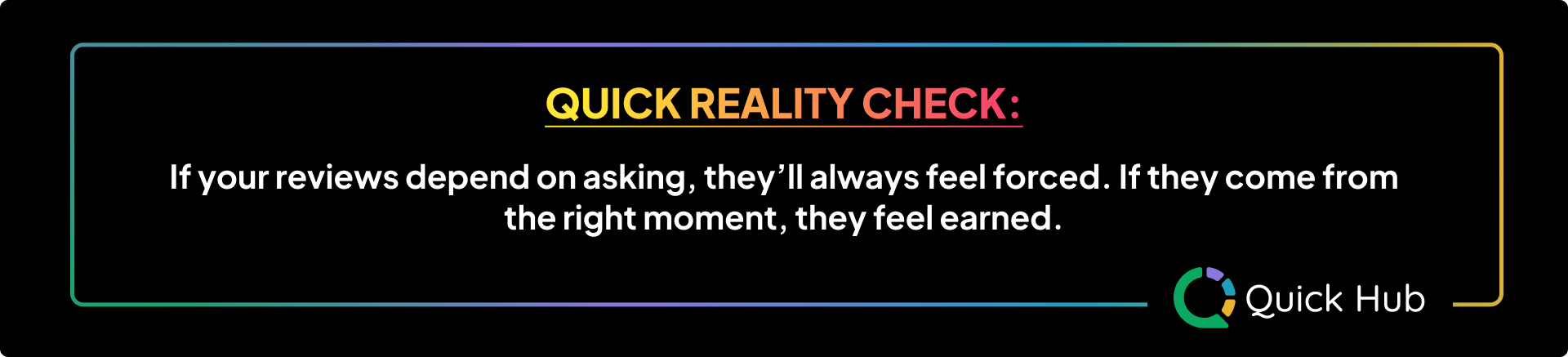
Quick Reality Check: If your reviews depend on asking, they’ll always feel forced. If they come from the right moment, they feel earned.
The Psychology Behind When Customers Actually Leave Reviews
Customers don’t leave Google reviews because they were asked politely. They leave because they felt something:
- Relief that a major headache was resolved.
- Excitement about receiving a great product or result.
- Gratitude for an attentive team member.
- Surprise when expectations were surpassed.
And those emotions don’t last forever. They appear in short, high-energy windows that psychologists call peak satisfaction moments:
- Right after a problem is solved.
- When a service is completed smoothly.
- When expectations are exceeded.
- The exact second a customer says “thank you!”
In these moments, emotion is high and psychological friction is low. That’s when reviews happen naturally. Not later. Not tomorrow. Not after an email sequence three days down the road. Because reviews aren’t logic-driven; they’re momentum-driven.
When businesses delay the request, they assume customers will remember how they felt. They won’t. Emotion fades fast; attention shifts faster.
By the time a delayed request arrives:
- The emotional high is completely gone.
- The experience feels distant in their memory.
- Writing a review feels like another chore on their to-do list.
So even thrilled customers ignore it—not intentionally, but passively. This is where most review strategies fail. They obsess over what script to say, instead of when to say it. But timing beats wording every single time.
High-performing systems don’t chase reviews later. They capture intent while it’s still alive, at the emotional peak, not after it. That’s the real reason review consistency breaks: not because customers don’t care, but because the moment passed. Miss the moment, and no follow-up can recreate it.
Timing vs Outcome in Review Behavior
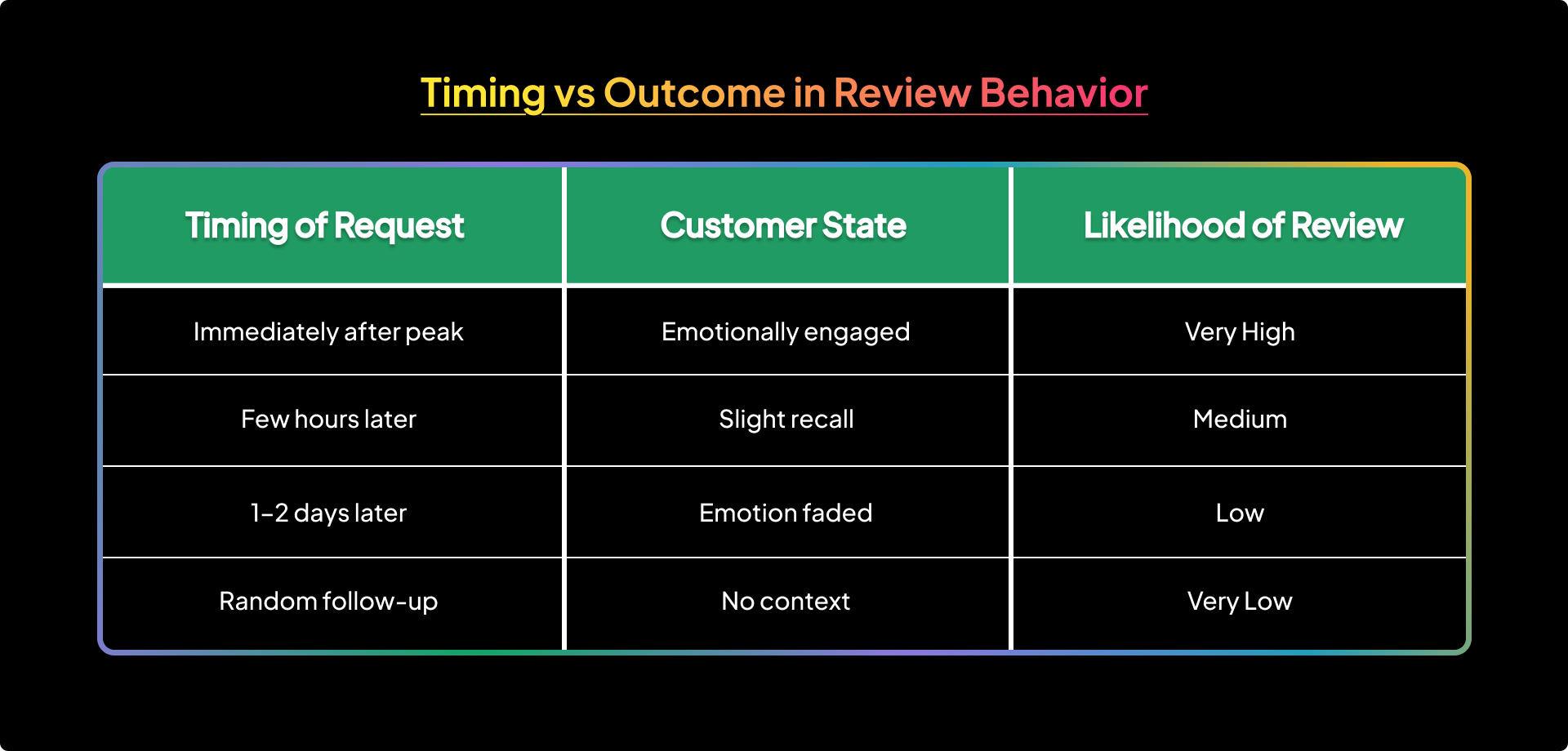
| Timing of Request | Customer State | Likelihood of Review |
|---|---|---|
| Immediately after peak | Emotionally engaged & grateful | Very High |
| Few hours later | Slight recall, busy with other tasks | Medium |
| 1–2 days later | Emotion faded, details forgotten | Low |
| Random follow-up | Zero context, feels intrusive | Very Low |
Asking Less, Timing Better: The Review Timing Framework
Most businesses assume the fastest way to grow their online reputation is to ask more often. It’s not. More requests create customer resistance. Better timing creates customer responses.
This is the foundation of the Review Timing Framework: Ask less. Time better. Customers don’t leave public feedback because it makes logical sense on paper. They do it when emotion, context, and momentum align.
There are three moments where this alignment happens most reliably:
1. Service Completion Moments
When a job, appointment, or service ends smoothly, customers feel a sense of closure, relief, and satisfaction. At this point, leaving a quick review feels natural—like finishing the experience, not being interrupted by another task. This is one of the cleanest, lowest-friction opportunities to capture public feedback.
2. Problem Resolution Moments
When something goes wrong but is resolved quickly and professionally, the emotional contrast is even stronger than a standard transaction. Customers remember how you responded when things got difficult, not just what was fixed. Handled correctly, this moment doesn’t damage trust; it cements loyalty. That’s why many of the most detailed, high-impact 5-star customer reviews come right after support interactions.
3. Gratitude Moments (“Thank You” Signals)
When a customer sends a message saying:
- “Thanks for the quick help!”
- “That was so easy, appreciate it!”
- “You guys are lifesavers!”
They’re not just being polite. They are signaling prime review readiness. These are high-intent moments where customers are emotionally primed to share their feedback publicly.
Most businesses miss this completely. They treat review requests like blunt broadcasts: same generic message, same arbitrary timing, same blunt follow-up. And then they wonder why results feel random. Because effective reputation building isn't driven by volume—it is driven by context. One well-timed nudge will always outperform five poorly timed reminders. Timing doesn’t just increase conversion; it preserves authenticity.
Pro Tip: Don’t ask when it’s convenient for you. Ask when it’s meaningful for them.
Why One-Time Google Review Requests Never Scale
One-time Google review requests sound efficient on paper: Ask once. Wait. Move on. But this approach breaks down the moment a business begins to grow.
As soon as review generation depends on people instead of process, operational fragility sets in. Someone has to remember to ask. Someone has to judge the right moment. Someone has to feel confident bringing it up. That human dependency creates inconsistency fast, and inconsistency is the enemy of scale. Even high-performing teams forget—not because they’re careless, but because collecting customer ratings is rarely their primary responsibility.
The Inevitable Pitfalls of Manual Review Collection:
- Some customers are asked, while others are completely overlooked.
- Timing is inconsistent, varying based on staff workload or mood.
- High-intent moments slip through unnoticed during busy hours.
- Spikes occur after staff meetings, followed by weeks of silence.
This randomness destroys any predictable review growth strategy. But forgetfulness isn’t the biggest problem—follow-up is. Most online feedback doesn’t happen on the very first ask. Customers intend to leave a review, but everyday distractions take over and “later” quietly disappears. Without structured reminders, initial intent fades and momentum dies.
No follow-up = no conversion.
That’s why many businesses see brief spikes in their Google Business Profile reviews, followed by months of silence. There’s no continuity. No compounding effect. No system sustaining growth.
Manual methods also collapse under scale. As customer volume increases, so does complexity. Tracking who was asked, who responded, and who needs a gentle reminder becomes impossible without dedicated software. And that directly weakens your local SEO rankings and online credibility over time.
To generate reviews consistently, businesses need review collection systems that operate independently of human memory, motivation, or mood—built on automated structure, not wishful thinking.
System vs One-Time Approach
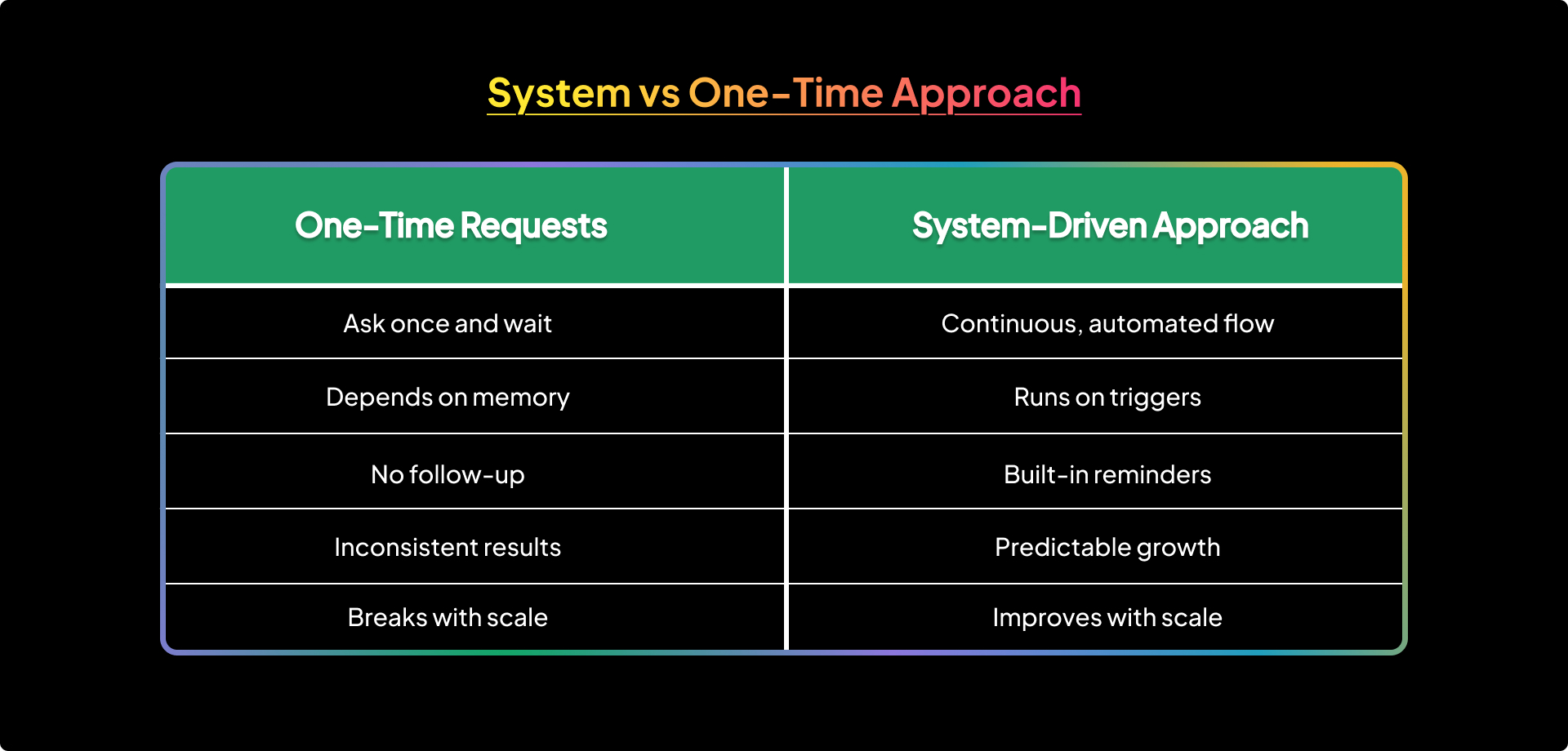
| One-Time Requests | System-Driven Approach |
|---|---|
| Ask once and wait passively | Continuous, automated workflow |
| Depends on staff memory and mood | Runs on predefined event triggers |
| No systematic follow-up | Built-in smart, conditional reminders |
| Inconsistent results and review droughts | Predictable, compounding monthly growth |
| Breaks down when volume increases | Becomes more efficient as you scale |
Turning Review Collection Into a Background System
At scale, review collection has only two outcomes: Run automatically. Or break repeatedly.
There is no middle ground. This is where businesses need to stop thinking in terms of “asking for reviews” and start thinking in terms of systems. The goal isn’t to manually solicit reviews on Google. The goal is to design a customer journey where 5-star reviews happen quietly in the background, without requiring daily team intervention.
Just like billing, order confirmations, and calendar reminders, a true background system runs quietly, reliably, and consistently. It is built on three core pillars:
1. Event-Based Triggers
Instead of staff asking randomly, review collection is triggered by concrete customer actions: a job status is marked “Complete” in your CRM, a support ticket is resolved, or a delivery is confirmed. These moments signal genuine completion. They remove guesswork and align Google review prompts with actual customer satisfaction.
2. Automated Delivery
Once triggered, the request is sent automatically through the customer’s preferred channel—WhatsApp, SMS, or email. No staff member needs to open an app or draft a message. This structural consistency ensures that every happy customer receives the opportunity to share feedback at the perfect moment without friction.
3. Silent Follow-Ups
Most customer reviews don't happen immediately on the first ping. A background system accounts for natural human delays. Instead of awkward manual follow-ups, intelligent reminders are scheduled with built-in stop rules: if the customer leaves a review or clicks through, the workflow halts immediately. No chasing. No pressure. No spam that damages customer goodwill.
This is how modern reputation management works: Reviews aren’t chased. They’re captured.
For small businesses, this shift is game-changing. Manual approaches may limp along at low volume, but growth exposes every crack. A background system absorbs scale effortlessly. When review collection runs like billing—predictable, invisible, and reliable—consistency replaces chaos. And consistency is what turns Google reviews into a compounding growth asset.
Bonus Tip: Effort creates spikes. Systems create compounding growth. If reviews depend on people, they fluctuate. If they depend on systems, they scale.
Making It Effortless for Customers to Leave Reviews
Most customers don’t skip leaving feedback because they had a bad experience. They skip it because the process feels inconvenient. Every extra hurdle—searching for your business listing, navigating menus, signing into third-party portals, or deciding where to click—causes immediate drop-off. Review friction kills participation faster than dissatisfaction ever does.
High-performing feedback capture systems follow one golden rule: Remove effort, not intent. The most consistent customer feedback comes from experiences that are instant, mobile-first, and friction-free.
1. Instant One-Click Review Access
When a customer is ready to leave feedback, the direct path should already exist. One tap. No searching. Direct links that open the native Google review dialog box immediately outperform generic "please find us on Google" requests because they eliminate cognitive friction. The decision has already been made; your system just needs to remove the obstacles.
2. Designed for Phone Behavior
Over 80% of local reviews are written on smartphones in between daily tasks, not during dedicated desktop sessions. That means your review flow must be built for taps, not typing essays. If a link takes too long to load, doesn’t open smoothly in mobile browsers, or requires complex sign-ins, the moment evaporates. Effective customer experience design is mobile-first by default.
3. Fewer Actions, Better Results
Every additional step in a conversion funnel cuts completion rates. This isn’t theory; it’s fundamental human behavior. That’s why simplified review workflows are central to modern trust-building. They respect customer attention, timing, and emotional momentum.
This shift mirrors how forward-thinking SMBs are consolidating their tools into unified systems, explored in The Evolution of Small Business Tools — From 10 Apps to 1 OS. It also aligns with the broader movement toward continuous digital presence covered in The Future of Digital Presence: Why Small Businesses Need One Unified System. When leaving a review feels easier than ignoring it, participation becomes the default. Ease converts far better than persuasion.
Pro Tip: If leaving a review takes more than 10 seconds, you’ve already lost most customers.
Following Up Without Sounding Pushy or Desperate
Most business owners hesitate to send reminders for one clear reason: they don’t want to look desperate or needy.
That hesitation is completely understandable, because most manual follow-ups are clumsy. When an owner sends an unprompted "Just following up to see if you can review us," it creates awkward pressure. The customer already saw the initial request, didn't act immediately, and now receives a message that feels like an obligation. At that point, the reminder stops being helpful and starts feeling intrusive.
The problem isn’t the follow-up itself; it’s how the follow-up is executed. Effective feedback systems rely on subtlety and context, not badgering. Instead of pushy reminders, high-converting systems use quiet, well-timed nudges designed with clear logic:
- Pause for the ideal interval (e.g., 24–48 hours after service).
- Trigger conditionally only if no review action was detected.
- Stop instantly the moment a review link is opened or submitted.
This is where delay logic and automated stop rules are indispensable. A well-designed system assumes positive intent: most happy customers genuinely want to leave a review, but got interrupted by life. One gentle, context-aware nudge recovers that lost intent without creating resentment.
That’s the difference between chasing and guiding. Instead of pushing harder, automation manages relevance behind the scenes, allowing your staff to remain focused on delivering great service.
The same principle of structured timing and conditional logic applies across all modern customer communication, as explained in What Is Marketing Automation? A Beginner’s Guide for Small Businesses. For local businesses, one intelligent, automated nudge will consistently outperform multiple manual follow-ups sent out of anxiety.
Pro Tip: If your follow-up feels like a reminder, it’s already too loud. Aim for a nudge, not a push.
How QuickHub Helps You Collect Google Reviews Without Begging
Begging for Google reviews is what businesses resort to when manual effort substitutes for automated systems. QuickHub turns that model upside down.
Instead of relying on memory, awkward requests at checkout, or clumsy manual follow-ups, QuickHub turns review generation into an automated, connected workflow that operates 24/7 in the background of your business.
The Review Automation Flow (How It Actually Works)
At its foundation, QuickHub treats customer reputation as a continuous system rather than an ad-hoc task:
- A verified customer event occurs: a service is marked completed in Quick CRM, a booking is finished on your calendar, or an inquiry is resolved in Quick Chat.
- An automated trigger activates: QuickHub initiates a personalized review invitation based on the exact service received.
- Multi-channel delivery: the invite is delivered through the customer’s preferred channel—WhatsApp, SMS, or email.
- Friction-free one-click review link: opens the Google review dialog directly on the customer’s phone.
- Smart, silent follow-ups: sent only if no action has been taken within 48 hours.
- Automatic stop rules: the instant the review link is clicked or confirmed, all reminders halt automatically.
No awkward conversations. No staff stress. No customer fatigue. This is how high-volume 5-star reviews are collected week after week.
Key QuickHub Features Powering Review Automation:
- Quick Reviews: Centralizes your Google Business Profile ratings, tracks incoming customer feedback, and alerts you to new reviews in real time.
- Workflow Automation: Empowers you to configure trigger events, time delays, and multi-channel conditions without writing code.
- Quick Chat & Omnichannel Inbox: Captures high-intent moments directly inside live web chat, WhatsApp, and social conversations.
- Quick Agents: AI-powered assistants that monitor sentiment and handle customer interactions with speed and care.
- Unified Dashboard: Provides crystal-clear analytics on review conversion rates, response times, and overall reputation growth.
Together, these capabilities replace disconnected single-purpose apps with one unified growth system, as detailed in our guide to Automating Growth with QuickHub.
What Actually Drives Review Conversions
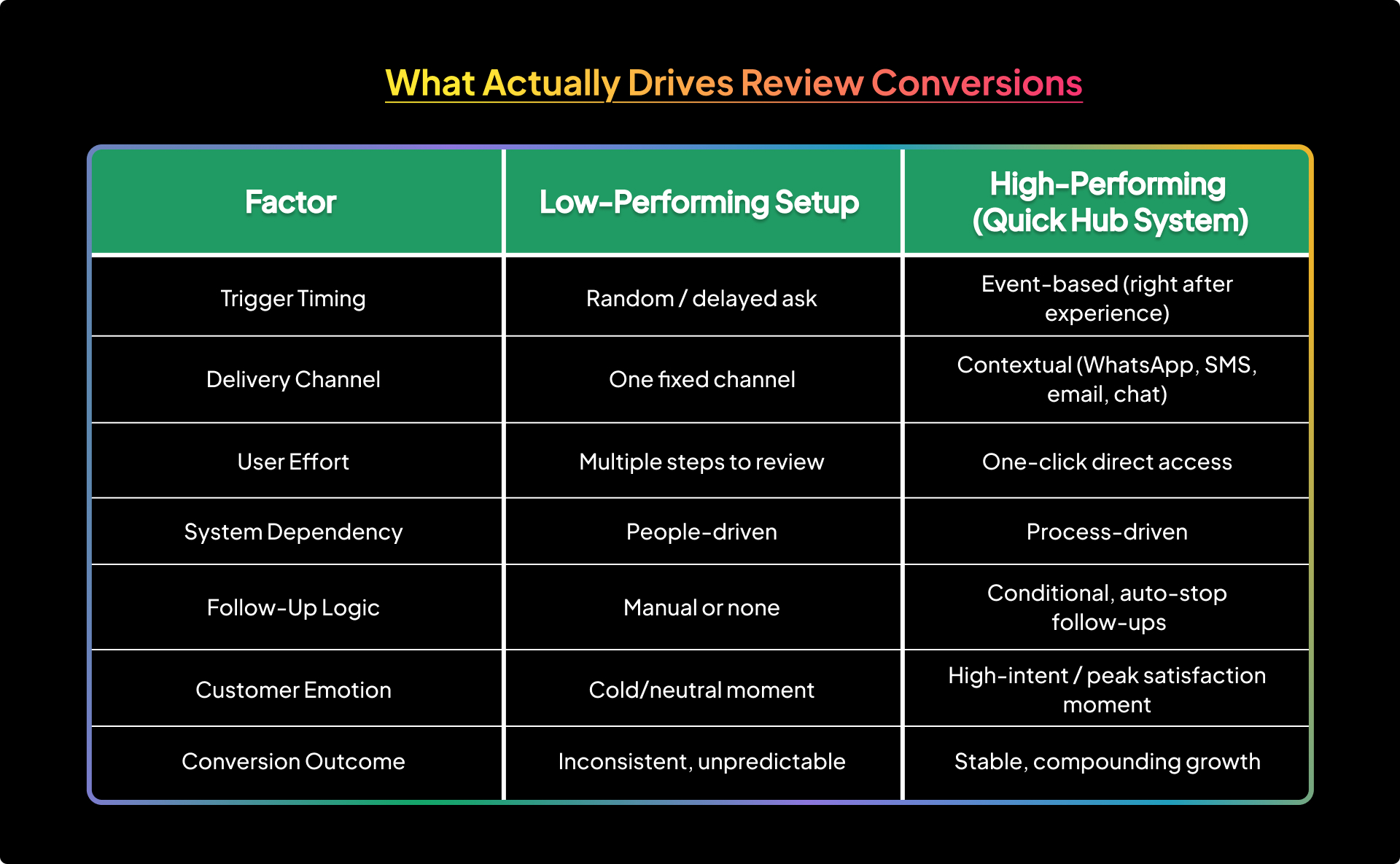
| Factor | Low-Performing Setup | High-Performing (QuickHub System) |
|---|---|---|
| Trigger Timing | Random or delayed manual request | Event-based (triggered right after positive experience) |
| Delivery Channel | Single rigid channel (e.g. email only) | Contextual (WhatsApp, SMS, email, or live chat) |
| User Effort | Multiple steps to search and log in | One-click direct link to review modal |
| System Dependency | People-dependent (staff must remember) | Process-dependent (runs automatically 24/7) |
| Follow-Up Logic | Manual or nonexistent | Conditional reminders with automated stop rules |
| Customer Emotion | Cold, neutral moment days later | High-intent, peak satisfaction moment |
| Conversion Outcome | Inconsistent, erratic reviews | Stable, compounding 5-star reputation growth |
Frequently Asked Questions (FAQ)
How do I ask for Google reviews without begging?
The most effective way to collect Google reviews without begging is to replace manual requests with automated, event-based triggers. When a review prompt is sent immediately after a positive experience—such as completing a service, resolving an issue, or delivering an order—the customer is already in a state of high satisfaction. Pairing this timing with a direct, one-click review link sent via SMS or WhatsApp makes leaving feedback feel like a natural completion of the service rather than a requested favor.
What is the best time to ask a customer for a Google review?
The optimal time to ask for a Google review is at the peak emotional moment, which occurs immediately after the service is completed or when a customer expresses gratitude (e.g., saying "thank you, that was great!"). Research shows that review conversion drops significantly within hours and hits near-zero after 48 hours as emotional engagement fades.
Why do customers ignore manual review requests?
Customers rarely ignore review requests out of malice or dissatisfaction; they ignore them due to friction and poor timing. When a request arrives days after the interaction, requires navigating multiple menus to find your listing, or arrives when the customer is busy, the effort required outweighs their initial enthusiasm. Simplifying the path to a single tap solves this drop-off.
Can I automate Google review requests through WhatsApp and SMS?
Yes. Platforms like QuickHub integrate directly with WhatsApp Business API and SMS to trigger automated review requests the moment an appointment is completed or an order is delivered. These channels achieve open rates exceeding 90%, yielding drastically higher response rates than traditional email campaigns.
How do automated follow-ups work without annoying customers?
Automated review systems use conditional logic and stop rules. If a customer doesn't act on the initial prompt, a single gentle nudge is scheduled 24 to 48 hours later. If the customer clicks the link or submits a review, the workflow stops instantly, ensuring customers never receive redundant or pushy reminders.
Final Takeaway: Stop Asking Harder. Build Smarter.
If your review collection depends on daily manual effort, it will inevitably break under pressure.
For years, the default small business playbook has been the same: ask more, remind more, push harder. Tweak the script. Remind the staff. Hope customers cooperate. But hope is not an operational strategy. Systems scale; hustle doesn’t.
When you treat reviews like favors, your reputation remains fragile, erratic, and unpredictable. Some weeks you get a handful of reviews; other months you experience complete radio silence. Not because your work wasn't great, but because your business lacked the infrastructure to capture customer satisfaction while it was fresh.
The real breakthrough happens when customer reviews stop being a periodic chore and become permanent infrastructure. Automated infrastructure doesn't forget. It doesn't get overwhelmed during rush hours. And it scales effortlessly whether you serve 10 clients a month or 1,000.
When review collection is engineered directly into your customer journey, 5-star ratings become the natural, compounding byproduct of every great interaction you deliver.
Because here is the truth most business owners miss: Every missed review is a lost customer, lost local ranking, and lost revenue.
The real question isn’t “How do we ask for more reviews?” It’s: “How many 5-star reviews is our current process quietly letting slip away every single day?”
Start your free QuickHub trial today and see how an automated review system turns your everyday customer satisfaction into an unstoppable local reputation.