
Introduction
"Everyone thought big enterprises would win the AI race. Instead, your neighborhood clinic, salon, and gym quietly took the lead."
That was the prediction no one put on a slide deck in 2024.
Back then, the story sounded logical: AI would belong to enterprises with data science teams, massive budgets, and years of digital infrastructure. Small businesses, we were told, would "eventually catch up."
Fast forward to 2026, and the script has flipped. Today, local businesses are using AI every single day to run real operations, not experiments:
- Auto-responding to customer inquiries across chat and social
- Handling bookings and appointment scheduling
- Qualifying leads before a human ever steps in
- Launching and optimizing campaigns
- Monitoring and responding to reviews in real time
This isn't pilot-stage innovation. This is AI adoption for small businesses at operational scale.
So what changed?
It turns out, small businesses had one advantage enterprises didn't: They weren't trapped inside layers of legacy systems, approval chains, and disconnected software. While large organizations spent months aligning IT, compliance, procurement, and training, local businesses were making faster, simpler decisions:
- "Will this reduce response time?"
- "Will this bring more bookings?"
- "Will this save my team hours every week?"
If the answer was yes, they moved. That's why local business AI automation is accelerating faster than enterprise rollouts. Not because SMBs are more technical, but because they're more outcome-driven. Every tool must justify itself in revenue, retention, or reputation. And when AI directly touches customer conversations, follow-ups, and demand generation, the return becomes obvious, fast.
This is the real story of SMB digital transformation in 2026. Not flashy labs. Not innovation departments. But small teams are quietly turning AI into a competitive weapon, one faster reply, one smarter follow-up, one better customer experience at a time.
The surprise isn't that local businesses adopted AI. The surprise is how quickly they built it into the heart of daily execution, while enterprises were still drafting roadmaps.
And that raises the real question: Why are smaller, leaner businesses moving faster with AI than companies with infinitely more resources?
That's where the story gets interesting.
Speed Beats Scale: Why Local Businesses Can Move Faster Than Enterprises
That single difference explains more about AI adoption in 2026 than any budget comparison ever could. On paper, enterprises should dominate AI. They have more data, larger teams, and deeper pockets. In reality, they also have something else: friction at every decision point.
Before an AI tool ever reaches a real customer interaction, it often has to pass through:
- Procurement evaluations
- Vendor risk assessments
- Legal and compliance reviews
- IT security checks
- Data governance approvals
- Multi-quarter pilot programs
By the time deployment finally begins, the market, and customer expectations, have already moved on.
Now compare that with how fast AI adoption in SMBs actually happens.
A local business owner sees missed calls, slow replies, or poor follow-ups. They test an AI chat agent. If bookings increase, they keep it. If not, they change it, sometimes within days, not quarters. Decisions are driven by outcomes, not committees.
This is also why choosing the right foundation matters more for small businesses than stacking endless tools. When systems are simple, connected, and outcome-driven, AI compounds faster. That's exactly why many owners are rethinking their entire stack and asking practical questions first, like what kind of CRM actually supports growth instead of slowing it down. If you're navigating that decision, this ties directly into "CRM for Small Business: What You Actually Need (& What You Don't)", where the focus shifts from feature overload to workflow clarity and revenue impact.
In 2026, AI leadership isn't about who can afford the most technology. It's about who can move, learn, and adapt the fastest, and that advantage is increasingly sitting with small and local businesses, not enterprise giants.
Survival Pressure Is Driving Smarter AI Adoption
"Enterprises use AI for optimization. Local businesses use AI for survival."
That difference changes everything about how — and how fast — AI gets adopted.
For most local businesses in 2026, the pressure is constant and very real:
- Fewer staff available for front-desk and phone support
- Rising customer acquisition costs from ads and marketplaces
- Thinner margins that don't allow wasted leads
- Customers who expect instant replies, even outside business hours
There's no room for "nice-to-have" technology. If AI doesn't reduce workload or increase revenue quickly, it doesn't stay. This is why AI for local business growth looks very different from enterprise AI programs. SMBs aren't experimenting in innovation labs. They're deploying tools like QuickHub to plug operational leaks that quietly cost them money every single day.
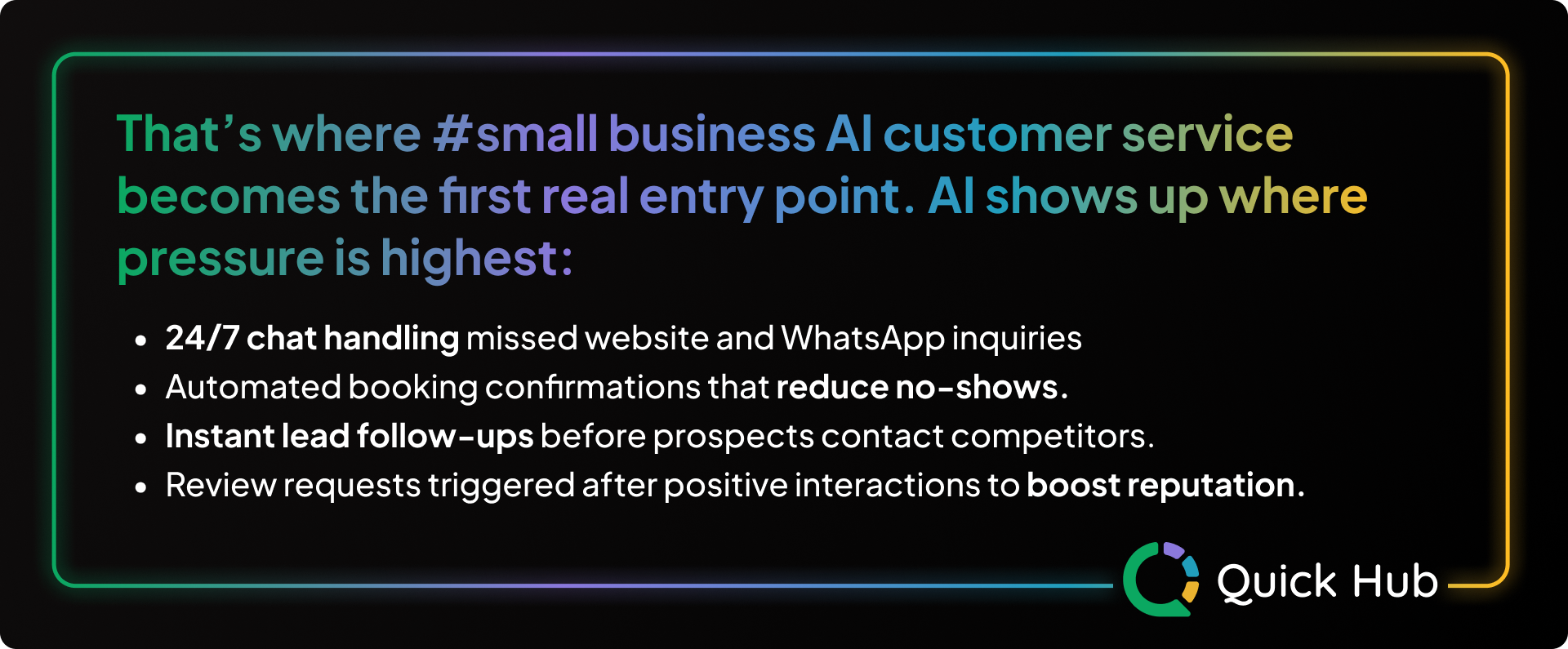
These aren't futuristic use cases. They're daily revenue protectors. And because the impact is immediate, adoption accelerates. QuickHub makes this practical by embedding AI directly into real workflows instead of adding yet another tool to manage.
Take a neighborhood restaurant.
Instead of missing calls during peak hours, AI handles reservation requests, confirms bookings, and follows up for reviews. Staff stay focused. Tables stay full. Reputation grows automatically.
Or consider a local gym.
AI responds to Facebook and website inquiries, qualifies trial leads, schedules visits, and sends reminders. Trainers focus on sessions, not inboxes. Conversions improve because follow-ups never slip, all coordinated inside QuickHub.
This is what AI automation for SMB survival actually means: not replacing people, but protecting revenue when teams are stretched thin.
Here's the insight enterprise conversations often miss: small businesses don't adopt AI because it's impressive. They adopt it because not adopting it has visible costs. Missed messages become lost bookings. Slow follow-ups waste ad spend. Unanswered reviews damage reputation.
In 2026, survival pressure isn't slowing AI adoption for small businesses. It's accelerating it, making it more practical, focused, and effective than most enterprise deployments.
Enterprises Have Data, SMBs Have Simpler Workflows
"More data doesn't mean better automation. It often means more confusion."
Enterprises love to talk about data. Data lakes. Data warehouses. Data pipelines. On paper, it sounds powerful. In practice, it often slows everything down. Because data is only useful when it can move, and in big organizations, it rarely does.
Where Enterprises Get Stuck
Most large companies operate on deeply layered tech stacks:
- ERP systems running operations
- CRMs managing sales pipelines
- Separate marketing platforms
- Standalone support tools
- BI dashboards pulling reports from all of them
Each system owns a piece of the customer, but no system owns the journey.
Now add integration dependencies, department-level permissions, data governance approvals, and custom workflows built over years. Suddenly, even simple automation becomes a project. Not a deployment, a project. AI might be available, but it's trapped inside fragmented data silos and approval chains.
Why SMBs Have the Upper Hand
Local businesses don't have ten departments arguing over dashboards. They have one goal: move the customer forward. That simplicity is a massive advantage for AI workflow automation in SMBs, as explored in The State of Small Business Automation in the US in 2026.
Most local business journeys look like this:
Ad → Message → Booking → Visit → Review → Repeat visit
That's it. No complex handoffs. No layered approvals. No conflicting ownership. These are simplified customer journeys, built around real actions, not organizational charts. And this is exactly the environment where AI performs best.
Why AI Works Better with Simpler Flows
AI doesn't need massive data volumes to be effective. It needs clear signals and clear next steps. AI thrives when workflows are:
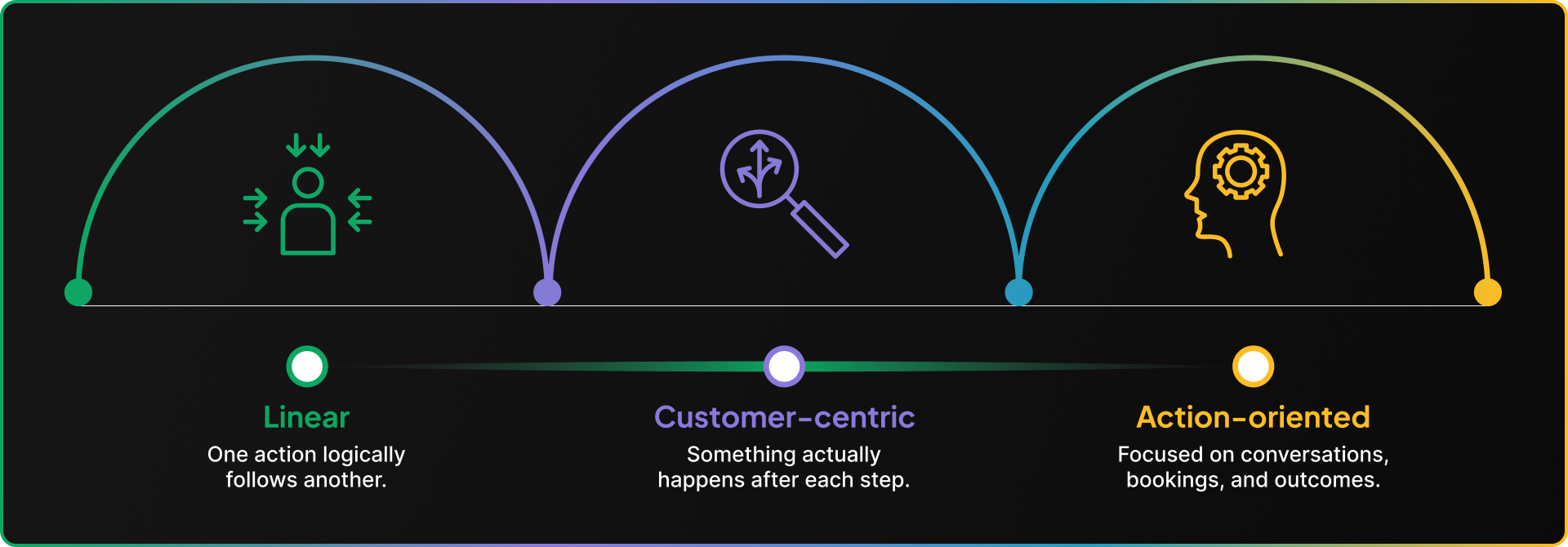
- Clear and linear
- Fast to iterate
- Tied to visible outcomes
- Built around customer needs, not org structure
In SMB environments, AI can see the message, understand the intent, and trigger the next step immediately. No translation layers. No reporting delays. No waiting on internal approvals. That's why AI CRM for small businesses is evolving faster than enterprise CRM stacks. It's not buried under legacy processes. It's embedded directly into daily operations.
The Contrast Is Stark
A local salon: Ad → chat → booking → reminder → review request. AI can automate the entire loop in real time.
A large enterprise: Lead → marketing platform → CRM → sales ops → regional team → support system → reporting tool. By the time AI even sees the data, the opportunity may already be cold.
Enterprises have more data. SMBs have more momentum. And in 2026, momentum matters more than perfect datasets. Because automation doesn't succeed where information is abundant. It succeeds where action is easy to trigger. That's why small businesses, with simpler workflows and cleaner journeys, are often getting more real value from AI, faster, than organizations with infinitely more data but infinitely more friction.
AI Agents Are Becoming the New Front Desk for Local Businesses
"In 2026, your first employee will often be an AI."
Not a receptionist. Not a junior marketer. Not even a sales rep.
For thousands of local businesses today, the first touchpoint a customer encounters is an AI agent, and customers are completely fine with that. Because what they want isn't small talk. They want answers. Fast.
What AI Agents Are Already Handling Daily
Across clinics, gyms, salons, and retail stores, AI agents for small businesses are quietly running the front desk:
- Responding instantly to WhatsApp and website chats
- Booking and rescheduling appointments
- Answering FAQs about pricing, availability, and services
- Qualifying leads before a human ever steps in
This is AI chat automation for local businesses in action — not as a futuristic experiment, but as everyday operations. Tools like Quick Agents, built inside QuickHub, make this possible by embedding AI directly into real customer workflows instead of treating it as a separate system.
Unlike human staffing, AI doesn't stop at 7 PM:
- No sick days
- No missed messages
- No Monday-morning backlog
Why Local Businesses Are Moving Fast on AI Agents
For SMBs, this shift isn't driven by tech curiosity. It's driven by math.
- Hiring is expensive
- Training takes time
- Turnover is constant
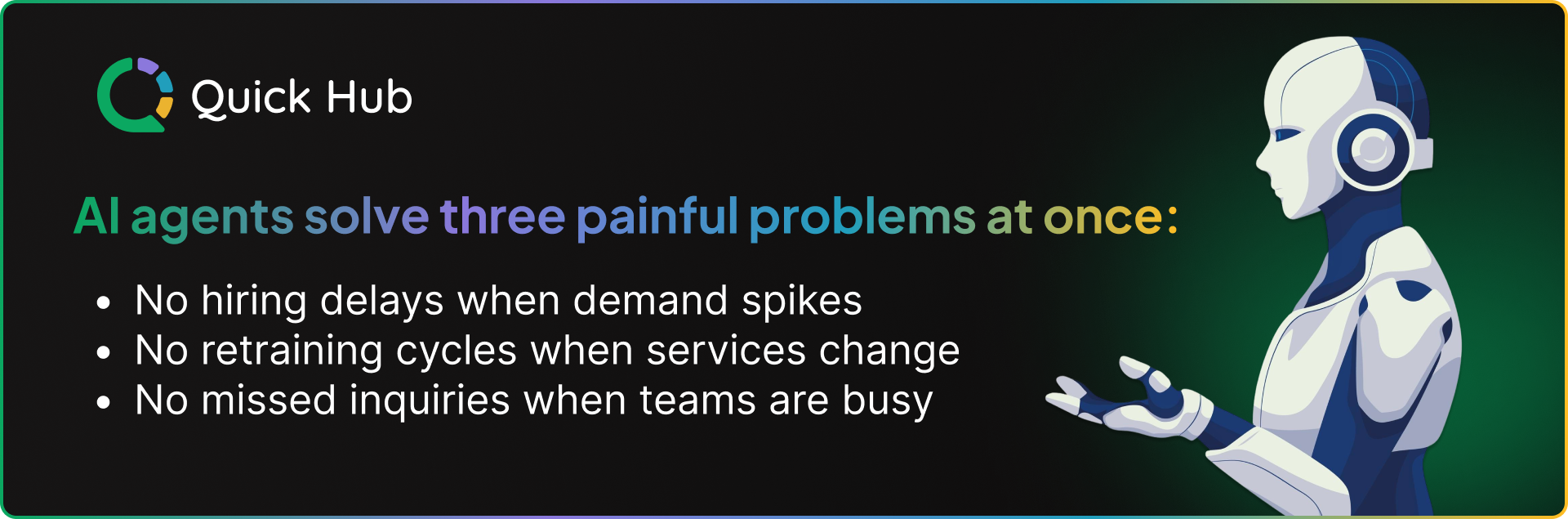
For businesses where every call and message can turn into revenue, response speed isn't a metric — it's survival. That's why virtual receptionist AI for SMBs has become one of the fastest-growing automation use cases in 2026, especially when deployed through systems like QuickHub that connect chat, CRM, and follow-ups in one place.
The Enterprise Irony
While local businesses deploy AI agents in days, many enterprises remain stuck in ticketing systems, routing queues, and layered approvals.
- A customer fills a form
- Waits
- Gets routed
- Waiting again
By the time someone responds, intent has cooled. Enterprises may have AI initiatives, but they're often buried under process. Local businesses don't have that luxury, or that patience. They deploy what works, fast, using tools like Quick Agents that show impact immediately.
Real-World Examples
A neighborhood clinic uses an AI receptionist to confirm insurance, book appointments, send reminders, and route urgent cases to staff. Front desk workload drops. Patient satisfaction rises.
A retail store runs an AI sales assistant on WhatsApp that answers product questions, shares catalog links, captures contact info, and hands off high-intent buyers to staff. No extra headcount. Higher conversions.
And here's the real shift:
Humans don't disappear. They get pulled into conversations that actually matter.
AI agents don't replace teams. They filter noise, protect time, and accelerate intent. In 2026, that's not just convenience, it's a competitive advantage. Because when customers expect instant replies, the businesses that respond first don't just look better.
They win more often.
Hyperlocal Marketing + AI = Growth Without Big Budgets
"Local businesses don't need global reach. They need the right neighbor to click."
Big brands chase impressions. Local businesses chase foot traffic, phone calls, and nearby intent. And in 2026, AI finally makes that level of precision affordable. Not with massive ad budgets. With smarter targeting and faster execution.
What AI Is Enabling in Hyperlocal Marketing
Modern hyperlocal marketing automation is no longer about blasting the same offer to everyone in a city. AI now helps local brands run campaigns that adapt to where people are and what they're doing.
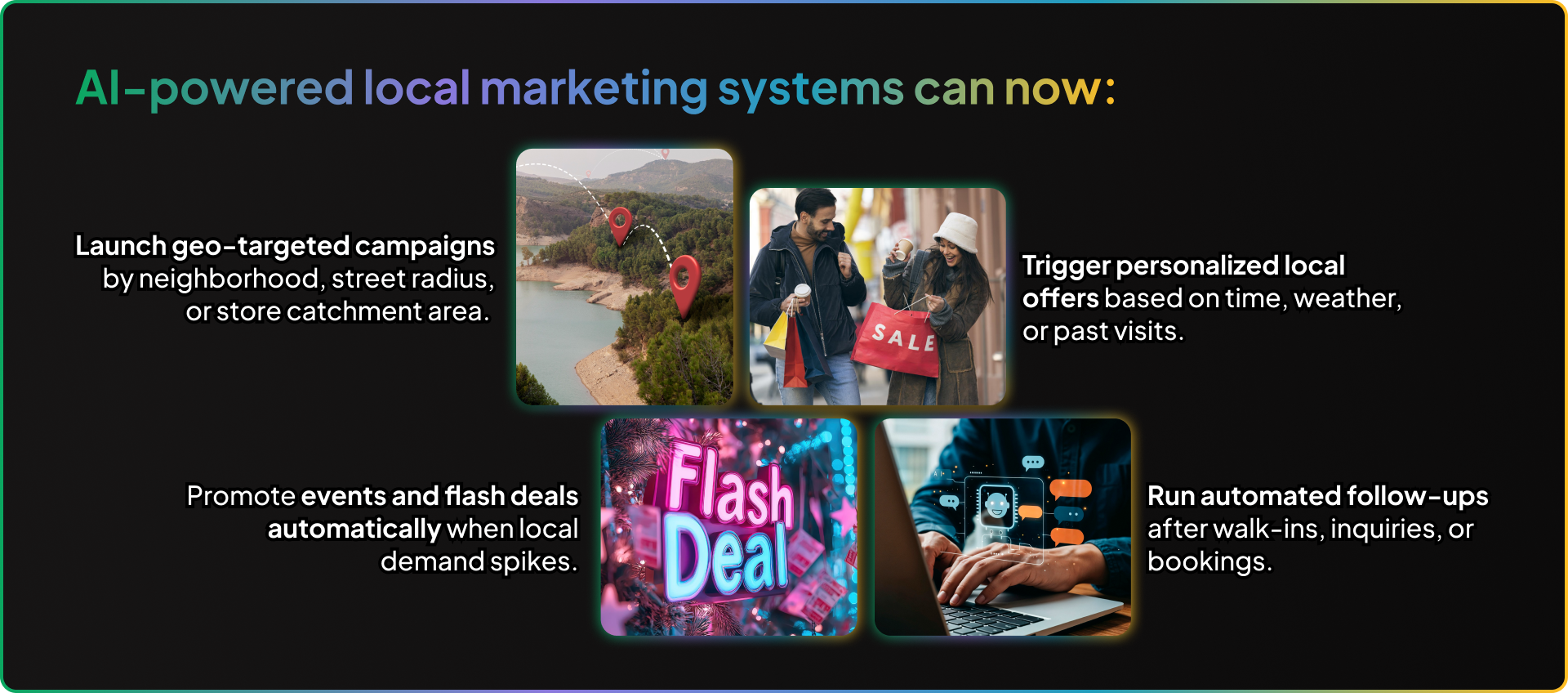
This is AI-powered local advertising that responds to real-world behavior, not just online clicks. And that's a massive shift. Because relevance beats reach every time.
Why This Works Better for SMBs Than Enterprises
Here's the uncomfortable truth: Large enterprises are built for scale. Local businesses are built for specificity. That gives SMBs three hidden advantages:
- More relevant messaging — Promotions tied to local habits, not generic personas
- Faster content cycles — No brand approvals that take three weeks
- Real-time community engagement — Reacting to what's happening this afternoon, not next quarter
Enterprises plan campaigns. Local businesses respond to reality. And AI thrives in environments where:
- Decisions are quick
- Feedback is immediate
- Results show up fast
That's why small business AI marketing tools are delivering outsized impact at the neighborhood level.
What This Looks Like on the Ground
A gym runs AI-driven promotions targeting apartment complexes within 1 km, office clusters during lunch hours, and students during exam season. Ads adjust. Messages change. Follow-ups trigger automatically after trial visits. No manual tweaking. No spreadsheet juggling.
A café uses AI to dynamically promote lunch combos to nearby offices before noon, evening snacks when rain starts, and loyalty offers to customers who visited twice in a week.
That's not mass marketing. That's context marketing, powered by automation.
The Bigger Shift No One Talks About
Hyperlocal AI doesn't just improve ads. It changes how small businesses grow.
Instead of asking: "How do we reach more people?"
They start asking: "How do we convert the people already around us, faster and better?"
AI flips the growth model from expansion-first to efficiency-first. And for local businesses operating on tight margins, that difference is everything. Because when the right person sees the right message at the right moment, you don't need a big budget. You just need better timing.
AI Is Becoming Embedded in SMB Operating Systems, Not Added as Tools
"Enterprises buy AI features. SMBs are buying AI-powered business brains."
There's a quiet shift happening in how small businesses adopt AI in 2026. They're not downloading separate AI apps. They're not experimenting with disconnected copilots. They're choosing systems where AI is already baked into the way work gets done.
The Big Shift: From Add-Ons to Architecture
Until recently, AI for business looked like this:
- A chatbot tool for the website
- An AI copy generator for ads
- A prediction tool for analytics
- Another dashboard to learn
Useful? Yes. Sustainable for small teams? Not really.
In 2026, the move is toward AI-powered business OS for SMBs, platforms where AI lives inside:
- CRM records
- Chat conversations
- Campaign builders
- Follow-up workflows
- Lead routing logic
Instead of switching tools, AI shows up at the exact moment decisions are made. That's not "using AI." That's operating with AI.
Why Embedded AI Accelerates Adoption So Fast
Small businesses don't resist AI. They resist complexity. When AI is embedded into unified automation platforms, three barriers disappear instantly:
- No new interfaces: Teams work in the same dashboards they already use
- No new training cycles: AI assists within familiar workflows instead of forcing behavior change
- No workflow disruption: Recommendations, drafts, triggers, and predictions appear where actions already happen
Instead of asking, "Should we try AI?"
The system simply says, "Here's the next best action."
That's why AI embedded workflows outperform standalone AI tools. They reduce thinking friction, not just execution time.
What Embedded AI Actually Does Day to Day
Inside modern SMB operating systems, AI now:
- Suggests reply drafts while agents are already chatting with customers
- Flags high-intent leads directly inside the CRM pipeline
- Adjusts campaign timing based on real engagement behavior
- Detects drop-off risk before support tickets appear
- Recommends follow-ups based on customer journey stage
No exporting data. No jumping between apps. No "AI experiment phase." Just smarter execution, continuously.
High-Growth Local Businesses Are Treating AI as Revenue Infrastructure
"The best local brands don't ask if they should use AI. They ask where AI should drive revenue next."
There's a clear line between local businesses that experiment with AI and those that scale with it. High-growth operators don't treat AI as a productivity hack. They treat it as revenue infrastructure, the system that consistently turns attention into bookings, conversations into conversions, and customers into repeat buyers.
What Top Performers Actually Use AI For
Instead of scattered experiments, they deploy AI-driven revenue automation across the full customer lifecycle:
- Increase response speed: AI ensures every inquiry gets an instant, relevant reply, even after business hours
- Improve lead conversion: Conversations are qualified, routed, and followed up automatically based on intent signals
- Reduce churn before it happens: Drop-off risks are detected early, triggering proactive outreach
- Scale reputation at the point of service: Happy customers are nudged for reviews at the right moment, not weeks later
This is not "marketing automation." This is AI sales automation for SMBs woven into daily operations.
What They Measure Instead of Vanity Metrics
Average businesses still track clicks, opens, and impressions. High-growth local businesses track performance-based automation metrics tied directly to money:
- Revenue per inquiry — Not just cost per lead
- Speed-to-contact — Because minutes decide conversions
- Customer lifetime value (CLV) — Not just first purchase
- Drop-off points in the journey — Where AI can intervene
These metrics change how automation is designed. Workflows aren't built to "send messages." They're built to remove friction between interest and income.
The Strategic Difference That Drives Growth
Most local businesses automate tasks. High-growth businesses automate outcomes:
- If response time drops → AI increases priority routing
- If leads stall → AI changes follow-up logic
- If churn risk rises → AI triggers retention flows
AI becomes part of the revenue engine, not just the communication layer. And once automation is connected to business KPIs, something powerful happens:
Teams stop asking, "Is this tool worth it?"
They start asking, "How do we scale this system?"
Why This Model Wins in 2026
With higher ad costs, smaller teams, and customers expecting instant service, growth no longer comes from working harder. It comes from systems that close the gaps humans can't cover consistently. That's why the fastest-growing local brands are building around AI as infrastructure, not as software they "also use," but as the invisible layer making every interaction faster, smarter, and more profitable.
In 2026, AI isn't supporting revenue. For high-growth SMBs, it is the revenue system.
Strategic Playbook: How Local Businesses Can Adopt AI Without Chaos
"The goal isn't to add AI. It's to remove friction."
Most local businesses don't fail with AI because the tech is too complex. They fail because they layer AI on top of broken workflows, and automate confusion at scale. High-performing teams follow a much simpler AI adoption strategy for small businesses: fix flow first, then automate what slows revenue down.
Step 1: Fix Customer Flow First
Before touching any AI tools, map the real customer journey:
- Where do inquiries come from?
- Where do they stall?
- Where do handoffs fail?
If the path from interest → conversation → booking → follow-up isn't clear, AI won't fix it. It will just move people faster into the same dead ends. AI works best when workflows are already logical.
Step 2: Centralize Conversations
AI can't help if data is scattered. High-growth SMBs move toward one shared inbox, one customer profile, and one interaction timeline. This makes practical AI automation for SMBs possible, because AI can finally see the full context of every customer, not just fragments across apps.
Step 3: Add AI at Bottlenecks
Don't automate everything. Automate what hurts revenue the most:
- Slow first responses
- Poor lead qualification
- Missed or late follow-ups
These are the moments where speed and consistency matter more than creativity, and where AI delivers immediate ROI.
Step 4: Connect AI to Outcomes
AI should trigger actions that matter:
- Did this lead book?
- Did this customer convert?
- Did this visit result in a review?
If automation isn't tied to bookings, sales, and reputation, it's not workflow optimization, it's activity tracking. That's where true AI workflow optimization begins.
Step 5: Scale What Converts (Not What Looks Cool)
Trendy AI features don't grow businesses. Repeatable, measurable flows do. Once a journey consistently converts, then, and only then, scale it across channels, locations, and campaigns. Because in 2026, winning with AI isn't about being first to try tools. It's about being fastest to systematize what already works.
Final Takeaway: The AI Advantage Is Shifting Downstream
"In 2026, AI isn't giving big companies an edge. It's giving small businesses a fighting chance."
For years, the assumption was simple: Enterprises would dominate AI because they had more data, more budget, and more analysts. But the reality playing out in AI transformation for local businesses tells a different story.
Big companies move carefully. Local businesses move decisively. They test faster. They see results sooner. And when something drives bookings, sales, or reviews, they scale it immediately. That speed, not size, is becoming the real competitive advantage in the future of SMB automation.
What the Best Local Brands Will Feel Like in 2026
To customers, high-performing local businesses will feel:
- Instant — Replies in seconds, not hours
- Personal — Context-aware, not scripted
- Always available — Even when the team is offline
Not because they hired bigger teams. But because their systems learned to respond before problems escalated and opportunities slipped away. That's what competitive advantage with AI for small business now looks like: Fewer manual steps, fewer missed moments, and far less dependence on human memory.
So ask yourself:
- Is AI helping you respond faster, or just analyze what went wrong later?
- Is your business competing with more money, or with better systems?
Because the gap in 2026 won't be between who uses AI and who doesn't. It will be between businesses that use AI as a few extra tools, and those that run on AI-driven workflows end to end. This is also where platforms like QuickHub are seeing the biggest impact: not by adding flashy AI features, but by embedding AI directly into customer conversations, campaigns, reviews, and follow-ups, so growth doesn't depend on juggling apps or remembering next steps.
The next wave of market leaders won't come from corporate towers.
They'll come from storefronts, clinics, studios, and service desks, powered by AI, connected by smarter systems, and moving faster than anyone expected.