
Introduction
At the beginning, marketing feels simple.
You get 10 leads a day, you reply manually, follow up when you can, and everything works. At 50 leads a day, cracks start to appear, delayed responses, missed follow-ups, and inconsistent communication. At 100+ leads a day, the system doesn't just slow down, it breaks.
This is where most small businesses hit a wall. The problem isn't a lack of customers. It's a lack of systems. Manual marketing works, but only up to a point. It relies on human effort for every action: every reply, every follow-up, every campaign. As volume increases, this approach becomes difficult to sustain. Delays become inevitable, opportunities slip through the cracks, and the customer experience starts to suffer.
The reality is simple: Manual marketing doesn't fail instantly, it fails gradually as demand outgrows your capacity to manage it.
And in today's fast-moving digital landscape, speed isn't optional, it's a competitive advantage. Businesses that respond to leads within 5 minutes are up to 21x more likely to convert them, yet many small businesses take hours, sometimes even days, to respond. At the same time, nearly 80% of customers expect immediate responses, making delays more costly than ever. On the operational side, companies that adopt automation report productivity gains of up to 20%, highlighting just how much efficiency is left on the table with manual processes.
This is where marketing automation becomes essential. Automation isn't just about saving time. It's about building a system that works even when you don't, one that responds instantly, follows up consistently, and scales effortlessly as your business grows. Instead of reacting to customer actions, automation allows you to create structured workflows that act the moment something happens.
What Is Manual Marketing?
Manual marketing refers to the human-driven execution of marketing tasks, where every action, from responding to leads to publishing content, is performed individually by a person rather than a system.
There are no automated triggers, no predefined workflows, and no real-time execution. Every message, follow-up, and campaign depends on someone remembering to do it and having the time to act.
At a small scale, this approach feels natural. It gives businesses full control over communication and allows for a personal touch. But that control comes at a cost, time, consistency, and scalability.
Common Manual Marketing Activities
Most small businesses rely on manual processes without realizing how much they limit growth. These typically include:
- Manual social media posting: Logging into platforms daily to publish content without scheduling tools.
- Manual lead tracking: Managing customer data through spreadsheets or disconnected systems.
- Manual follow-ups: Sending emails or messages individually instead of using structured workflows.
- Manual review requests: Asking customers for feedback based on memory rather than automated triggers.
Each of these tasks may seem manageable on its own, but together they create a system that is heavily dependent on time and effort.
Why Manual Marketing Works Initially
In the early stages of a business, manual marketing often works well.
- Customer volume is low.
- Communication is easier to manage.
- Personalized responses feel manageable.
- There's no immediate need for complex systems.
At this stage, businesses can maintain control over every interaction without feeling overwhelmed. In fact, manual marketing can even feel more "authentic" because every response is handled personally.
Where Manual Marketing Breaks Down
The problem begins when growth increases demand. As the number of leads, messages, and campaigns rises, manual systems start to show their limitations:
- Delayed responses: Teams can't keep up with incoming inquiries.
- Missed follow-ups: Opportunities slip through due to human error.
- Inconsistent communication: Different customers receive different experiences.
- Operational bottlenecks: Growth becomes harder to manage.
Research shows that over 40% of businesses struggle to respond to leads quickly, and delayed responses significantly reduce conversion rates. In a competitive market, even a small delay can mean losing a customer to a faster competitor.

What Is Marketing Automation?
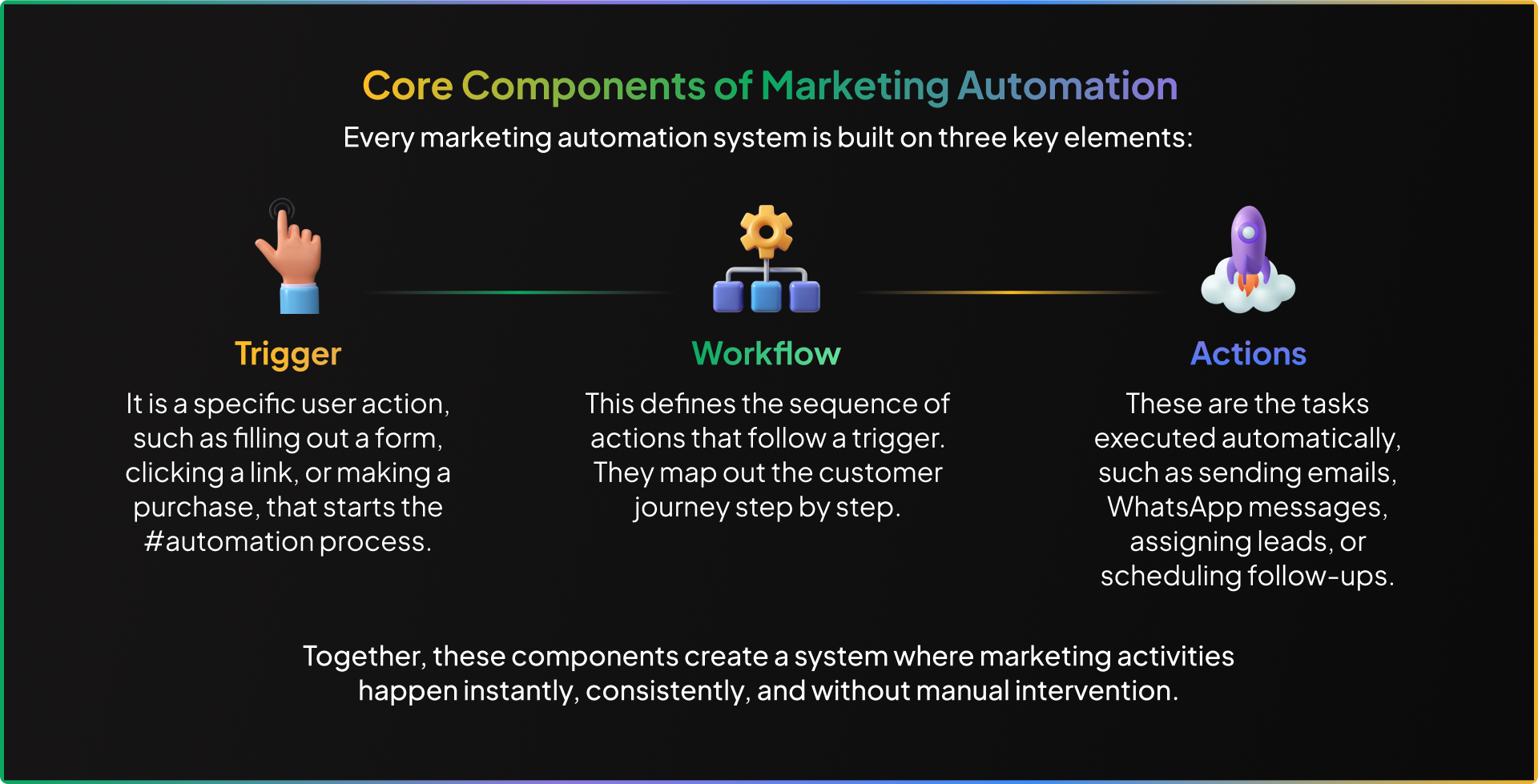
Marketing automation is the system-driven execution of marketing tasks using predefined workflows, data, and triggers. Instead of relying on manual effort for every action, automation allows businesses to set up systems that execute tasks automatically, whether it's sending a message, assigning a lead, or launching a campaign.
At its core, marketing automation removes the dependency on constant human involvement and replaces it with structured, repeatable processes that run in real time. This shift is critical for growing businesses. Instead of reacting to customer actions manually, automation ensures that responses, follow-ups, and engagement happen instantly, every single time.
Real Workflow Example: Lead Capture Automation
To understand how automation works in practice, here's a simple but powerful workflow:
- A user submits a form on your website.
- An instant WhatsApp or email response is triggered.
- The lead is automatically assigned to a sales representative.
- A follow-up message is sent after a few hours.
- A reminder is triggered the next day if there's no response.
This entire process runs automatically, without anyone needing to remember or manually execute each step.
This is what makes marketing automation powerful: Every lead is captured, nurtured, and followed up with, without delays or gaps.
Key Benefit of Marketing Automation
The biggest advantage of marketing automation isn't just efficiency, it's transformation.
- Manual marketing is reactive. It waits for someone to act.
- Automation is proactive. It acts the moment something happens.
Businesses that use marketing automation can respond instantly, maintain consistent communication, and scale their operations without increasing workload. In fact, studies show that companies using automation see up to a 20% increase in productivity and significantly improved response times.
In a landscape where speed directly impacts conversions, this shift can define whether a business grows or stalls. Automation turns marketing from a manual, effort-driven process into a proactive system that drives predictable growth.
How Does Marketing Automation Work?
Marketing automation may sound complex, but at its core, it's built on a simple principle:
When a customer takes an action, your system responds instantly, without manual effort.
Instead of relying on people to execute tasks one by one, automation creates a structured system where every interaction is triggered, processed, and executed in real time.
1. Trigger-Based Systems
Everything in marketing automation starts with a trigger. A trigger is a specific user action that signals the system to respond.
This could include:
- Filling out a form.
- Clicking on an ad or link.
- Sending a message.
- Making a purchase.
Once the trigger occurs, the system immediately activates a predefined response. This is what eliminates delays. Instead of waiting for someone to notice and respond, the system reacts instantly, ensuring that no opportunity is missed. In fact, businesses that respond quickly are significantly more likely to convert leads, making trigger-based systems a critical advantage.
2. Workflow Automation
Once a trigger is activated, workflows take over. A workflow is a sequence of automated actions designed to guide a customer through a journey. These actions are not random, they are structured, timed, and based on behavior.
For example:
- Day 0 → Welcome message.
- Day 1 → Product introduction.
- Day 3 → Follow-up reminder.
- Day 5 → Offer or incentive.
Each step happens automatically, without requiring manual intervention. This ensures that every lead is nurtured consistently, regardless of how many customers are in the system at once. Instead of managing individual conversations, businesses manage entire journeys at scale.
3. Multi-Channel Execution
Modern marketing doesn't happen on a single platform, and neither does automation.
Marketing automation systems operate across multiple channels, including:
- Email.
- WhatsApp.
- SMS.
- Social media platforms.
This allows businesses to reach customers where they are most active, while maintaining consistent messaging across all touchpoints.
For example, a single workflow might:
- Send an email.
- Trigger a WhatsApp follow-up.
- Retarget the user through social media ads.
All of this happens as part of one unified system. Studies show that multi-channel marketing can increase customer engagement rates by over 250%, making it a key driver of modern marketing success.
Manual vs Automation: The Real Difference
Understanding the difference between manual marketing and marketing automation isn't just about features, it's about how your business operates at its core.
One depends on effort. The other depends on systems. And that difference determines how fast, and how far, you can scale.
1. Narrative Comparison
- Manual marketing is reactive. It waits for someone to notice a message, remember a follow-up, or take action.
- Marketing automation is proactive. It acts the moment a trigger occurs, instantly and consistently.
- Manual marketing depends on people. Every task requires time, attention, and availability.
- Automation depends on systems. Once set up, it runs continuously without needing constant input.
- Manual marketing creates delays. Responses take minutes, hours, or sometimes days.
- Automation ensures instant execution. Every response, follow-up, and action happens in real time.
The difference is simple but powerful:
Manual marketing reacts after something happens.
Automation responds the moment it happens.
In a world where speed directly impacts conversions, this shift is critical. Research shows that businesses that respond first are far more likely to win the customer, making automation a competitive advantage, not just an efficiency tool.
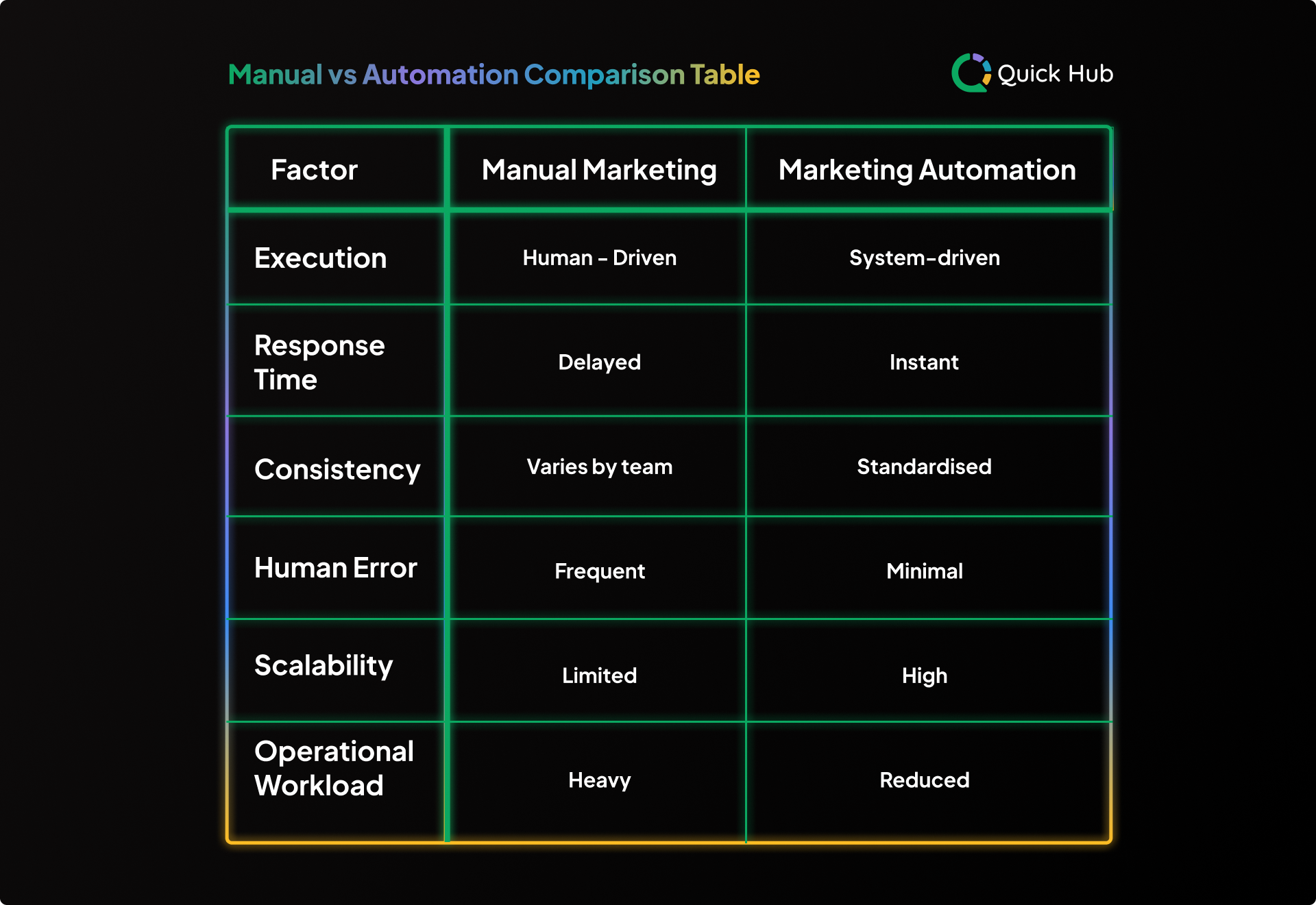
2. Manual vs Automation Comparison Table
The Hidden Costs of Manual Marketing
Manual marketing often appears cost-effective on the surface. There's no upfront investment in tools, no complex setup, and everything feels under control. But the real cost isn't visible in your expenses, it shows up in lost revenue, wasted time, and missed opportunities. As your business grows, these hidden costs compound quickly, turning what once felt manageable into a major growth bottleneck.
1. Lost Revenue from Delays
Speed is one of the most critical factors in converting leads. When responses are delayed, potential customers lose interest or choose a competitor who replies faster. And in most cases, that delay isn't intentional, it's a result of manual systems that can't keep up.
Studies show that businesses that respond within 5 minutes are up to 21x more likely to qualify a lead, yet most small businesses take significantly longer to respond. That gap directly translates into lost sales. Every missed or delayed response isn't just a delay, it's a potential customer choosing someone else.
2. Inconsistent Customer Experience
Manual marketing depends on individuals, and people are naturally inconsistent.
- Different team members respond differently.
- Response times vary.
- Messaging isn't always aligned.
This creates an uneven customer experience, where some customers receive quick, helpful responses while others are left waiting or receive incomplete information. Over time, this inconsistency affects trust, brand perception, and ultimately, conversions.
3. Operational Burnout
Manual marketing requires constant effort. Teams spend hours every day, replying to messages, sending follow-ups, tracking leads, and managing campaigns. As volume increases, so does the workload, without a proportional increase in efficiency.
This leads to:
- Team fatigue.
- Reduced productivity.
- Higher chances of human error.
Research indicates that repetitive manual tasks are one of the leading causes of workplace burnout, especially in small teams managing multiple responsibilities.
4. Limited Scalability
Manual systems don't scale, they stretch.
As demand grows:
- More leads require more responses.
- More campaigns require more effort.
- More customers require more management.
Eventually, the system reaches a limit where growth becomes difficult to sustain without adding more people or increasing workload. In contrast, automated systems can handle thousands of interactions simultaneously without additional effort, making scalability one of the biggest advantages of automation.
Is Marketing Automation Worth It for Small Businesses?
The short answer: Yes, especially as your business starts to grow.
Marketing automation isn't just a "nice-to-have" for small businesses anymore. It becomes essential the moment your customer volume increases beyond what you can manually manage.
At low volumes, manual marketing may seem sufficient. But as inquiries, leads, and campaigns grow, the limitations become clear, slower responses, missed follow-ups, and rising workload. That's where automation delivers measurable ROI.
How Marketing Automation Delivers ROI
1. Faster Responses = Higher Conversions
Speed directly impacts sales. Businesses that respond to leads within 5 minutes are up to 21x more likely to qualify them, yet most small businesses respond much later due to manual processes. Automation eliminates this delay.
- Instant replies.
- Immediate lead capture.
- Real-time engagement.
This alone can significantly increase conversion rates.
2. Higher Conversions Through Consistent Follow-Ups
Most leads don't convert on the first interaction.
They require follow-ups, reminders, and nurturing. Manual systems often fail here, not because businesses don't want to follow up, but because they forget or don't have the time.
Automation ensures every lead is followed up, no opportunity is missed, and the communication stays consistent. Studies show that companies using automation for lead nurturing generate 50% more sales-ready leads at a lower cost.
3. Lower Workload, Higher Efficiency
Manual marketing scales with effort. Automation scales with systems.
Instead of spending hours on repetitive tasks, automation handles:
- Messaging
- Scheduling
- Follow-ups
- Reminders
This reduces operational workload while increasing output. In fact, businesses using marketing automation report productivity improvements of up to 20%, allowing teams to focus on strategy instead of repetitive execution.
4. The Real ROI of Marketing Automation
The return on investment isn't just financial, it's operational and strategic.
- More leads converted (through speed and consistency)
- Less time spent on repetitive work
- Better customer experience
- Ability to scale without increasing team size
The Automation Readiness Test (Framework #1)
Is it time to let the machines take the wheel, or are you just feeling a little "social media fatigue"? Before you invest in a new tech stack, you need to know if your manual workflow is actually costing you money.
In our experience, if you tick more than two of these boxes, your current process isn't just "busy," it's broken.
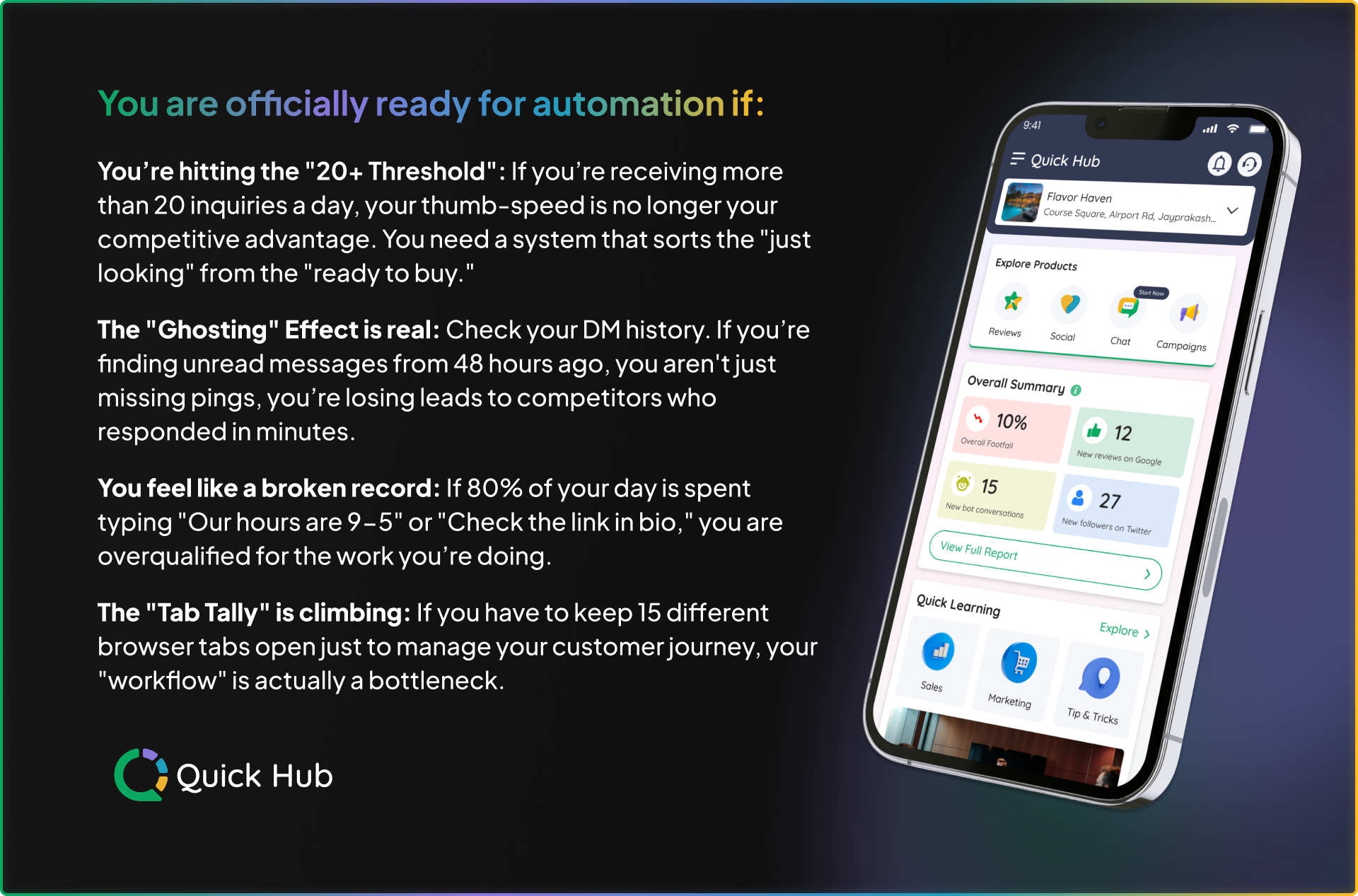
The Verdict: If any of this sounds like your typical Tuesday, you aren't just "ready" for automation, you're already overdue. Every hour you spend on manual follow-ups is an hour you aren't spending on high-level strategy.
The 3-Layer Marketing Automation Model (Framework #2)
Automation isn't a "set it and forget it" switch; it's a tiered ecosystem. To build a resilient brand, you have to move beyond simple auto-replies and start thinking about lifecycle management. While most creators get stuck at Layer 1, the real ROI lives at Layer 3. Here's how to stack your strategy for maximum impact:
Layer 1: Response Automation (The "Front Desk")
This is your first line of defense. It's about being "always on" without actually being always on.
- The Goal: Eliminate the "dead air" between a user inquiry and your first touchpoint.
- Key Action: Instant replies and FAQ triggers that handle the low-hanging fruit (pricing, hours, "How do I start?").
Layer 2: Engagement Automation (The "Nurture")
Once the conversation starts, don't let it go cold. This layer bridges the gap between a "lead" and a "customer" by maintaining the momentum.
- The Goal: Increase your conversion rate through consistency.
- Key Action: Automated follow-ups 24 hours after an inquiry, event reminders, and "still interested?" check-ins. It's about showing up exactly when the user is most likely to buy.
Layer 3: Growth Automation (The "Engine")
This is where you scale. Layer 3 isn't just reacting to users; it's proactively pulling them back into your ecosystem to drive lifetime value (LTV).
- The Goal: Predictable revenue and audience reactivation.
- Key Action: Full-scale lead generation campaigns, automated cross-selling, and "We miss you" reactivation sequences for dormant customers.
Most platforms focus on Layer 1, the "bot" talk. But true differentiation happens when you master Layer 3. By automating your growth loops, you're no longer just answering questions; you're building a revenue engine that runs while you sleep.
The Human Element: When Manual Marketing Still Makes Sense
Automation is your engine, but you are still the driver. If you try to automate everything, you risk becoming a digital vending machine: functional, but completely forgettable. To maintain a premium brand, you must know when to put the "bot" away and step in personally. Here is where the human touch isn't just a "nice to have," it's your greatest competitive advantage.
High-Value High-Touch (The VIP Rule)
When a whale enters your ecosystem, a potential enterprise partner or a high-ticket coaching lead, they don't want a sequence; they want a relationship.
The Rule: Use automation to handle the vetting, but once a lead hits a certain "Value Score," a human should take over the conversation. Personalized Loom videos or hand-typed DMs convert at a rate no script can match.
The "Spark" (Creative Campaigns)
Algorithms can optimize a layout, but they can't feel an emotion or understand a cultural moment.
The Rule: Your big-swing brand campaigns, your visual storytelling, and your "viral" experiments require human intuition. Automation is for the distribution of the art, not the creation of it.
The "North Star" (Strategy & Pivot)
Automation is excellent at following a map, but it's terrible at realizing the road is closed.
The Rule: Quarterly audits, competitor analysis, and shifts in brand voice must stay in human hands. You need to be the one deciding where the ship is going; the automation just helps you get there faster.
The Golden Rule of Modern Marketing
If you take nothing else away from this guide, remember this: Automation executes. Humans differentiate.
Automation is designed to handle the repetitive, so you can focus on the remarkable. By offloading the "busy work" of Layer 1 and 2, you clear the mental space required to actually talk to your customers, innovate your product, and lead your industry.
The Roadmap: How to Transition from Manual to Automation
Moving from a 100% manual workflow to an automated engine doesn't happen overnight, and it shouldn't. A "big bang" approach usually leads to broken links and frustrated customers.
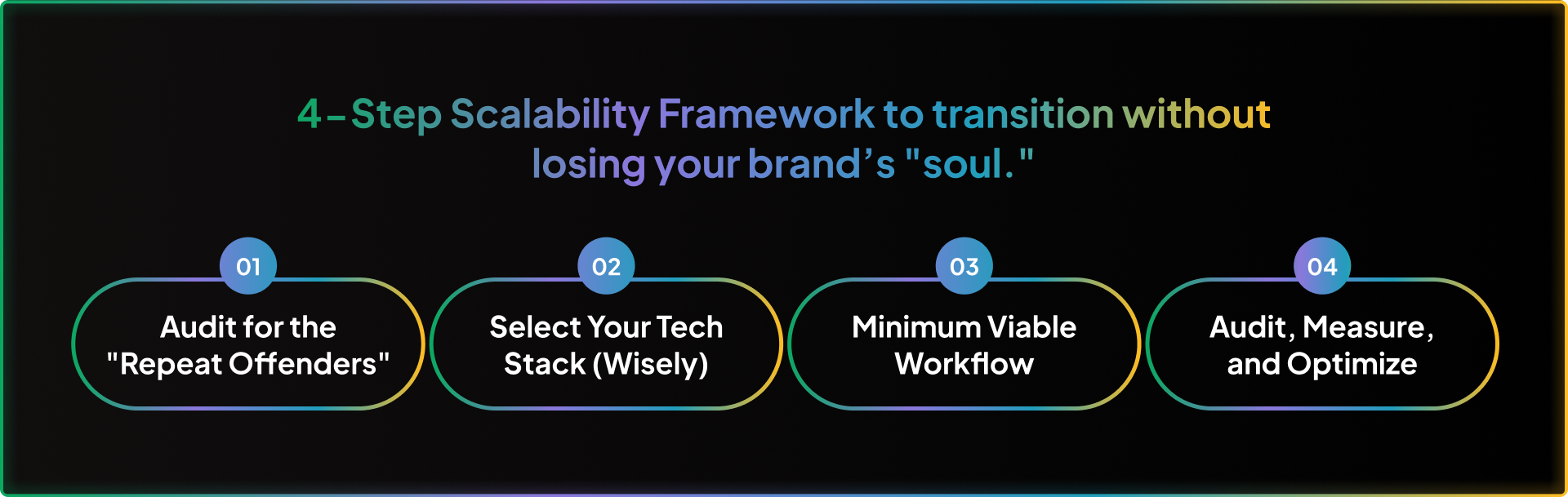
Step 1: Audit for the "Repeat Offenders"
Before you buy a single tool, spend one week tracking your time. Identify the tasks you do more than five times a day.
- Look for: Copy-pasting the same "How to buy" message, manually sending calendar links, or chasing invoice reminders.
- The Goal: If it's repetitive and low-variance, it's a prime candidate for Layer 1 automation.
Step 2: Select Your Tech Stack (Wisely)
Don't get blinded by "feature bloat." You need tools that play well with others.
- The QuickHub Advantage: Prioritize platforms with robust API integrations and native CRM connections.
- The Filter: If a tool doesn't save you more time than it takes to manage, it's not an asset, it's an expense.
Step 3: Build Your "Minimum Viable Workflow"
Don't try to build a 20-step customer journey on Day 1. Start with one high-impact "If/Then" sequence.
- The Priority: Usually, this is the Lead Response Flow. Map out exactly what happens from the moment a user comments to the moment they receive a link.
- The Test: Run the flow yourself as a "customer" to ensure the tone is right and the links actually work.
Step 4: Audit, Measure, and Optimize
Automation isn't "set it and forget it"; it's "set it and monitor it."
- The Metrics: Watch your Response Time (should drop), your Engagement Rate (should stay steady or rise), and your Conversion Rate.
- The Pivot: If people are "dropping off" at a certain step in your automated DM, that's your signal to step back in and tweak the copy.
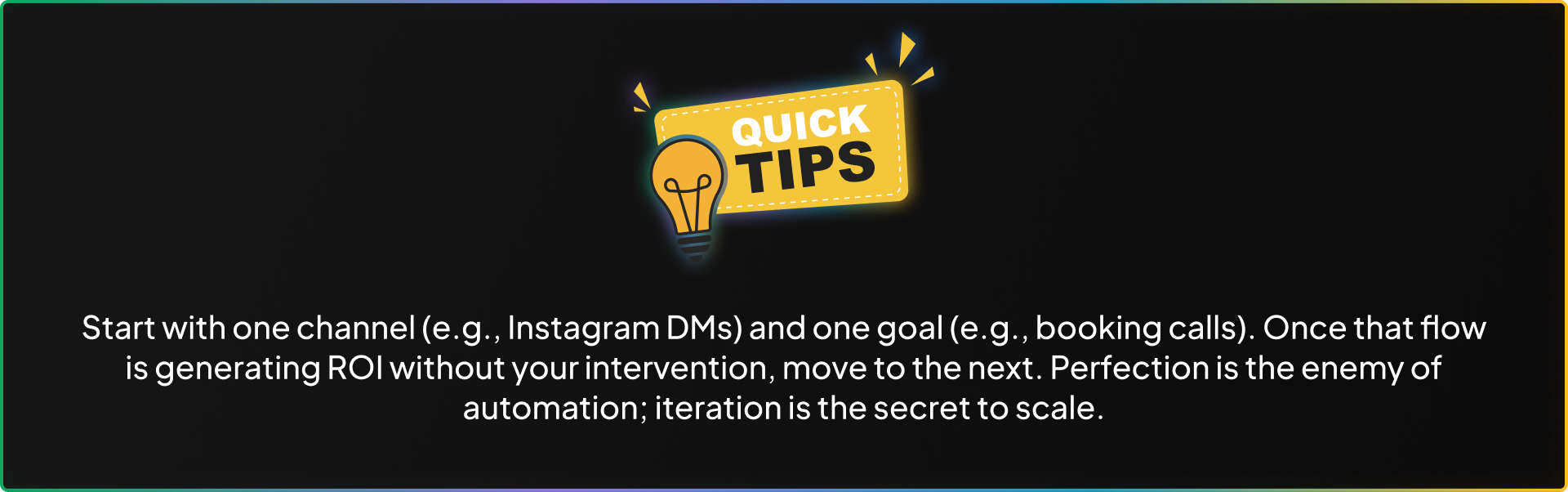
The Golden Rule: Start Small → Scale Gradually
The biggest mistake you can make is trying to automate your entire business in a weekend.
All-in-One Platforms (The "Unified" Approach)
While niche tools are great for specialized tasks, most growing businesses eventually hit a wall: Fragmentation. When your SMS tool doesn't talk to your Review manager, and your Social scheduler doesn't see your Email data, you aren't automating, you're just managing a bigger mess.
This is where All-in-One Marketing Hubs come in. They aren't just "features"; they are the operating system for your brand.
QuickHub: The Enterprise-Grade Engine for Local Brands
If Hootsuite is the gold standard for social-first enterprises, QuickHub is the disruptor designed for the business that needs social, SMS, and reputation management under one roof.
It's built for the "Marketing Team of One" (or a small, agile group) who needs to punch above their weight class without the $2,000/month enterprise price tag.
- The "Unfair" Advantage: QuickHub doesn't just schedule posts; it connects the entire customer journey. You can launch an Instagram ad, trigger a WhatsApp follow-up, and request a Google review, all from the same dashboard.
- Built-in AI (Quinn AI): Unlike basic schedulers that just "post," QuickHub uses AI to draft captions, suggest high-performing hashtags, and even automate your review responses based on sentiment analysis.
- The "Speed-to-Lead" Inbox: It centralizes your DMs from Instagram, Facebook, and WhatsApp into a single "Fast Response" hub, ensuring no inquiry ever goes cold while you're switching tabs.
Why it's a differentiator: Most platforms ask you to build the bridge between your marketing and your sales. QuickHub is the bridge. By consolidating your "Engagement" (Layer 2) and your "Growth" (Layer 3) into one interface, you eliminate the data gaps that kill conversions.
Go with an All-in-One like QuickHub if you want to reclaim 10+ hours a week by letting one system orchestrate your entire marketing lifecycle.
Conclusion: From Effort to Scalable Growth
Manual marketing is where most businesses start. It's flexible, hands-on, and works well when customer volume is low.
But as your business grows, those same manual processes become limitations.
- Responses get delayed.
- Follow-ups get missed.
- Workload increases.
- Growth slows down.
What once felt manageable starts holding you back. Marketing automation changes that. It replaces effort-driven execution with system-driven growth, where responses happen instantly, follow-ups are never missed, and customer journeys are managed automatically at scale. Instead of reacting to every task, you build a system that handles it for you. And that shift is what allows businesses to grow without chaos.
The real question isn't whether you should automate, it's how long you can afford not to.