
Introduction
"If modern marketing feels harder than it used to, it's not because you're behind. It's because everything is moving at once."
On paper, modern marketing should feel easy and effortless. Teams today have access to more marketing tools, more data, and more channels than ever before. There are tools for planning, publishing, tracking, automating, and analyzing every step of the customer journey. And yet, speak to almost any marketing team and you'll hear the same thing: everything still feels behind.
Deadlines blur. Strategy meetings end with screenshots instead of decisions. Slack messages and notifications pile up, but clarity never quite arrives.
The problem isn't effort. It's not ambition. It's not even a skill.
It's visibility.
As marketing stacks grew, teams built systems to stay organized—content calendars, project boards, analytics dashboards, collaboration tools. Somewhere along the way, the system itself became the work. Instead of focusing on outcomes, marketers spend their days navigating fragmented workflows and stitching together context across tools.
This is where marketing operations quietly begin to fail. When campaigns, posts, and ads live in separate platforms, timelines fracture. When timelines fracture, teams lose control. And when control disappears, marketing turns reactive.
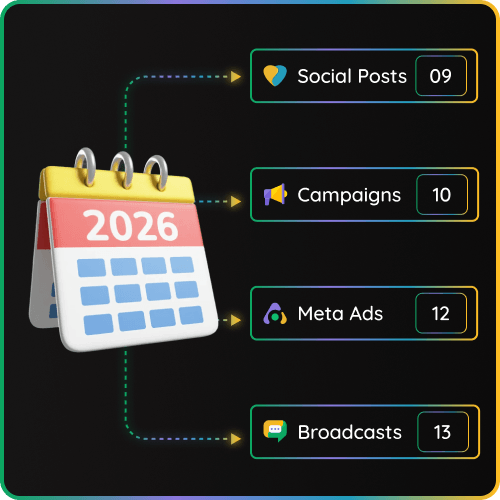
What teams actually need isn't another tool. They need a unified marketing calendar—a single, shared view that shows what's happening, what's coming next, and how everything connects.
In a world of constant motion, focus doesn't come from doing more. It comes from finally seeing everything in one place.
It's Not a Lack of Effort, It's a Lack of Visibility
If marketing teams feel exhausted, it's not because they're underperforming. It's because they're operating without a clear line of sight.
Activity is constant:
- Emails are drafted
- Posts are scheduled
- Ads are tweaked
But ask a simple question: "Where are we with this?" …and the room pauses.
This hesitation is the signal. The issue isn't productivity. It's marketing visibility.
The Fragmentation Problem
When execution is scattered across platforms, context disappears:
- A campaign lives in one tool
- Social content in another
- Paid ads somewhere else
Each system tells part of the story, but none of them show the whole picture. Teams rely on memory, screenshots, and status updates instead of shared understanding.
This is how marketing execution efficiency erodes.
Visibility isn't about more data. It's about context over time. Teams need to see what's live, what's overlapping, and what's coming next—on a timeline, not in silos.
The Solution
A centralized marketing calendar solves this by anchoring execution to time. When actions are placed on a shared timeline, dependencies surface naturally. Conflicts become obvious, and decisions get faster.
Because in a world of constant motion, focus doesn't come from doing more. It comes from finally seeing everything in one place.
When Coordination Becomes the Job
At some point, marketing teams stop doing marketing, and start managing marketing. The shift is subtle. Almost invisible at first.
A quick check-in turns into a meeting. A simple follow-up becomes 3 messages across three different tools. Entire mornings disappear answering questions that sound harmless but are deeply revealing:
- "Is this live yet?"
- "Who owns this now?"
This is coordination overhead, and it's one of the most underestimated drains in modern marketing.
The Hidden Cost
Every campaign has its own rhythm:
- A launch date
- A review cycle
- A dependency on design, approvals, or legal sign-off
Individually, these rhythms make sense. But when they're spread across 5 different platforms, they stop sounding like structure, and start sounding like noise.
Teams begin chasing updates instead of outcomes. Creativity gets buried under task management. Momentum slows, not because work stops, but because alignment becomes a full-time job.
The Pattern
Collaboration tools don't solve this problem. They capture conversations, not context. They help teams talk, but they don't help them see. And without a clear view of how campaigns connect over time, execution inevitably drags.
This is where systems like QuickHub change the dynamic by design. When activity from Quick Campaigns, Quick Social, and Quick Ads lives on one shared timeline, coordination stops being a task teams have to manage. Alignment becomes automatic. Teams don't ask where things stand. They already know.
And that's how it should be.
Coordination should be invisible. The moment it becomes the work, something upstream is broken.
Seeing the Whole Picture: Why a Unified Calendar Changes Everything
Most marketing tools are designed around actions:
- Send this email
- Publish that post
- Launch that ad
What they rarely show is how those actions relate to one another over time. And that missing layer—time—is where clarity either emerges or completely falls apart.
Time as Context
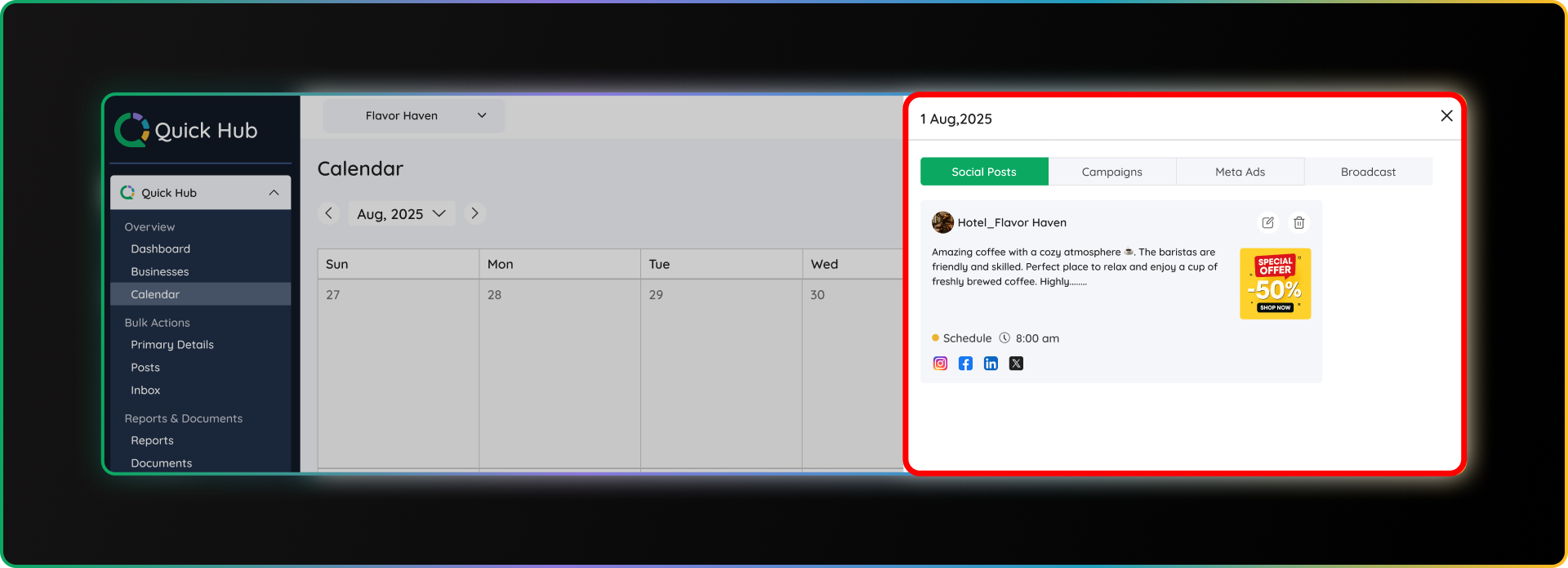
A unified marketing calendar turns isolated actions into a system. When every campaign, post, and launch exists on the same shared timeline, relationships become visible. You start noticing:
- Where efforts unintentionally overlap
- Gaps where messaging disappears for days
- Moments when communication stacks too tightly and overwhelms attention
This is where strategy finally has room to breathe.
Instead of reacting to what's already live, teams begin planning with intent. Instead of guessing what should go out next, they start anticipating what needs reinforcement, what needs spacing, and what needs silence. The calendar stops being a static planning artifact and becomes a thinking surface, a place where patterns show up before problems do.
Real-World Visibility Failures
Think about it in practical terms:
- How often have 2 campaigns gone live on the same day without anyone realizing it?
- How many times has a "big launch" been unsupported because social, email, and ads weren't aligned in time?
- How often do teams discover gaps only after performance drops?
These aren't strategy failures. They're visibility failures.
When time becomes visible, decision-making changes. Planning becomes calmer. Trade-offs become clearer. And marketing starts feeling less like damage control and more like intentional orchestration.
The real question isn't whether teams are doing enough. It's whether they can actually see what they're doing, before the results force the lesson.
From Chaos to Rhythm: When Marketing Starts Feeling Like Music

"Perfect rhythm beats perfect strategy." That's the mantra of the most efficient marketing teams. Success isn't about who works the longest hours or sends the most campaigns, it's about moving in harmony.
In most SMBs, marketing chaos isn't caused by volume. It's caused by disconnection:
- Emails launch without social support
- Promotions overlap unintentionally
- Ads start running before audiences are warmed up
Every individual action may make sense, but collectively, they collide, creating noise instead of impact.
The Symphony
The solution? A unified marketing calendar. With QuickHub, this calendar becomes the conductor of your marketing orchestra. Each note—whether it's a Quick Social post, a Quick Campaign, or a Quick Ad—lands in context. Each action reinforces the next, building momentum rather than confusion.
A Practical Example
Imagine a retail SMB preparing a holiday sale:
- Friday: Social posts tease upcoming deals via Quick Social
- Saturday: Email campaigns launch with full product details through Quick Campaigns
- Sunday: Paid ad campaigns amplify the message via Quick Ads
All of this is visible in one place, eliminating misalignment, last-minute scrambles, or duplicated efforts. Campaigns stop feeling like isolated pushes and start feeling like a cohesive performance, where timing, sequencing, and audience experience are synchronized.
The Critical Questions
Ask yourself:
- Are my campaigns clashing without me realizing it?
- Could my messages land more powerfully if every channel worked in harmony?
- How much more effective would our marketing be if execution felt like a coordinated performance rather than a chaotic scramble?
When marketing moves together, it doesn't just happen faster, it happens smarter. And that is the rhythm every growing business needs to turn effort into predictable growth.
Automation, Used Lightly and Intentionally
"The best systems don't announce themselves. They simply make work feel easier."
This is the philosophy behind intentional marketing automation. Too often, small businesses either over-automate, letting messages fire without context, or under-automate, leaving teams to rely on memory and manual follow-ups. Both extremes kill efficiency.
The sweet spot lies in automation that works with your team, not against it.
What Automation Should Do
Automation isn't about removing humans from marketing. It's about removing repetitive tasks that drain time and mental energy. When executed intentionally, automation allows teams to focus on creativity, strategy, and audience connection rather than juggling schedules and reminders.
With QuickHub, Workflow Automation integrates seamlessly with the unified marketing calendar, making every action contextual and predictable. Reminders, follow-ups, and campaign dependencies run quietly in the background, so teams never miss a beat.
Real-World Automation Flow
For example:
- A campaign publishes on social
- An automated follow-up email triggers 3 days later
- Review reminders fire the week before renewal dates
- Campaign reports generate automatically on Mondays
The result? Marketing moves with precision and flow, rather than friction and chaos. Automation doesn't take over, it supports execution without hijacking it, making campaigns feel effortless yet powerful.
The Self-Check
Ask yourself:
- Are repetitive tasks stealing creative energy from my team?
- Could my campaigns execute themselves without constant check-ins?
- How much more consistent would my marketing be if follow-ups, reminders, and ad activations were handled automatically and intelligently?
When automation is intentional, contextual, and aligned with the calendar, it transforms from a burden into a quiet growth engine, letting teams focus on what really matters: delivering campaigns that resonate and convert.
Finding Focus Again: The Mental Shift Teams Don't Expect
Most teams don't realize how much mental energy they spend tracking work, until they stop having to. Scattered systems force the brain to act as the glue:
- Remembering dates
- Double-checking statuses
- Switching tabs for reassurance
This constant background load kills focus.
The QuickHub Difference
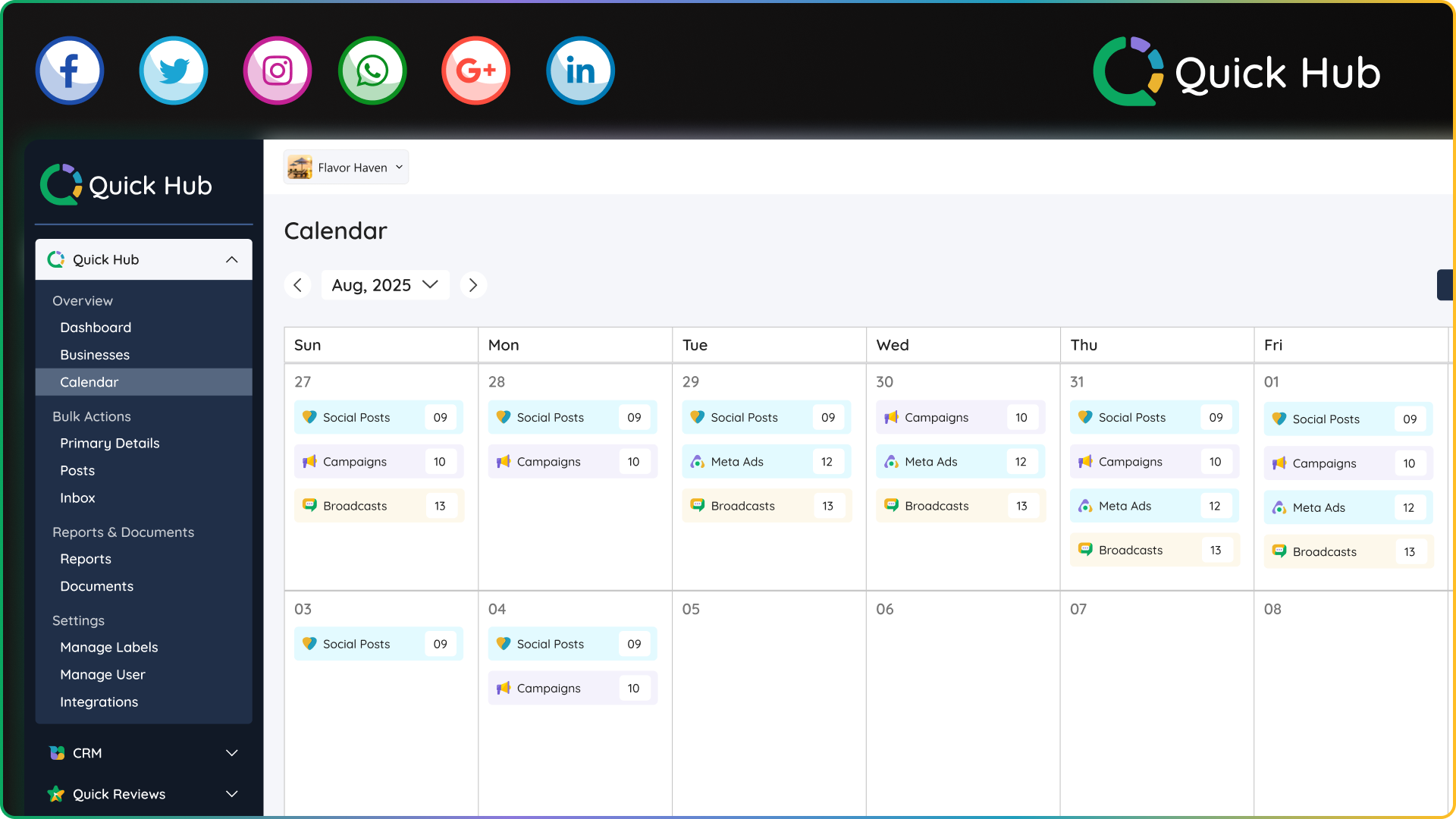
QuickHub's unified marketing calendar takes the chaos out of planning and execution by giving teams a single, clear view of all marketing activity. From Quick Social posts and Quick Campaigns to Quick Ads and broadcasts, you can see:
- What's been posted
- What's scheduled
- When everything is happening
Easy Filtering and Discovery
Need a quick overview? Simply filter by campaign type or channel to instantly understand where every message, ad, or update fits in the bigger marketing picture.
This centralized visibility eliminates guesswork, reduces coordination overhead, and ensures every action is aligned, so teams can focus on creating, optimizing, and growing instead of chasing scattered updates.
Great Marketing Isn't Done in a Thousand Tabs
For years, success meant doing more—more posts, more tools, more dashboards. The real skill today is alignment.
A unified calendar brings campaign management, cross-channel marketing, and marketing workflow planning into one clear view.
This is where QuickHub brings everything together:
- Quick Campaigns
- Quick Social
- Quick Ads
- Quick CRM
- Quick Reviews
- Quick Chat
- Quick Agents
- Workflow Automation
The Purpose
Not to add complexity, but to remove it.
Great marketing doesn't happen in a thousand tabs. It happens in one clear view, where teams move together, execution flows, and focus finally returns.
Final Takeaway: Visibility Is the New Competitive Edge
The most successful marketing teams in 2026 won't be the ones working the hardest. They'll be the ones seeing the clearest. When every campaign, conversation, and action lives on a unified timeline, teams stop chasing updates and start orchestrating growth.
A unified marketing calendar isn't just a planning tool. It's the foundation of a marketing system where visibility creates alignment, alignment creates efficiency, and efficiency creates predictable, scalable results.
Stop managing chaos. Start conducting symphonies.