
Not because your product is inferior. Not because your prices are too high. But because someone else looks more trustworthy online. Before customers spend money with you, they investigate you. They don’t start with your pricing page. They don’t start with your sales pitch. They start with your online reputation. They scan your ratings. They read reviews (especially the negative ones). And compare you with alternatives.
And all of this happens in under 3 minutes.
That silent evaluation shapes buyer perception long before your business gets a chance to respond. In today’s digital landscape, reputation isn’t a side metric, it’s a trust filter. It decides whether someone clicks, inquires, or leaves.
Here’s the uncomfortable reality: reputation influences revenue silently.
You won’t get notified when a customer chooses your competitor because of weaker trust signals. But the impact shows up in ways that are easy to miss:
- Lower conversion rates.
- Longer decision cycles.
- Higher price sensitivity.
- Increased acquisition costs.
When reviews are inconsistent or negative, hesitation increases. When trust drops, revenue follows. And here’s the real problem, most businesses aren’t even aware it’s happening. If you’re not actively monitoring your reputation, your customers are forming opinions without you. And while you stay unaware, your competitors gain the advantage.
Because right now, you are being compared. Side by side. Rating by rating. And your reputation is already influencing decisions, whether you’re managing it or not.
The Illusion of “We Have Good Reviews”
Most businesses feel safe when they see this:
- “We have 4.5 stars.”
- “We respond to reviews sometimes.”
- “We check Google every few weeks.”
It feels responsible. It feels proactive. But in reality, it’s often an illusion. Because reputation is not a static number. It’s not a screenshot. It’s not something you check once in a while. A 4.5-star rating today tells you very little about what’s actually happening beneath the surface. It doesn’t show whether trust is improving… or slowly declining. And that’s where the real risk lies.
Most businesses don’t know:
- If negative reviews are increasing week by week.
- If positive feedback is becoming less enthusiastic.
- If competitors are gaining reviews faster.
- If the same complaints are being repeated.
- If customer sentiment is shifting in tone, not just ratings.
These small changes don’t look alarming at first, but over time, they compound. For example, your rating might stay at 4.5 for months. But if you’re getting fewer 5-star reviews and more 3-star ones, your brand perception is weakening quietly.
Customers notice this, even if you don’t. That’s why looking at individual reviews isn’t enough. What matters is the pattern they create over time. Reputation is not about one bad review. It’s about the direction your trust is moving. This is where structured tracking becomes important. Instead of reacting to isolated comments, you start understanding trends:
- Is trust increasing or decreasing?
- Are customers becoming more satisfied or more critical?
- Is your perception improving or slowly eroding?
Because long-term revenue is shaped by patterns, not snapshots. The shift is simple: Stop thinking about ratings. Start thinking about trends.
Reputation Is Relative: You’re Always Being Compared
Your customers are not evaluating you in isolation. They’re evaluating you in context. Search your business name. Then search your top competitor. That side-by-side view? That’s exactly how modern buying decisions happen.
Customers compare:
- Star ratings.
- Total review count.
- Review recency.
- Rating distribution.
- Sentiment tone.
- Response consistency.
This comparison happens instantly, and it shapes decisions before your team ever speaks to the customer.
Here’s the catch:
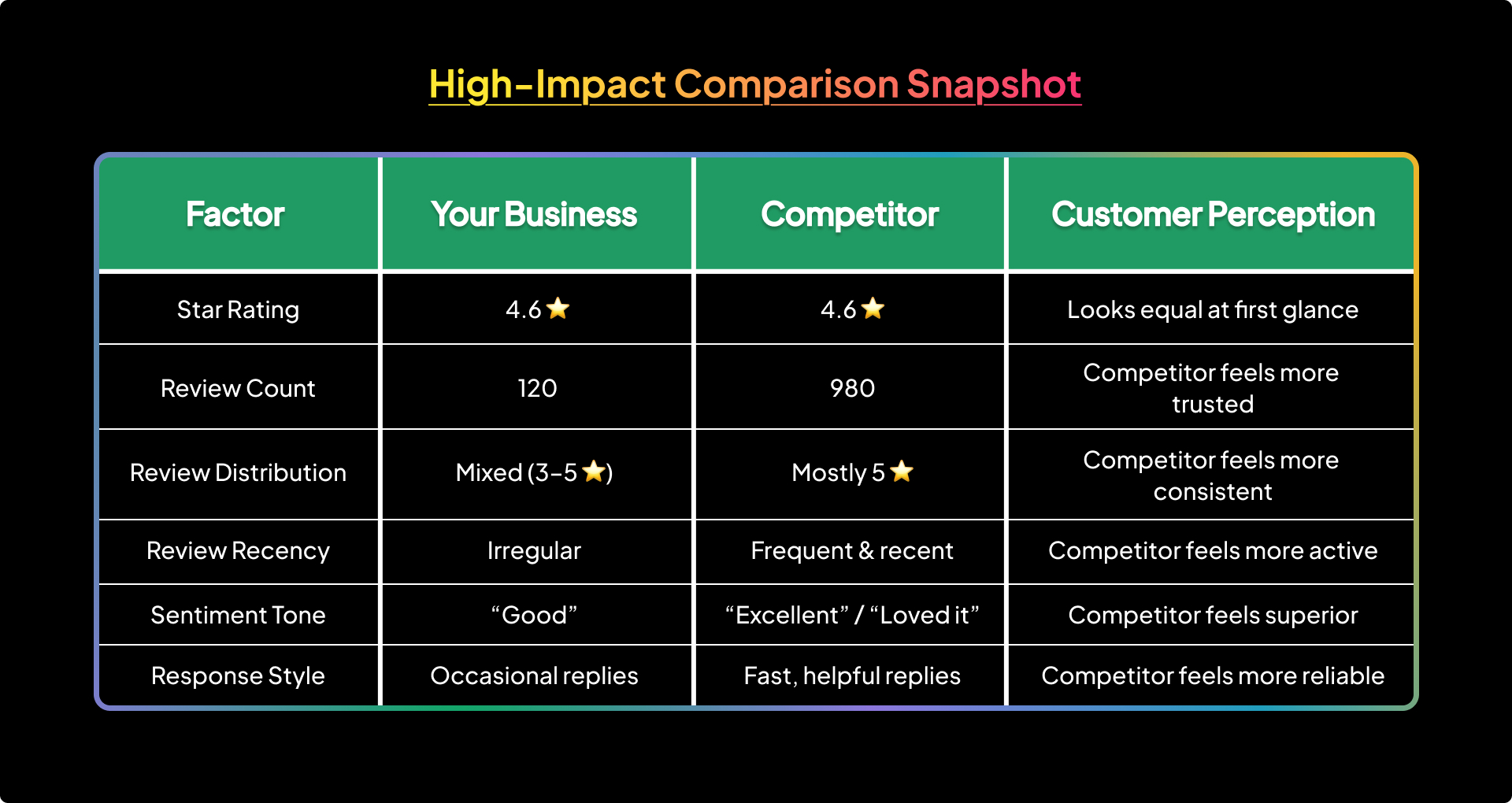
If you have 4.6 stars and 120 reviews. And your competitor has 4.6 stars and 980 reviews.
You don’t look equal. If your reviews are mixed between 3 and 4 stars. And theirs are consistently 5-star experiences. You don’t feel as trustworthy. Because customers don’t just look at the average, they scan patterns. This is where review distribution becomes critical. A brand with consistent positive feedback feels safer than one with uneven experiences, even if the rating difference is small.
Then comes sentiment.
- Are customers saying “good” or “exceptional”?
- Are the same complaints showing up repeatedly?
- Are responses helpful or defensive?
These small signals create a bigger perception. And perception drives action. When competitors have clearer, stronger trust signals, they win before the conversation even begins.
That directly impacts:
- Click-through rates.
- Booking decisions.
- Purchase confidence.
- Conversion speed.
This isn’t just reputation management. This is brand positioning, happening in public.
And the truth is simple: You are being compared. Constantly.
Which leads to the real question: Do you actually know how you look next to your competition or are you guessing?
The Cost of Flying Blind
Reputation doesn’t collapse overnight. It declines quietly. And without structured tracking, you don’t see it happening.
Small signals often look harmless at first:
- A sudden spike in 1-star reviews.
- A few more neutral 3-star ratings.
- Slightly slower review growth.
Individually, they don’t feel urgent. But together, they form patterns, and patterns shape perception. This is where most businesses go wrong.
Without tracking trends over time:
- You miss negative spikes turning into recurring issues.
- You fail to spot repeated complaints about the same problem.
- You overlook positive feedback being replaced by neutral sentiment.
- You don’t notice when review momentum slows down.
- You react only after damage becomes visible.
And by then, it’s already late. Because perception doesn’t wait for internal reports. It directly impacts how customers behave.
When trust weakens:
- Prospects hesitate more.
- Comparisons increase.
- Questions multiply.
- Decisions get delayed.
That hesitation quietly reduces your conversion rate and slows down your entire sales process.
Over time, the impact compounds:
- Lower conversion performance.
- Higher churn rates.
- Increased customer acquisition costs.
- Weakened brand authority.
This is how revenue loss actually happens, not through one bad review, but through patterns that go unnoticed. Flying blind isn’t just about missing data. It’s about missing reality. Your customers are already noticing changes. Your competitors may already be capitalizing on them. And your revenue is being influenced by signals you’re not tracking. Reputation isn’t dangerous because of negativity. It’s dangerous when negativity goes undetected. By the time you see the impact in your sales numbers, fixing it becomes slower, harder, and more expensive.
Introducing the Online Reputation Report
What if reputation wasn’t something you checked? Or What if it was something you measured like revenue, pipeline, or cash flow?
That’s the shift. Reputation stops being reactive and becomes infrastructure. With the Online Reputation Report, scattered feedback turns into structured business intelligence. Because growth doesn’t come from occasionally reading reviews, it comes from tracking patterns.
Centralized Reputation Tracking
Instead of jumping between platforms and manually scanning comments, everything lives in one place.
- No platform-hopping.
- No screenshots.
- No guesswork.
This creates a single, unified view of your reputation. Whether you manage one location or multiple, you get consistent visibility across the board. When all feedback is centralized, clarity replaces chaos, and decisions become faster.
Structured Comparison
Reputation only makes sense in context. The report lets you compare performance side by side, your business vs competitors, or across locations. Instead of reacting to individual reviews, you start analyzing:
- Trends over time.
- Gaps in perception.
- Differences in positioning.
This turns reputation from a reactive activity into a strategic advantage.
Visualized Data That Drives Decisions
Raw numbers don’t drive action, clarity does. The report presents insights through simple visual formats:
- Review trends over time.
- Rating distribution.
- Sentiment breakdown.
You don’t need to read every review. You understand what customers are saying, at scale. And that changes how decisions are made. Instead of guessing, you measure. Instead of reacting late, you act early. When reputation becomes measurable, growth becomes intentional.
Feature Breakdown #1: Time-Based Reputation Tracking
Reputation isn’t static. It moves. And if you’re not tracking that movement, you’re reacting to outdated perception.
The Online Reputation Report by Quick Hub includes time-based tracking, allowing you to view:
- Last 7 days.
- Last month.
- Custom date ranges.
This simple shift changes the question from: “What’s our rating?” → to → “How is our rating changing?”
And that’s where real insight begins.
Detect Rating Trajectory
A 4.6-star rating means very little without context.
- Is it improving?
- Is it declining?
- Is it unstable?
When you track movement over time, patterns become visible. A slow dip over 30 days can signal early dissatisfaction. A steady rise can confirm your improvements are working. This is the difference between reacting late and acting early.
Spot Sudden Spikes in Negative Reviews
Short-term tracking makes hidden issues visible. If multiple low ratings appear within a few days, it’s not random, it’s a signal. Something has changed in the customer experience. Without time-based filters, these spikes get buried in averages. With them, you catch issues early, before they damage broader perception.
Monitor Campaign Impact on Sentiment
Every business decision affects customer perception.
- New offer launched.
- Pricing updated.
- The process changed.
Time-based tracking helps you connect these actions to real feedback. You can clearly see whether sentiment improves, declines, or stays neutral. This turns reviews into performance indicators, not just feedback.
Track Improvement After Changes
When you invest in better service, you should see results. Time-based tracking shows whether those efforts are actually improving perception. You don’t rely on assumptions, you see the shift in sentiment over time. Because reputation isn’t about a single rating. It’s about direction. And when you understand direction, you gain control.
Feature Breakdown #2: Business & Label Comparison
Reputation doesn’t just change over time, it varies across locations, teams, and competitors. That’s why the Online Reputation Report lets you compare multiple businesses or labels side by side. Instead of one overall score, you get a clear, granular view, location by location, brand by brand. This is where reputation becomes operational intelligence.
Multi-Location Comparison
If you run multiple branches, performance won’t be equal. Some locations deliver consistent 5-star experiences. Others may show rising complaints or weaker sentiment.
With side-by-side comparison, you can instantly see:
- Which locations build trust?
- Which ones are slipping?
- Where customer experience needs attention?
This removes blind spots and prevents one weak location from affecting your entire brand.
Franchise Performance Tracking
In franchise systems, consistency is the biggest challenge. Internal standards don’t always match customer perception. But reviews reveal the truth.
With comparison data, you can track:
- Review volume per franchise.
- Rating consistency.
- Sentiment trends.
This creates accountability. It also highlights top-performing franchises, so you can replicate what’s working across the network. Reputation becomes a measurable KPI, not a guess.
Brand vs Competitor Positioning
You’re not just competing on product, you’re competing on perception. With direct comparison, you can see how your reputation stacks up:
- Are competitors gaining reviews faster?
- Is their sentiment stronger?
- Are they perceived as more reliable?
These insights directly influence strategy. Because in competitive markets, the business that looks more trustworthy often wins.
Identify Underperforming Branches Early
Early detection is everything. When one location starts declining, comparison helps you spot it before it becomes a bigger issue. You can act locally, fix faster, and protect overall brand perception. Clarity leads to faster decisions, and better outcomes.
Feature Breakdown #3: Bar Graph Review Comparison
Numbers alone don’t influence strategy. Visual clarity does. The Online Reputation Report transforms raw feedback into a bar graph review comparison, allowing you to instantly see:
- Number of reviews by business.
- Star rating comparison.
- Full review distribution breakdown (1-star to 5-star)
This isn’t just data, it’s competitive visibility. Because reputation strength isn’t defined by averages alone. It’s defined by structure.
See Volume Dominance
Review count signals authority. If one business has 1,200 reviews and another has 140, even with similar ratings, buyers instinctively trust the one with higher volume. This is where review volume tracking becomes critical. Volume communicates market validation. It signals longevity, reliability, and consistency. With a visual bar graph, you immediately see who owns the trust narrative in terms of scale.
Identify Rating Gaps
A 0.3-star difference may seem small internally. But visually, through a star rating comparison tool, even small gaps become strategic signals. When displayed side by side, these differences influence perception dramatically. A 4.7 next to a 4.3 feels safer. More stable. More credible. Seeing the gap clearly forces action instead of complacency.
Detect Unstable Distribution
Here’s where most businesses misunderstand reputation. Customers don’t calculate averages. They subconsciously scan distribution. If a business shows a heavy concentration of 5-star reviews and minimal 1-star feedback, it feels consistent. If reviews are scattered evenly across 2, 3, 4, and 5 stars, it feels unpredictable. This is why review distribution analysis matters more than a single rating number. An unstable distribution signals inconsistent experiences. Consistency builds trust density.
Understand Trust Density
Trust density is the concentration of positive experiences relative to total feedback. When visualized, it becomes immediately obvious whether your reputation is solid or fragile. The bar graph comparison doesn’t just show data. It shows market perception structure. And perception structure determines buying confidence, often before your sales team ever speaks.
Feature Breakdown #4: Sentiment Categorization
Star ratings tell you what customers scored. Sentiment tells you how they felt. That difference is everything. The Online Reputation Report includes structured sentiment analysis for reviews, categorizing feedback into positive reviews, neutral reviews, and negative reviews. This creates a clear positive negative review breakdown, allowing you to move beyond averages and understand emotional direction. Because reputation shifts emotionally before it shifts numerically.
Detect Rising Dissatisfaction Early
A business can maintain a stable 4.5-star rating while dissatisfaction quietly increases underneath.
How?
Neutral reviews. Three-star feedback often signals unmet expectations. Not angry enough for 1-star. Not happy enough for a 5-star. When neutral sentiment begins to rise, it’s usually the first indicator of friction. With structured customer sentiment tracking, you see this shift before it damages your overall rating. Early detection means faster correction.
Catch Neutral-to-Negative Shifts
Sentiment rarely collapses overnight. It slides. Neutral feedback this month can turn into negative reviews next month if operational issues aren’t addressed. By tracking sentiment categories over time, you can identify directional movement:
- Are positives increasing?
- Are neutrals stacking up?
- Are negatives clustering around a specific complaint?
This clarity turns public feedback into predictive intelligence.
Spot Operational Friction Early
If negative reviews consistently mention delayed responses, staff attitude, billing confusion, and product quality issues. You’re not dealing with reputation problems. You’re dealing with operational signals. Sentiment categorization surfaces those signals clearly, so leadership can respond at the root level.
Identify Brand Strengths to Amplify
Positive reviews aren’t just validation. They’re positioning assets. When customers repeatedly praise specific features, experiences, or team members, you gain insight into your true competitive advantage. Sentiment data shows you what the market already values about your brand. And when you understand emotional patterns, not just star counts, reputation stops being reactive. It becomes strategic.
Feature Breakdown #5: Downloadable Reports
Data is powerful. Shared data is transformational. The Online Reputation Report doesn’t just live inside a dashboard, it can be exported, shared, and used strategically across your organization. With a built-in reputation dashboard export, you can instantly generate structured insights and turn them into action. This isn’t about saving a PDF for records. It’s about making reputation visible at every decision-making level.
Export the Report
With a simple click, you can download online reputation report summaries that include rating comparisons, review distribution, and sentiment breakdowns. No more manual screenshots. No more copying comments into spreadsheets. No more fragmented updates. You generate a clean, structured reputation performance report that reflects real-time trust metrics. This elevates reputation from “marketing feedback” to executive data.
Share With Your Team
When reputation insights stay isolated, improvement stalls. But when you share structured data with marketing, operations, customer service, and leadership, alignment accelerates. Marketing sees what customers value. Operations sees where friction occurs. Customer support sees recurring complaint themes. Leadership sees competitive positioning. This shared visibility turns online reputation into a company-wide KPI.
Use in Meetings and Strategic Planning
Imagine reviewing reputation trends in monthly leadership meetings the same way you review revenue. Discussing sentiment shifts. Evaluating branch comparisons. Measuring rating trajectory. Planning service recovery strategies based on real feedback. That’s how reputation becomes proactive instead of reactive.
Align Strategy With Perception
When you export and distribute reputation insights consistently, you eliminate guesswork. Campaign messaging aligns with real customer praise. Operational improvements target actual complaint patterns. Stakeholders understand the public trust movement clearly. Reputation becomes structured intelligence. Not anecdotal noise. And once reputation becomes measurable, shareable, and strategic, it stops being a reactive burden. It becomes a competitive advantage.
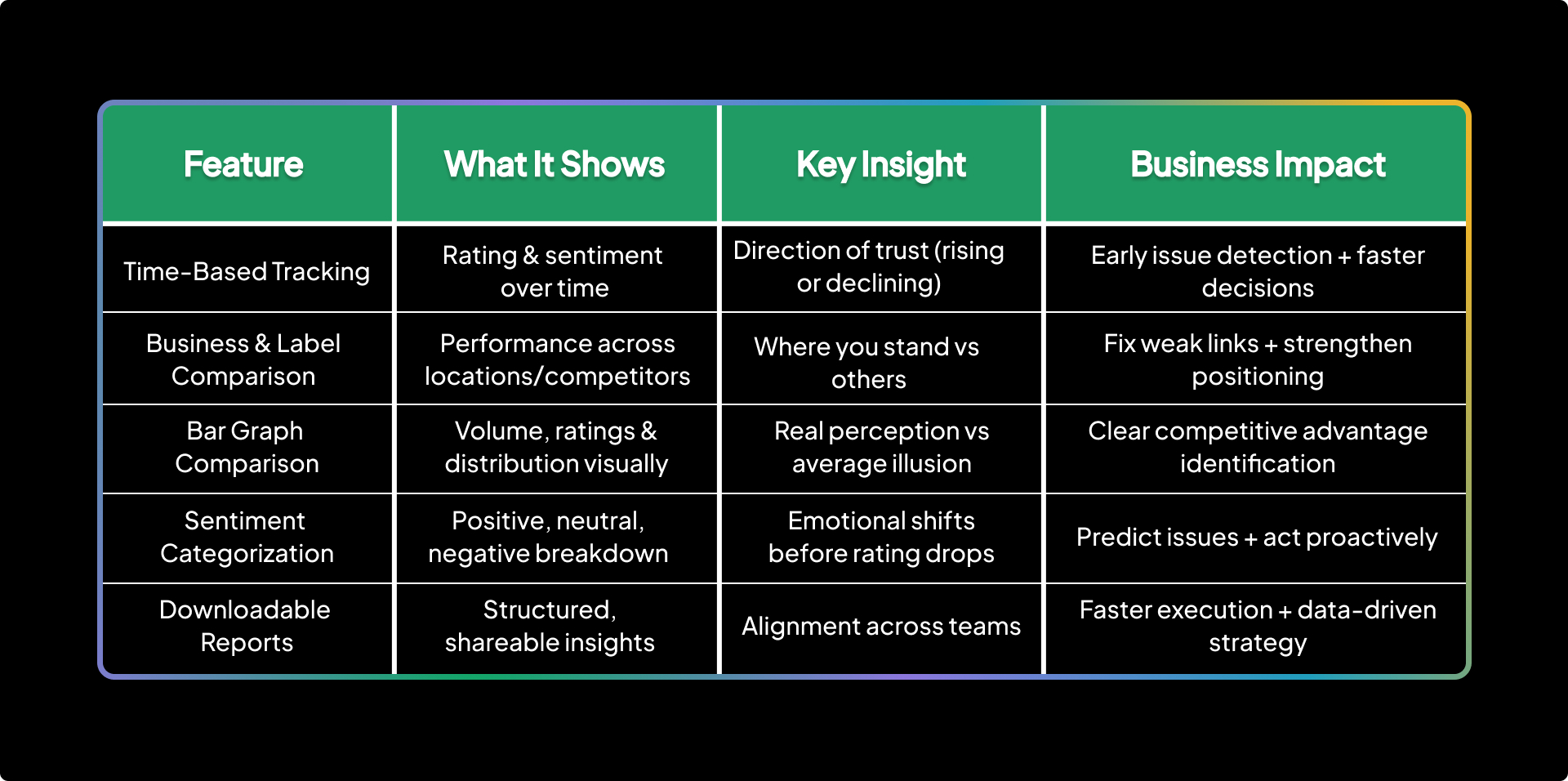
When these 5 features work together, reputation stops being feedback, and becomes a measurable growth system.
Turning Reputation into a Competitive Asset
Reputation used to be reactive. A bad review came in. You replied. You moved on. That era is over. Today, reputation isn’t damage control, it’s competitive leverage. When structured properly, it becomes:
- An early warning system.
- A positioning clarity tool.
- A conversion lever.
- A retention signal.
This is the evolution of modern reputation strategy.
Reputation as an Early Warning System
Patterns in customer feedback reveal problems before revenue drops. If complaints start clustering around delays, communication gaps, or product issues, you see it early. This isn’t reacting to reviews. It’s predicting risk before it scales.
Reputation as Positioning Clarity
Customers define your brand, whether you track it or not.
If they consistently mention:
- “Fast delivery” → that’s your strength.
- “Confusing onboarding” → that’s your gap.
Structured insights show how the market actually sees you. And that clarity sharpens your positioning.
Reputation as a Conversion Lever
Trust directly impacts buying decisions.
- Strong rating distribution → builds confidence.
- Positive sentiment → reduces hesitation.
- High review volume → signals authority.
When trust goes up, friction goes down. And when friction drops, conversions increase.
Reputation as a Retention Indicator
Retention starts before the purchase.
Declining sentiment trends often signal future churn:
- Rising neutral reviews → inconsistent experience.
- Increasing complaints → growing dissatisfaction.
This turns reputation into a forward-looking retention metric, not just feedback.
Real-World Application
- Real estate developers track sentiment to detect buyer hesitation early.
- eCommerce brands analyze feedback before scaling ads.
- Multi-location businesses compare branches to fix inconsistencies.
In each case, reputation becomes actionable intelligence, not passive visibility. When you treat reputation as infrastructure, not noise: It stops being a liability. It becomes a competitive advantage.
From Guessing to Predicting
Most businesses guess. They guess why conversions dropped. They guess why close rates slowed. They guess why customers seem more hesitant. But guessing is expensive. When you have structured reputation data, you stop reacting emotionally to isolated reviews and start predicting market behavior with clarity. This is where reputation shifts from observation to intelligence.
Forecasting Trust Trajectory
A single rating snapshot tells you nothing about direction. But consistent review performance tracking reveals momentum. If positive sentiment is increasing month over month, your trust trajectory is strengthening. If neutral reviews are replacing enthusiastic feedback, friction is forming. By analyzing patterns through structured trust trend analysis, you can forecast whether your brand perception is compounding, or eroding. That foresight gives leadership time to adjust before revenue feels the impact.
Preventing Review Crises
Review crises rarely appear out of nowhere. They build. A spike in 1-star reviews within a short timeframe. Recurring complaints about the same issue. Sudden sentiment shifts tied to a policy change. With proactive reputation risk management, these signals become visible early. Instead of scrambling during public backlash, you intervene before patterns escalate. Prediction replaces panic.
Scaling Ad Spend Safely
Advertising amplifies perception. If your reputation signals are strong, paid campaigns convert efficiently. If trust signals are weakening, ad spend magnifies hesitation. Structured online reputation forecasting ensures you scale marketing only when public sentiment supports it. This protects ROI and reduces wasted acquisition costs. You’re no longer pouring traffic into unstable trust environments.
Improving Customer Experience With Data
Patterns in sentiment reveal experience gaps faster than internal reports ever will. When structured correctly, reputation becomes a real-time customer experience monitor. You see where expectations are unmet and where satisfaction is strongest. That insight drives smarter operational improvements. Because once you can predict perception shifts, you stop guessing. And businesses that predict trust don’t just protect revenue. They compound it.
The Big Truth: Reputation Is Moving Capital
Here’s the truth most businesses underestimate: Reputation behaves like capital. Not like feedback. Not like marketing fluff. Not like a vanity metric. Capital. It grows. It compounds. It deteriorates. It accelerates momentum, or drains it. When you understand reputation capital, you stop treating reviews as comments and start treating them as assets.
Reputation as Financial Capital
Financial capital grows when monitored, invested wisely, and protected from risk. Reputation works the same way. Strong review acquisition increases review equity. Consistent positive sentiment strengthens brand valuation signals. Upward rating trajectory enhances market confidence. But when ignored, negative patterns accumulate quietly, creating long-term trust depreciation. And unlike cash flow problems, reputation erosion often isn’t visible until revenue slows.
Reputation as Brand Equity
Brand equity is built on perception consistency. When customers repeatedly experience, and publicly confirm, the same positive outcomes, your brand equity growth accelerates. When feedback becomes inconsistent, equity weakens. Every review contributes to your public positioning. Every sentiment shift influences your authority. Every distribution imbalance affects your credibility. This is not a theory. It’s observable market behavior.
Reputation as Growth Momentum
Momentum is fragile. When reputation trends upward, increasing review volume, stronger positive ratios, improved distribution, and growth becomes easier. Conversion friction decreases. Customer confidence rises. That’s growth momentum fueled by trust. But when negative sentiment rises and neutral feedback dominates, momentum slows. Hesitation increases. Decision cycles extend. Reputation is not static reputation management. It’s moving capital inside your business ecosystem.
If tracked → it compounds. If ignored → it deteriorates.
You can invest in ads. You can optimize pricing. You can expand operations. But if your reputation capital weakens, every growth lever becomes less effective. Because in modern markets, trust is currency. And your reputation is already trading, every single day.
To Conclude
You don’t lose customers because of one bad review. You lose them because you didn’t see the pattern forming behind it. Reputation doesn’t collapse loudly. It erodes quietly— in tone, in timing, in trends you didn’t track.
And by the time it shows up in your revenue…it’s already expensive to fix. Because here’s the truth most businesses ignore: Your reputation is already working. Right now. It’s influencing who clicks. Who trusts. Who chooses you or your competitor?
It’s either compounding growth… or silently draining it. There’s no neutral. The question is no longer “Does reputation matter?” That debate is over.
The real question is: Are you managing it—or reacting to it too late?
Because the moment you start measuring reputation like a business asset, everything changes. You stop guessing. You start seeing. You catch problems early. You double down on what works. And most importantly, you take control of how your market perceives you.
That’s the shift. Reputation is no longer feedback. It’s infrastructure. And once it becomes visible, structured, and trackable, it stops being damage control and starts becoming a strategic growth engine. If you want to start building a stronger review base, read How to Collect More Google Reviews Without Begging Customers.
Because your reputation is already shaping your growth curve.
Now the decision is simple: Will you manage it or let it manage you?