
Introduction
"If growth feels random, it's because your stack is disconnected."
That line hits close to home for a lot of small and mid-sized businesses in 2026. On the surface, it looks like you're doing everything right. You're running ads. You're posting on social media. You're replying to messages. You're sending campaigns. But behind the scenes, all of it is happening in different tools that were never designed to work together.
Most SMBs today still operate like this: ads live in one platform, leads land in another, follow-ups happen on WhatsApp or phone calls, and customer data sits in spreadsheets or half-used CRMs. Each tool works fine on its own. But none of them see the full picture of the customer journey. And when systems can't see the journey, they can't optimize it.
That's why modern growth is no longer about finding the next clever tactic or the next trending channel. It's about building SMB growth systems where customer data, conversations, campaigns, and follow-ups move through one connected flow. In other words, growth now depends on how well your CRM, automation, and campaigns function as a single revenue engine, not as isolated activities. This shift is what defines the modern growth stack for small businesses.
Instead of asking, "Which ad should we run next?" or "Which tool should we buy next?", high-performing SMBs are asking a different question: "Where does our customer journey break, and how do we fix the system?"
Because in 2026, revenue doesn't come from doing more. It comes from removing friction between every step, from first click to final conversion and beyond. And that's exactly where revenue automation platforms are starting to matter far more than individual marketing tools.
Why Most SMB Tech Stacks Are Built Backwards
And this is exactly where things start going wrong—not because SMBs don't invest in tools, but because they invest in tools in the wrong order.
"Most businesses buy tools to fix problems, not to build journeys."
It usually starts with urgency. You need more leads, so you buy an ad tool. Messages start coming in, so you add a chat app. Then someone says you should track customers, so a CRM gets added later. Each decision makes sense in isolation. But together, they create what many owners now recognize as a fragmented SMB tech stack—a patchwork of platforms that were never designed to share context or coordinate actions.
The result is predictable. Customer data is scattered. Conversations live in one place, campaigns in another, and sales follow-ups depend on memory or manual notes. Automation, if it exists at all, is limited to single steps: an auto-reply here, a confirmation message there, maybe a basic email sequence. But nothing connects the dots across the full journey.
This is what tool sprawl in small businesses really looks like. Not too many tools, but too many tools solving narrow problems without any system-level design. And when tools don't share a common data layer, they can't support intelligent automation, meaningful attribution, or consistent customer experiences.
The deeper issue isn't technical. It's strategic. Most stacks are built around immediate pain, not around how customers actually move from interest to conversation to purchase to repeat business. That's why even with multiple subscriptions and dashboards, growth still feels manual and unpredictable.
And when systems are designed this way, automation can never graduate from task execution to decision support, which is where the real performance gains actually come from.
Campaigns Create Attention — CRM Is What Turns It Into Revenue
This is the natural consequence of building stacks around tools instead of journeys: You get attention, but you don't get outcomes.
"Ads don't make you money. What happens after the click does."
Campaigns are great at what they're designed to do. They generate traffic. They create leads. They start conversations across email, WhatsApp, social media, and landing pages. In today's SMB world, attention is not the problem. In fact, many small businesses are paying for plenty of it. The real problem starts the moment that attention lands inside the business.
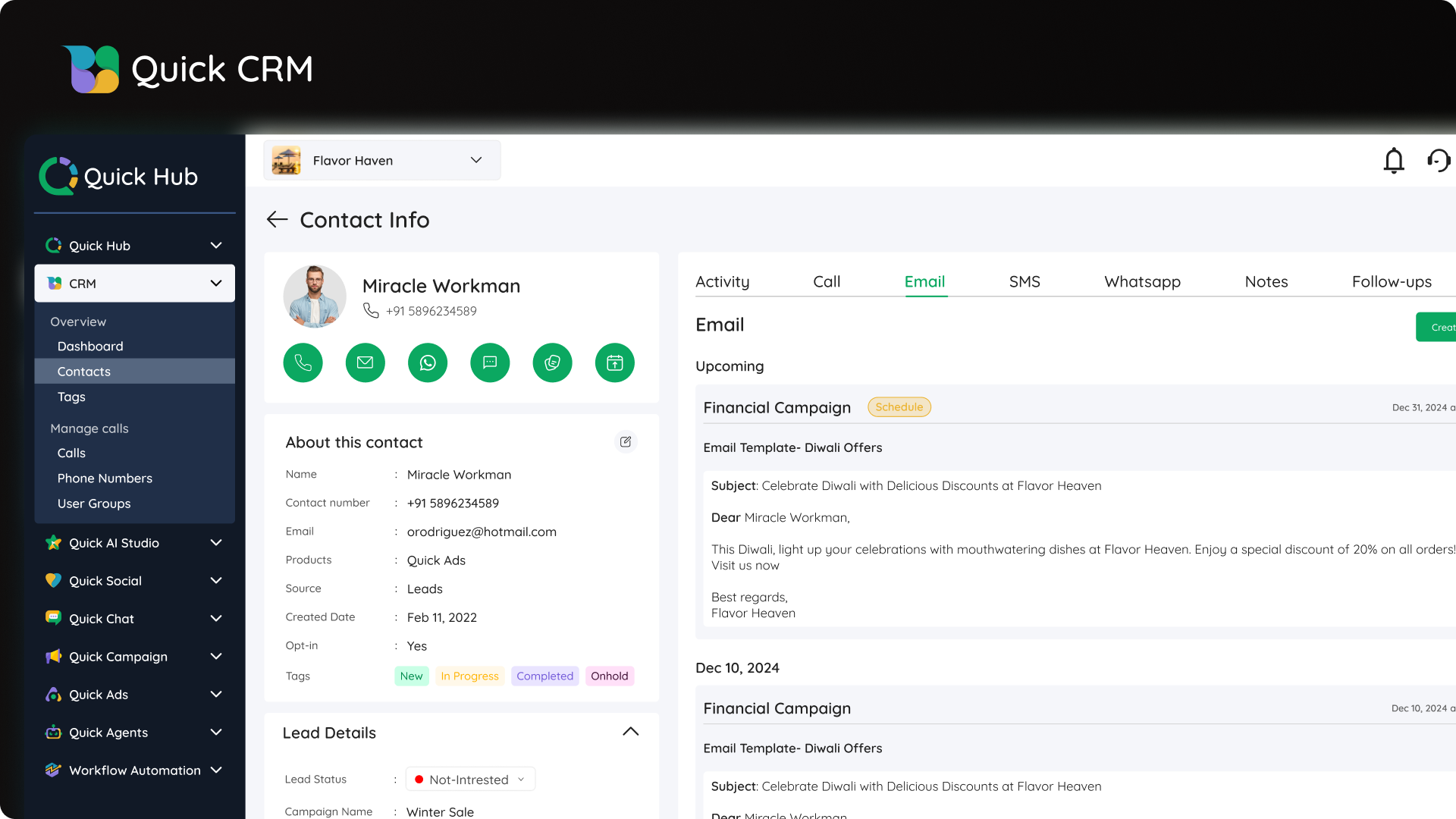
Without a proper CRM for revenue growth, there's no clear ownership of leads. No structured follow-up process. No visibility into who has replied, who is waiting, and who is about to drop off. Conversations happen, but deals don't move forward in any predictable way. Teams are busy, but pipelines are thin. This is why modern CRM is no longer just a contact database or a reporting tool. In 2026, the CRM is the system that tracks every inquiry, every message, every handoff, and every stage to conversion. It becomes the control center for lead management in SMBs, not just a place to store names and phone numbers.
When CRM is missing, or poorly connected, businesses rely on inboxes, personal WhatsApp accounts, and mental reminders to manage opportunities. That works at a very small scale. It completely breaks once volume increases or more than one person touches the customer.
And this is the uncomfortable truth most ad platforms won't tell you: Campaigns can only start demand. They cannot finish the sale.
Revenue is created in the messy middle, where response speed, follow-up timing, and deal ownership actually decide whether interest becomes income. That's why CRM doesn't sit after campaigns in the growth stack. It sits at the center of it. But even CRM alone can't carry the entire journey anymore, because tracking activity is not the same as moving customers forward, which brings us to the next missing layer in most SMB growth systems.
Automation Is the Glue That Holds the Growth Stack Together
Once CRM becomes the place where demand is tracked and owned, the next bottleneck becomes obvious: movement. Leads exist. Conversations happen. Deals sit in stages. And then… nothing moves unless someone remembers to move it.
"If humans have to remember every follow-up, growth will always leak."
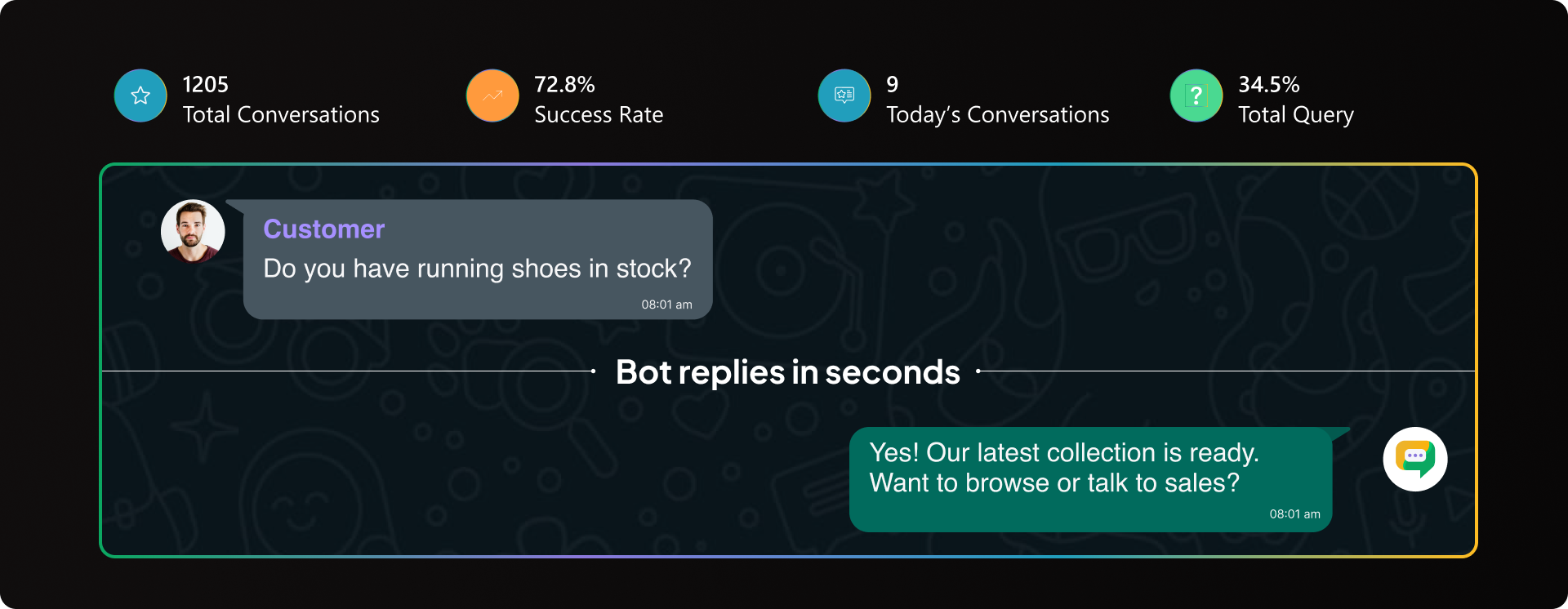
This is where marketing automation workflows stop being a "nice-to-have" and start becoming operational infrastructure. Not to replace teams, but to make sure momentum never depends on memory.
What automation should be doing in modern SMB growth systems is simple and powerful:
- Routing new leads instantly to the right person
- Triggering follow-ups based on real behavior, not just time delays
- Moving deals between stages when actions happen, not when someone updates a field
- Re-engaging cold prospects the moment interest drops
In other words, automation should be pushing opportunities forward, continuously, automatically, and contextually. But in most small businesses today, automation looks very different. It sends generic drip emails. It schedules reminders that get buried under notifications. It runs in isolation from what the customer is actually doing. That's not automation. That's just scheduled messaging.
The big shift happening in 2026 is moving from time-based automation to behavior-driven automation for SMBs. Instead of asking, "Has three days passed?" systems now ask, "Did the customer reply, click, visit, or go silent?" And the next action changes accordingly. This is how automated sales follow-ups become intelligent instead of annoying. The system adapts to the customer, instead of forcing every lead into the same fixed sequence.
And this is the moment when growth stacks start behaving less like disconnected tools and more like real funnels, where attention flows into conversations, conversations flow into opportunities, and opportunities keep moving until they either convert or clearly exit.
The Funnel Is No Longer Linear, It's a Continuous Loop
Once CRM tracks and automation moves, the entire funnel finally starts acting like a single machine. And that's when another outdated idea breaks completely: the idea that growth happens in a straight line.
The old model looked like this: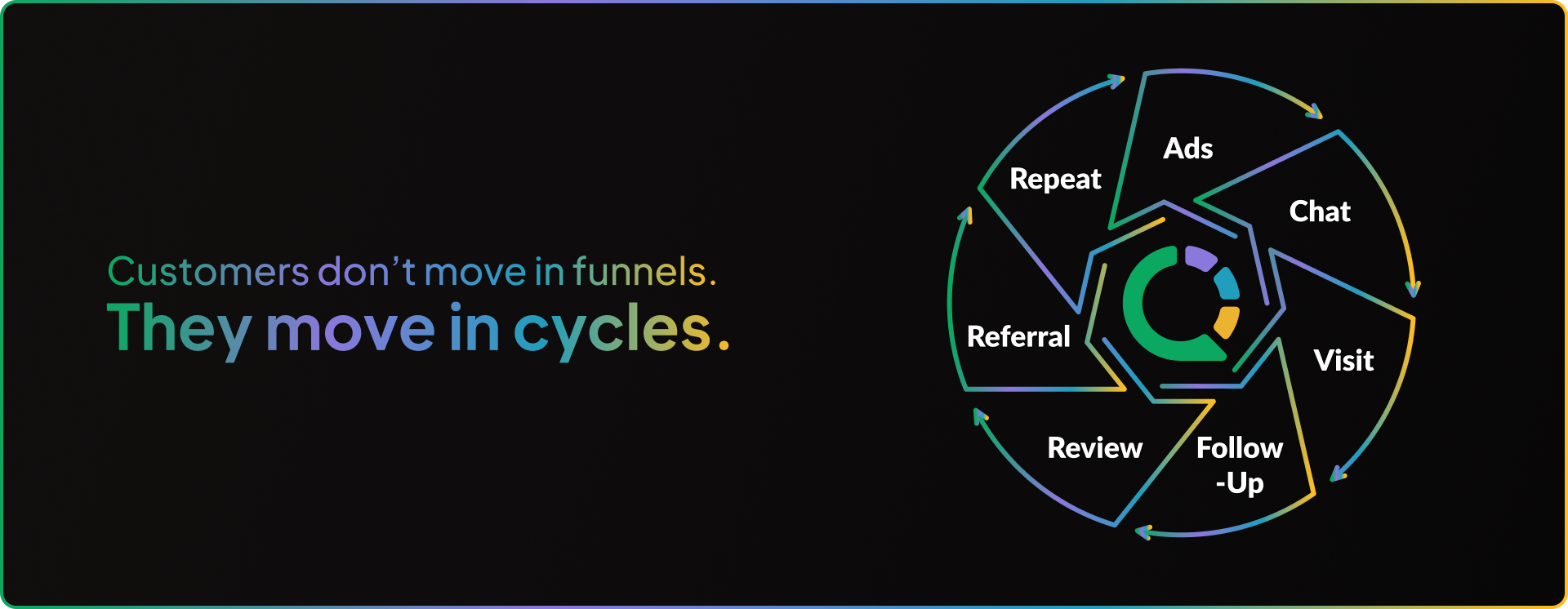
Traffic → Leads → Sales → Done
That's not a funnel. That's a loop. And it only works when every part of the growth stack stays connected after the first conversion. This is why stack integration is no longer just about convenience, it's about continuity. When systems are connected, reviews can trigger referral or re-engagement campaigns. Campaigns can reopen conversations inside the same customer profile. And conversations can trigger sales actions and retention workflows. Each phase feeds the next. Nothing resets. Nothing starts from zero. But when tools are fragmented, every phase becomes a restart.
Marketing doesn't know what sales discussed. Support doesn't know what offer was sent. Retention campaigns don't know who just had a great or terrible experience. So context disappears, momentum dies, and customers feel like they're talking to a business with amnesia. This is where customer lifecycle automation becomes the real growth advantage for small businesses. Not just automating acquisition. Not just optimizing conversion. But designing systems that support acquisition, conversion, and retention together as one continuous process.
Because here's the uncomfortable truth: most SMBs don't struggle to get attention. They struggle to keep relationships moving forward once attention is won.
That's why retention-driven growth strategies are now outperforming pure lead-generation tactics. When your growth stack is built as a loop instead of a funnel, every customer interaction becomes future demand, not a dead end. And suddenly, marketing stops being a cost center. And becomes a compounding engine.
Where Most Growth Stacks Still Break Down
If growth is now a loop, not a funnel, then campaigns can no longer live in isolated tools either. They have to operate inside the same system that manages conversations and conversions. Yet for most SMBs, that connection is exactly where things still fall apart.
"Your stack might be digital, but your handoffs are still manual."
On paper, the tools are there. In reality, execution keeps slipping through the cracks. Here's what breakdown actually looks like inside many small businesses:
- A lead comes in, but no one is automatically assigned to follow up
- A deal gets closed, but marketing never knows which campaign worked
- A happy customer leaves quietly, no review request ever goes out
- A past buyer exists in the database, but no re-engagement ever happens
Individually, these feel like small misses. Collectively, they create massive lead leakage problems and invisible revenue loss.
So why does this keep happening?
Because most stacks are still organized around departments, not decisions. Marketing tools optimize for sending. Sales tools optimize for tracking. Support tools optimize for tickets.
But no system owns the moment where one action should trigger the next. Data isn't shared in real time. Ownership isn't automatically assigned. And workflows quietly stop the moment a task is technically "completed" in one tool. That's why so many SMBs think they have automation, but still rely on humans to remember what should happen next. And memory does not scale.
The cost shows up everywhere:
- Higher acquisition costs because retention is weak
- Inconsistent experiences that erode trust
- Missed upsells, referrals, and repeat purchases
This is how broken sales funnels in SMBs actually happen in 2026. Not because businesses don't care about growth, but because their systems were never designed to move customers forward without constant human intervention. Automation gaps in marketing aren't a technology problem anymore. They're an architecture problem.
What a High-Performance SMB Growth Stack Looks Like in 2026
Fixing broken handoffs doesn't require heroic effort from your team. It requires a growth stack where decisions, not departments, drive what happens next.
"High-growth SMBs don't chase tactics. They build revenue machines."
In 2026, top-performing small businesses aren't running scattered tools. They're operating on an integrated growth stack for SMBs where every system plays a specific role, and every role is connected. Here's how the modern stack actually works when it's built for revenue, not reporting:
Campaign Engine → Demand Creation
This is where attention starts. Ads, social, email, and offers generate traffic, leads, and conversations. But instead of dumping leads into a spreadsheet or a generic inbox, every interaction is instantly logged against a real customer profile.
- No delays
- No guessing
- No lost source data
CRM → Opportunity Management
The CRM is no longer a passive database. It becomes the command center where every inquiry is owned, every deal is staged, and every follow-up is visible.
Sales doesn't ask, "Who should I call next?" The system already knows, and shows it. This is revenue operations for small businesses, not just contact management.
Automation → Execution Layer
Automation is what removes human dependency from momentum.
- Leads are routed the moment they arrive
- Follow-ups trigger based on behavior, not calendars
- Deals move stages automatically when actions happen
- Cold leads get re-engaged without manual effort
Instead of reminding people what to do, the system simply does it. This is where connected CRM, automation, and campaigns stop being tools and start acting like infrastructure.
Analytics → Optimization Loop
Finally, performance data doesn't live in isolated dashboards. It flows across the stack. You can see:
- Which campaigns generate real revenue?
- Where deals stall in the journey?
- Which follow-ups increase close rates?
- Which customers actually come back?
That's when optimization becomes practical, not theoretical. And when all four layers share unified customer profiles, shared workflows, and revenue-focused dashboards, the business results show up fast:
- Faster response times
- Higher close rates
- Stronger lifetime value
- Less chaos, more control
Not because teams are working harder, but because systems are finally working together.
Why SMBs Are Moving Toward Unified Growth Platforms
Once SMBs experience what a connected growth stack can do, a new realization hits fast: Managing five tools to simulate one system is no longer worth the effort.
"The stack is collapsing into systems."
That's the market shift playing out right now. For years, small businesses were told to assemble their own tech ecosystems:
- One tool for ads
- One for CRM
- Another for messaging
- Something else for campaigns
- Spreadsheets to hold it all together
On paper, that looks flexible. In reality, it creates constant friction. Every integration is a risk. Every sync delay breaks context. Every extra login adds hesitation. And hesitation, in growth, is expensive. Very expensive.
So in 2026, the trend is clear: SMBs are moving away from tool collections and toward one execution layer across the entire customer journey.
From scattered tools...
Separate ad tools, separate CRMs, and separate messaging apps.
To unified systems...
Unified marketing and CRM platforms, all-in-one SMB growth software, and business automation systems built around workflows, not features.
Why does this matter so much for small teams?
Because unified platforms mean:
- Fewer integrations to manage
- Faster setup and onboarding
- Less operational overhead
- Fewer things that can silently break
But the bigger shift is not technical. It's operational. When systems are unified, powerful things start to happen by default:
- Campaigns don't just collect leads — they trigger workflows
- Chats don't just end conversations — they update CRM stages
- Sales actions don't stop at closing — they feed retention and review campaigns
- Nothing has to be copied, exported, or re-entered
Context moves automatically. Ownership is clear. And momentum doesn't die between steps. This is why platforms like QuickHub are increasingly being adopted not as "marketing tools," but as growth operating layers, where CRM, chat, campaigns, ads, reviews, automation, and AI agents live inside one continuous system designed for how SMBs actually work.
Not more dashboards. Just fewer gaps between intent and action.
How Platforms Like QuickHub Fit Into the Modern Growth Stack
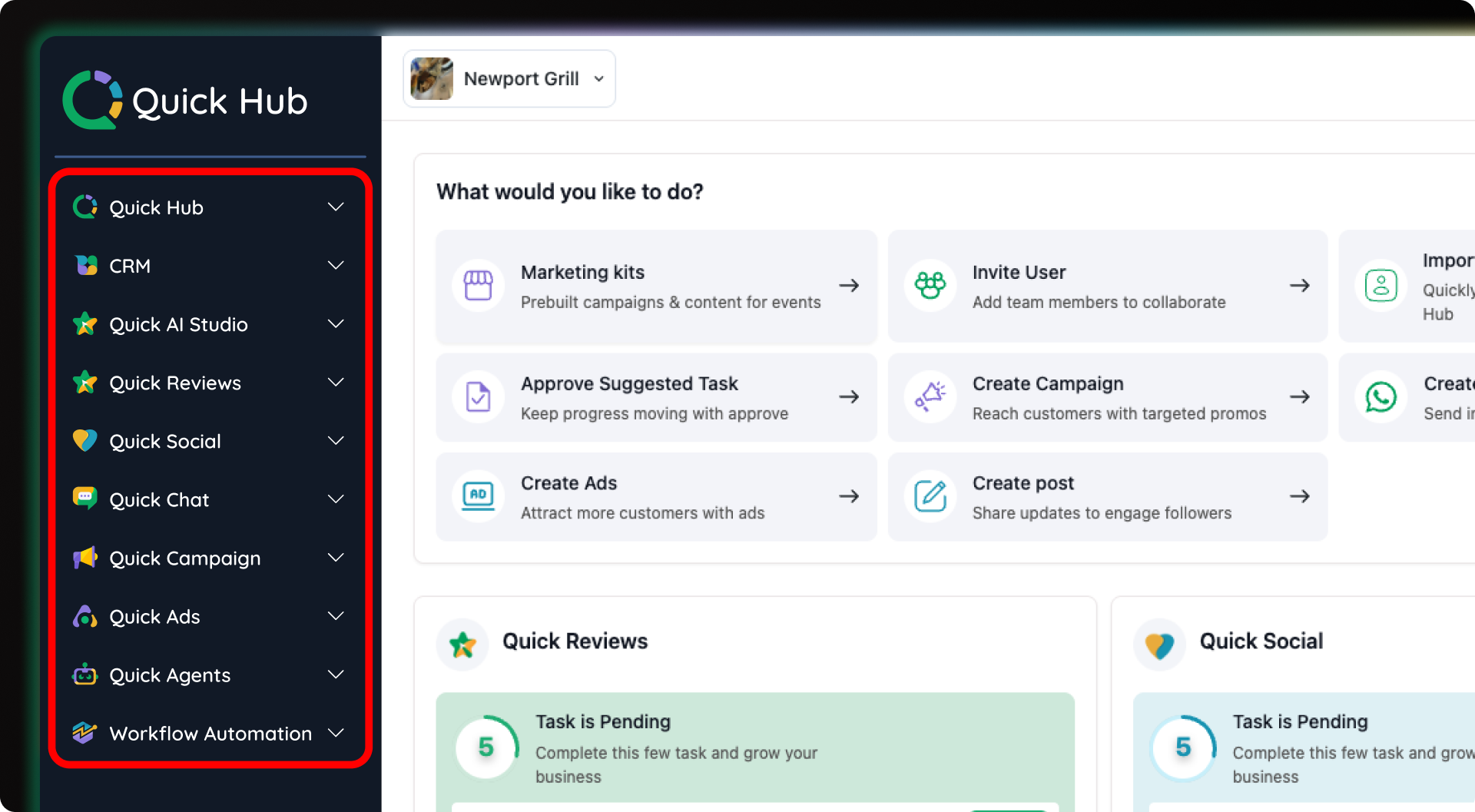
By now, the pattern is clear: Growth is no longer about picking the best individual tools, it's about removing the gaps between them.
That's why the most important shift in SMB tech is not which software you use, but how much of the customer journey your systems can actually own end to end. This is where modern growth platforms position themselves very differently from traditional tools. They are not designed to solve one problem in isolation. They are designed to run connected workflows across marketing, sales, and retention, inside a single operating layer.
Not as:
- Another tool to plug in
But as:
- A connected growth operating system
What This Enables Practically (Not Theoretically)
When CRM, chat, campaigns, and automation live in one flow, everyday execution changes:
- Leads don't just get stored, they are instantly routed to the right owner
- Conversations don't just sit in inboxes, they move deals through stages
- Campaigns don't just broadcast, they trigger actions based on behavior
- Closed deals don't disappear, they feed reviews, referrals, and re-engagement
This is what unified sales and marketing automation actually looks like in real SMB operations. Not dashboards talking to dashboards, but actions triggering actions.
And because the data layer is shared:
- Revenue visibility exists across the full journey
- Bottlenecks show up faster
- Optimization becomes practical, not theoretical
Why This Model Matters Specifically for SMBs
Enterprise teams can afford tech specialists, custom integrations, and complex stacks. Most SMBs can't, and shouldn't have to. They need systems that work out of the box, don't require technical maintenance, and support growth without increasing operational load. That's why platforms in this category are gaining momentum. QuickHub CRM automation platform is being adopted not as a replacement for one tool, but as the SMB growth operating system that:
- Unifies CRM and pipelines
- Integrates messaging and chat
- Executes campaigns
- Runs automation workflows
- Manages reviews and retention loops
All built around real-world SMB workflows, not enterprise process diagrams. Instead of asking teams to stitch systems together, the platform itself becomes the system.
Strategic Playbook: Building Your Growth Stack in the Right Order
If there's one mistake that keeps SMB growth stuck, it's this: Teams keep adding tools instead of fixing flow.
So before buying another app, dashboard, or plugin, the real move is to rebuild your growth stack around how revenue actually moves through your business.
Not channels. Not features. But decisions, handoffs, and follow-ups. Here's a practical growth stack strategy for SMBs that aligns systems to outcomes.
Step 1: Map the Revenue Journey (Not the Marketing Funnel)
Forget the textbook funnel for a moment. Map what truly happens after someone shows interest:
- Where do the leads stop responding?
- Why do follow-ups get delayed?
- Where do handoffs between people break?
- Where do deals stall before closing?
This reveals the real revenue system design, not just campaign performance. If you don't know where money is leaking, no software can fix it.
Step 2: Centralize Customer Data Before You Automate Anything
Automation on fragmented data only scales chaos. Before workflows, before campaigns, before AI, you need:
- One profile per customer
- One conversation history
- One timeline of actions
So every team member and every automation sees the same truth. This is the foundation of any serious funnel automation framework. Without it, nothing stays consistent.
Step 3: Automate Decisions, Not Just Messages
Most SMB automation today stops at sending reminders and scheduling follow-ups. But real automation should answer:
- Who owns this lead right now?
- When should sales step in?
- When should marketing re-engage?
- When does service take over?
This is where systems stop being communication tools and start becoming execution engines.
Messages are easy. Decision flows are what actually protect revenue.
Step 4: Let Campaigns Trigger Workflows, Not Exist Separately
In disconnected stacks, ads live in one tool, CRM lives in another, and follow-ups happen somewhere else. This means nothing reacts to anything. In a proper growth stack, lead source affects follow-up speed, behavior changes messaging, and sales outcomes trigger retention flows.
Campaigns should not be events. They should be inputs into automated business processes. That's how demand turns into predictable revenue instead of random spikes.
Step 5: Optimize for Lifetime Value, Not Just First Conversion
The fastest-growing SMBs don't just ask: "How do we get more leads?"
They ask:
- How do we bring buyers back faster?
- How do we trigger reviews automatically?
- How do we turn service into re-sales?
Because once your stack supports retention, referrals, and repeat purchases, your growth becomes less dependent on ads and more driven by system momentum. That's when marketing stops being a cost center and starts acting like infrastructure.
The modern SMB growth stack isn't about complexity. It's about connection.
When CRM, automation, and campaigns work as one system, teams move faster, customers experience continuity, and revenue becomes more predictable. And growth stops depending on heroic manual effort. It starts depending on how well your systems execute, even when your team is busy doing everything else.
Final Takeaway: Stacks Don't Grow Businesses, Systems Do
Growth doesn't scale on hustle. It scales on design. For years, small businesses were told to keep adding tools:
- Add a CRM
- Add automation
- Add more campaigns
But none of those, on their own, create predictable revenue. Because:
- CRM alone won't grow you — It only records what already happened
- Automation alone won't save you — It just speeds up whatever process exists
- Campaigns alone won't convert you — They only create attention, not outcomes
What actually moves the needle is when all three operate as one connected flow. That's when they stop being a tech stack and start acting like a revenue operating system.
A system where:
- Every campaign triggers the next best action
- Every conversation updates the customer journey
- Every deal influences future follow-ups and retention
- Every touchpoint is connected to a business outcome
This is what modern SMB growth systems are built on—not more dashboards, but smarter execution. And this is the shift happening in 2026:
From managing tools → to managing customer movement From tracking activity → to optimizing decision paths From running campaigns → to running connected revenue systems
So the real question for small businesses is no longer: "Which tool should we buy next?"
It's: "Do our systems actually move customers forward, automatically?"
Because the modern SMB growth stack isn't about technology choices. It's about building a system where every action moves the customer closer to the next decision, without relying on manual hustle to make it happen.