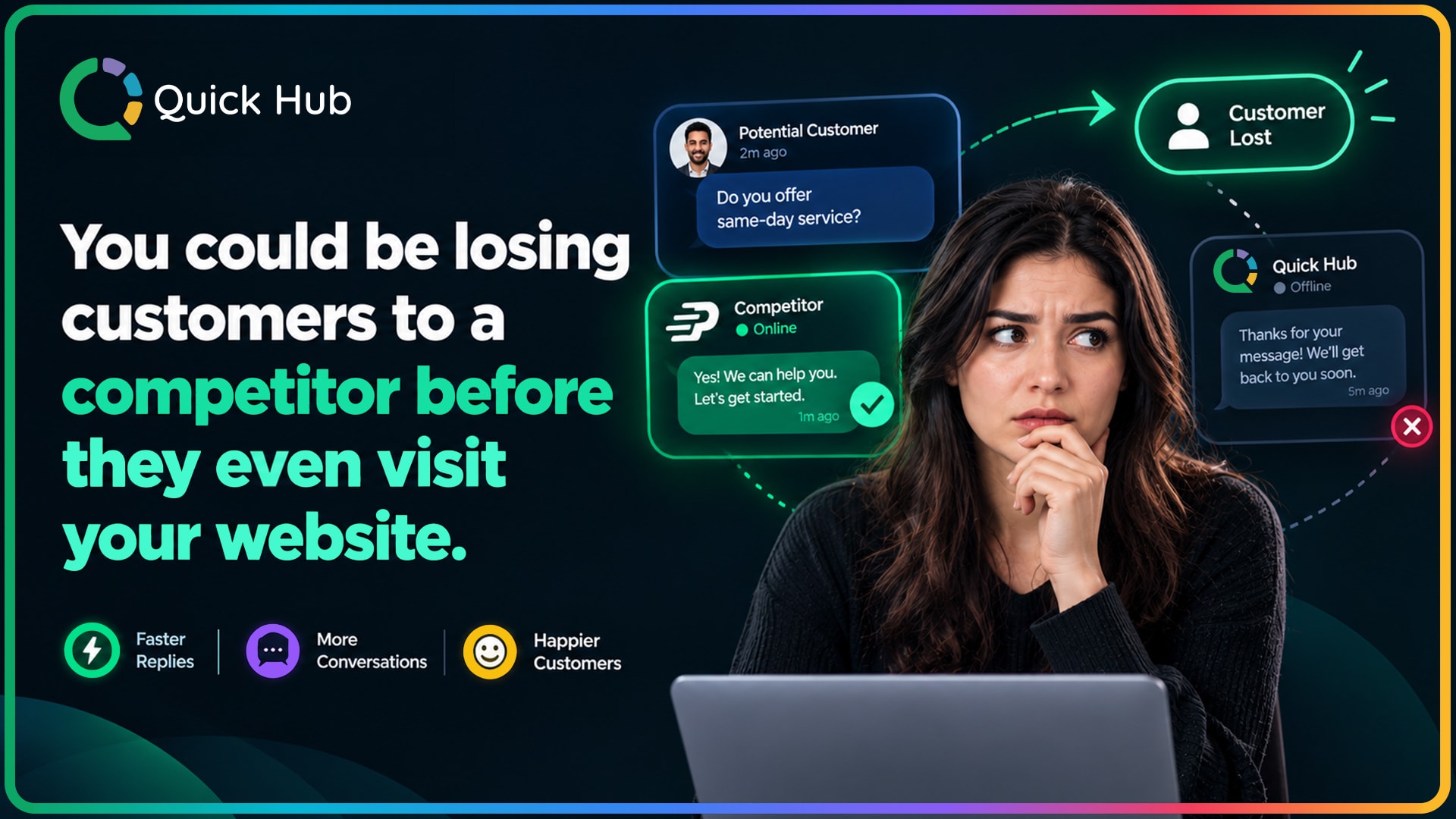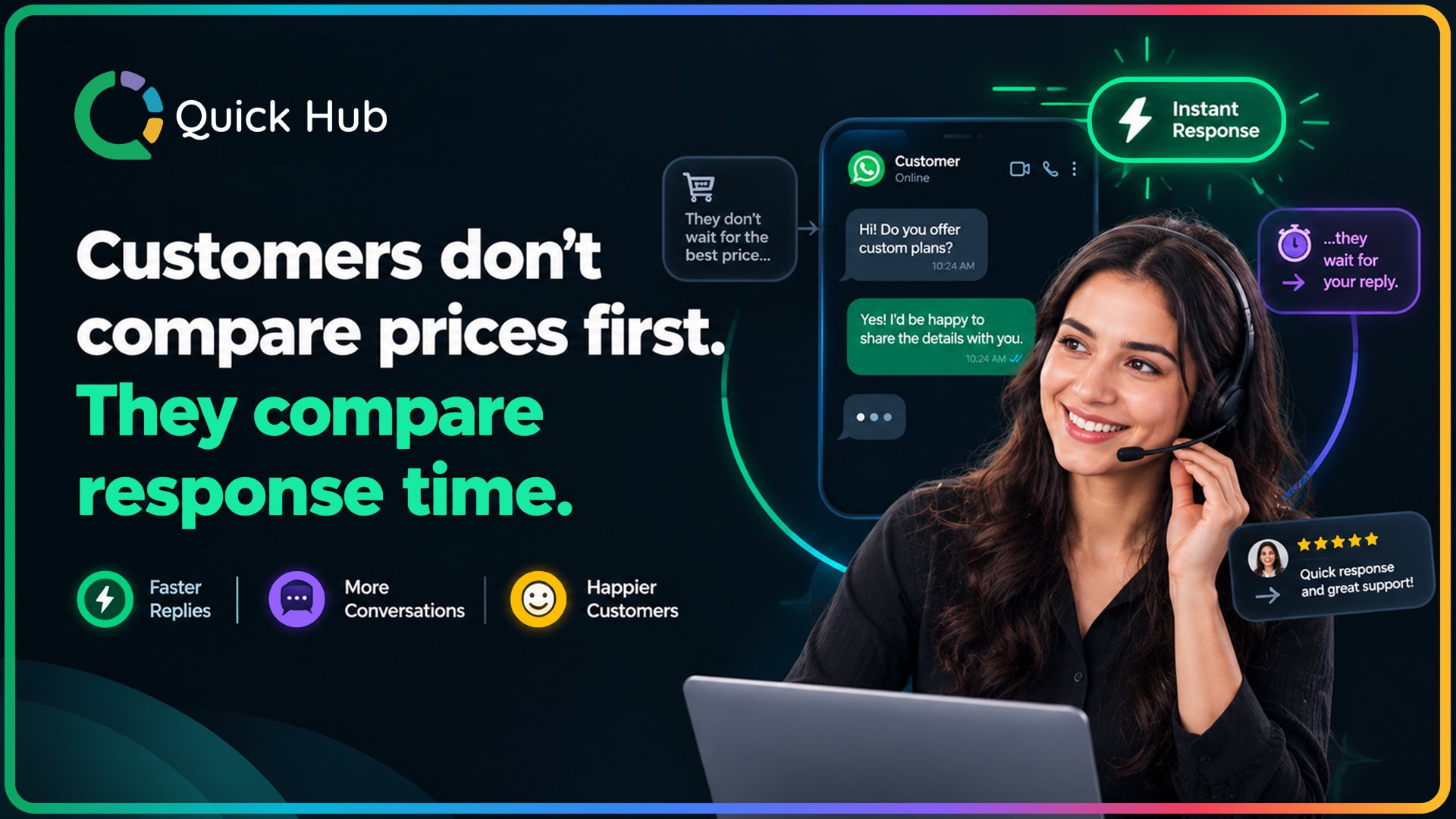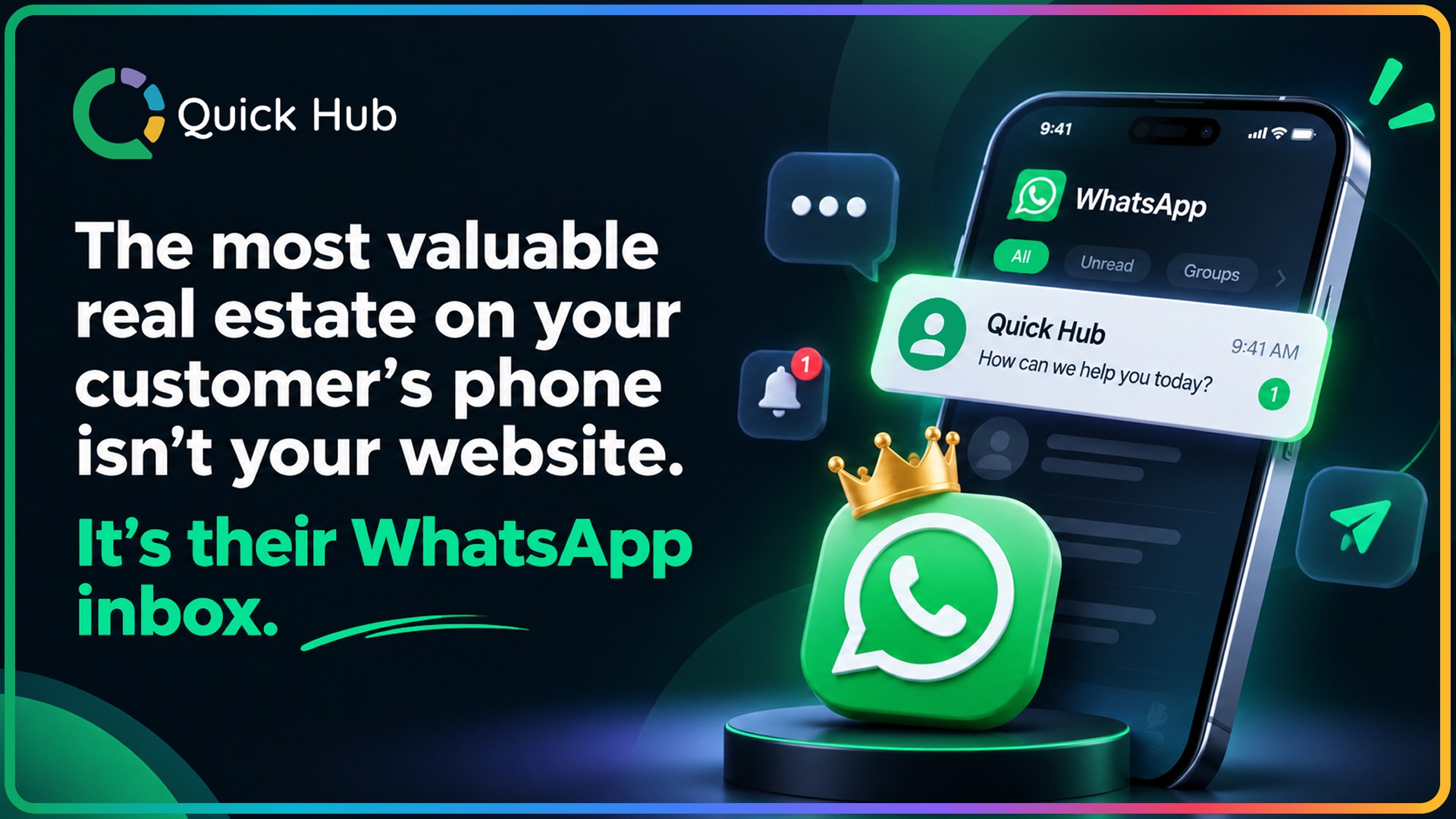

For years, businesses fought for homepage visits, email opens, and social media impressions. But while brands were busy competing for attention, customer behaviour quietly changed. Today, some of the most valuable opportunities to influence a buying decision exist inside the app people open dozens of times a day. Today, attention doesn’t live on websites, inboxes, or feeds anymore. Instead, it has shifted into something far more personal, far more habitual, and far more immediate.
Messaging apps.
And for most small businesses, it lives inside one platform above all others:
WhatsApp.
People don’t check websites daily. They don’t open every promotional email. They don’t scroll Instagram profiles with buying intent. But they open WhatsApp constantly. First thing in the morning. Between tasks. During breaks. Late at night. It is the most habitual screen on their phone, not because they choose it, but because it is already part of how they communicate, decide, and respond. And that changes everything.
This is the moment WhatsApp Broadcast stopped being optional marketing and quietly became something much bigger. It is no longer just a promotional tool. It has become the modern equivalent of a homepage visit, but with one critical difference:
The attention is already inside the experience.
Offers don’t wait to be discovered. They are seen instantly. New launches don’t require navigation. They appear directly in the user’s daily flow. Reminders don’t depend on email open rates. They interrupt action at the right moment. And most importantly, upsells don’t feel like an interruption. They feel like they are relevant.
Websites wait for visitors. Broadcast messages enter the customer’s day. Ads fight algorithms. Broadcasts bypass them entirely. In today’s small business landscape, the channel that consistently earns attention doesn’t just improve communication, it defines revenue flow. And right now, that channel is WhatsApp. Because when attention moves, business models must follow. Broadcast messaging is no longer optional experimentation. It is becoming the core operational infrastructure for modern small businesses.
Why Most Businesses Still Get WhatsApp Broadcast Wrong
Most small businesses don’t ignore WhatsApp Broadcast because they doubt its effectiveness. They fail because they don’t know how to run it consistently, confidently, and at scale. On paper, bulk messaging looks easy: Write something. Send it. Wait for results. In reality, execution breaks down almost immediately.
The first problem: Message paralysis
Teams open the broadcast screen and freeze:
- What should the message say?
- How promotional is too promotional?
- Will this annoy customers?
- Will people unsubscribe?
Without pre-built guidance, every broadcast feels risky. So teams delay. Then skip. Then forget completely. Nothing gets sent.
The second problem: No operating system
There’s no messaging framework. No repeatable structure. No calendar. No system. Broadcasting becomes a creative task competing with daily fires. The moment work piles up, WhatsApp marketing is the first thing teams stop doing.
Then comes the most damaging belief of all:
Irrelevant messaging is. Short, contextual, well-timed WhatsApp messages routinely outperform emails and social posts because they appear where attention already exists. WhatsApp messages typically see 90%+ open rates and response rates up to 45–60%, far exceeding email’s average 15–25% open rate.
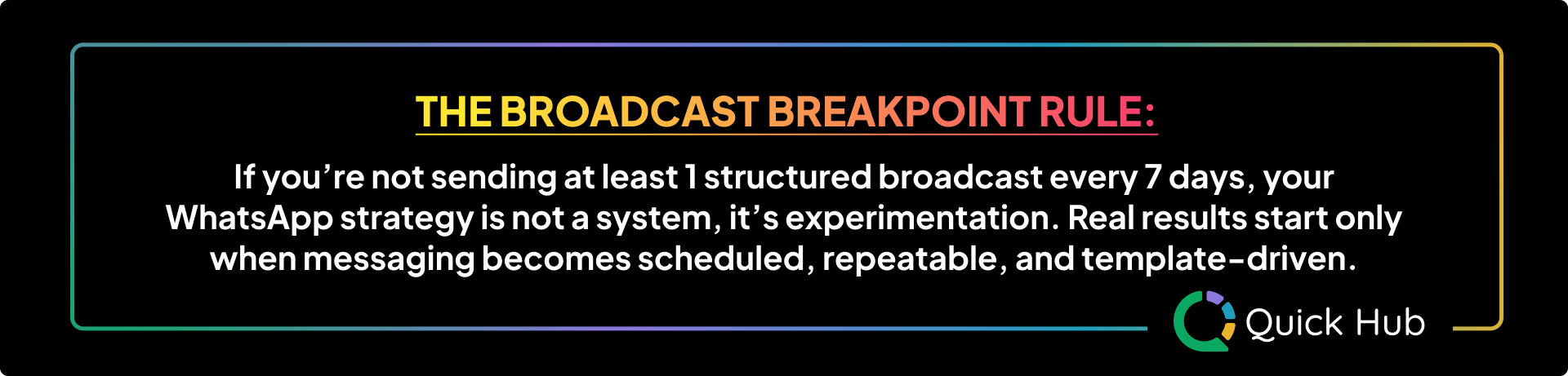
A simple 3–4 line broadcast, sent at the right moment, often drives faster replies and clearer intent than long-form campaigns elsewhere. But most businesses never reach that stage. They send one message. Then disappear for weeks. And then conclude WhatsApp “doesn’t work.” Consistency doesn’t fail because of lack of interest. It fails because there’s no system. Without consistency, WhatsApp Broadcast never matures into what it should be: a dependable revenue channel instead of a one-off attempt.
WhatsApp Broadcast Is No Longer Just Text
For years, broadcast messaging was treated like a louder version of SMS: short text, one-way communication, and a hope that someone might respond. It was transactional, static, and fundamentally limited in what it could achieve. That version of WhatsApp is now outdated.
Today, WhatsApp Broadcast has evolved into a full interaction layer. Messages are no longer restricted to plain text. Businesses can now send images, PDFs, product catalogs, pricing cards, and clickable CTA buttons that allow customers to act instantly—buy, book, call, or reply—without leaving the chat. This shift is not cosmetic. It is structural. Because the moment communication becomes interactive, it stops being “messaging” and starts becoming a conversion environment.
With QuickHub’s Quick Chat, broadcasts are no longer isolated announcements. They become entry points into live conversations where intent is captured in real time. The second a user clicks a button or replies, they are no longer a passive receiver, they are a qualified lead inside a tracked funnel.
Instead of pushing updates and hoping for action later, businesses now create micro conversion surfaces directly inside WhatsApp. This changes the entire role of broadcast communication.
A single message can now function as:
- A product launch page.
- A flash sale landing card.
- A booking interface.
- A restock alert with instant purchase flow.
- A re-engagement trigger with immediate response tracking.
There is no “visit later” behavior anymore. There is only immediate decision-making inside the chat.
This is why WhatsApp Broadcast is outperforming traditional channels like email, landing pages, and even social ads: It removes the biggest drop-off point in the customer journey: the redirect.
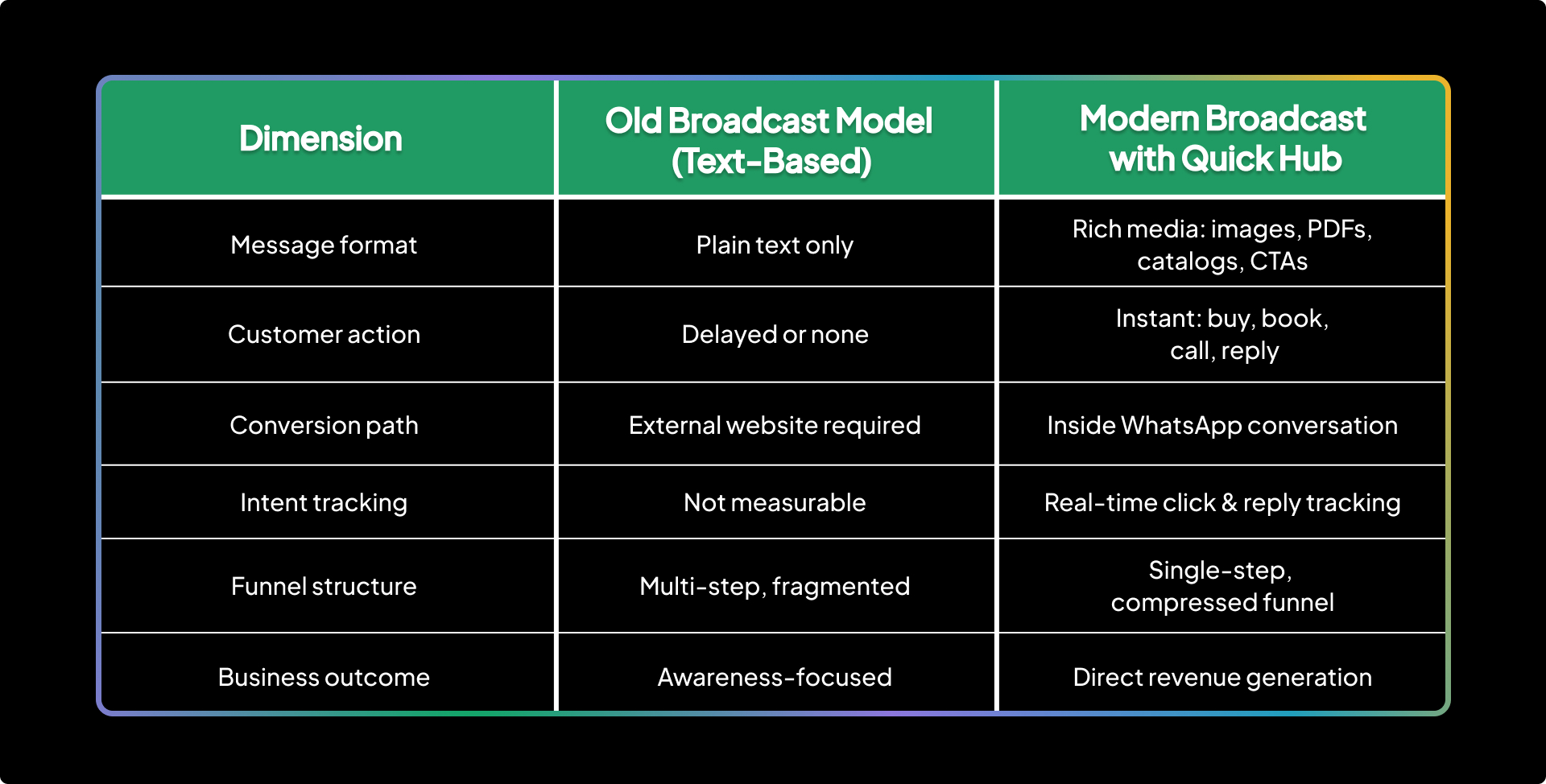
In this new model, every broadcast is no longer just communication. It is a transaction-ready moment disguised as a message.
Why This Channel Converts So Well
WhatsApp Broadcast follows a completely different set of rules, and those rules consistently work in the business’s favor:
1. No Algorithm Gatekeeping
Emails fight spam filters. Social posts fight feed algorithms. Ads fight rising auction costs. WhatsApp broadcasts arrive directly in the user’s primary conversation list. There is no middle layer deciding whether your message gets seen. If it is sent, it is delivered.
2. Industry-Leading Open Rates
The most powerful advantage is simple behavior: people open WhatsApp. Unlike email inboxes that become graveyards of unopened newsletters, messaging apps maintain an urgency that no other channel can replicate.
Key Statistics (WhatsApp vs other channels):
- WhatsApp open rates: 90–98%
- Average email open rates: 15–25%
- Click-through rates (WhatsApp): 35–45%
- Click-through rates (email): 2–5%
- Response time on WhatsApp: under 5 minutes (average among active users)
- Response time on email: 1–24 hours (or never)
These numbers are not marginal improvements, they are structural advantages.
3. Instant Reading Behavior
WhatsApp messages are not “saved for later.” They are opened and read within minutes of arrival. This makes the channel exceptionally effective for time-sensitive actions:
- A restock alert.
- A limited-time discount.
- A payment reminder.
- A product drop announcement.
Each of these works because timing and attention are aligned.
4. High Trust Environment
Unlike ads or cold emails, WhatsApp operates inside a personal communication space. When a business sends a valuable, well-structured message, it inherits the trust and immediacy of the platform itself.
Additional insight:
- 70%+ of users say they prefer messaging businesses via WhatsApp over email or calls.
- Messages from known brands are opened 3x faster than promotional emails.
- WhatsApp has significantly lower “message fatigue” compared to social feeds.
Why Does This Matter?
In today’s attention economy, distribution is not the problem, attention is. WhatsApp Broadcast solves this at the root:
- No algorithm delay.
- No inbox competition.
- No scroll fatigue.
- No discovery barrier.
It delivers your message into a space where the user is already active, already engaged, and already primed to respond.
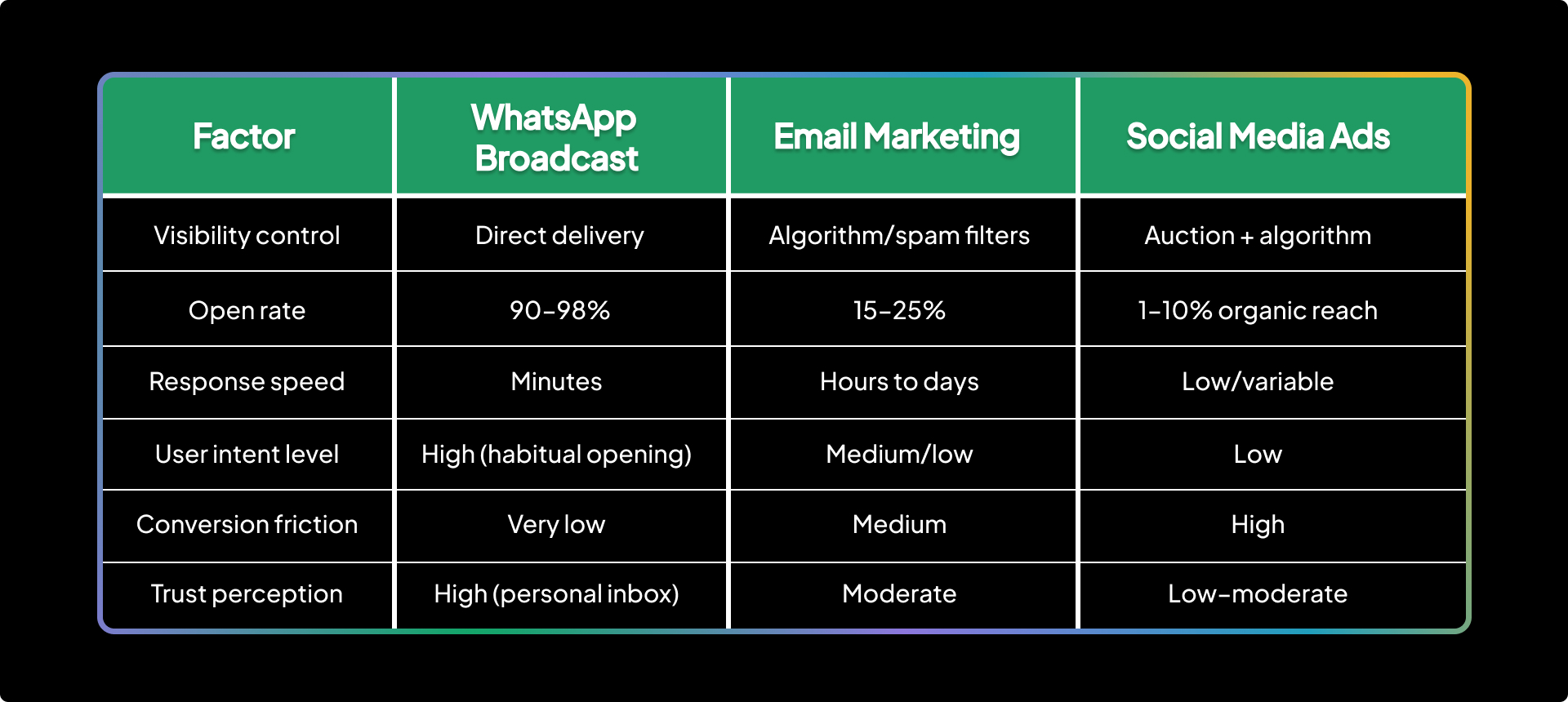
WhatsApp doesn’t convert better by chance. It converts better because it operates where attention already exists, and where decisions happen fastest.
How Quick Hub Turns Broadcast Into a One-Click System
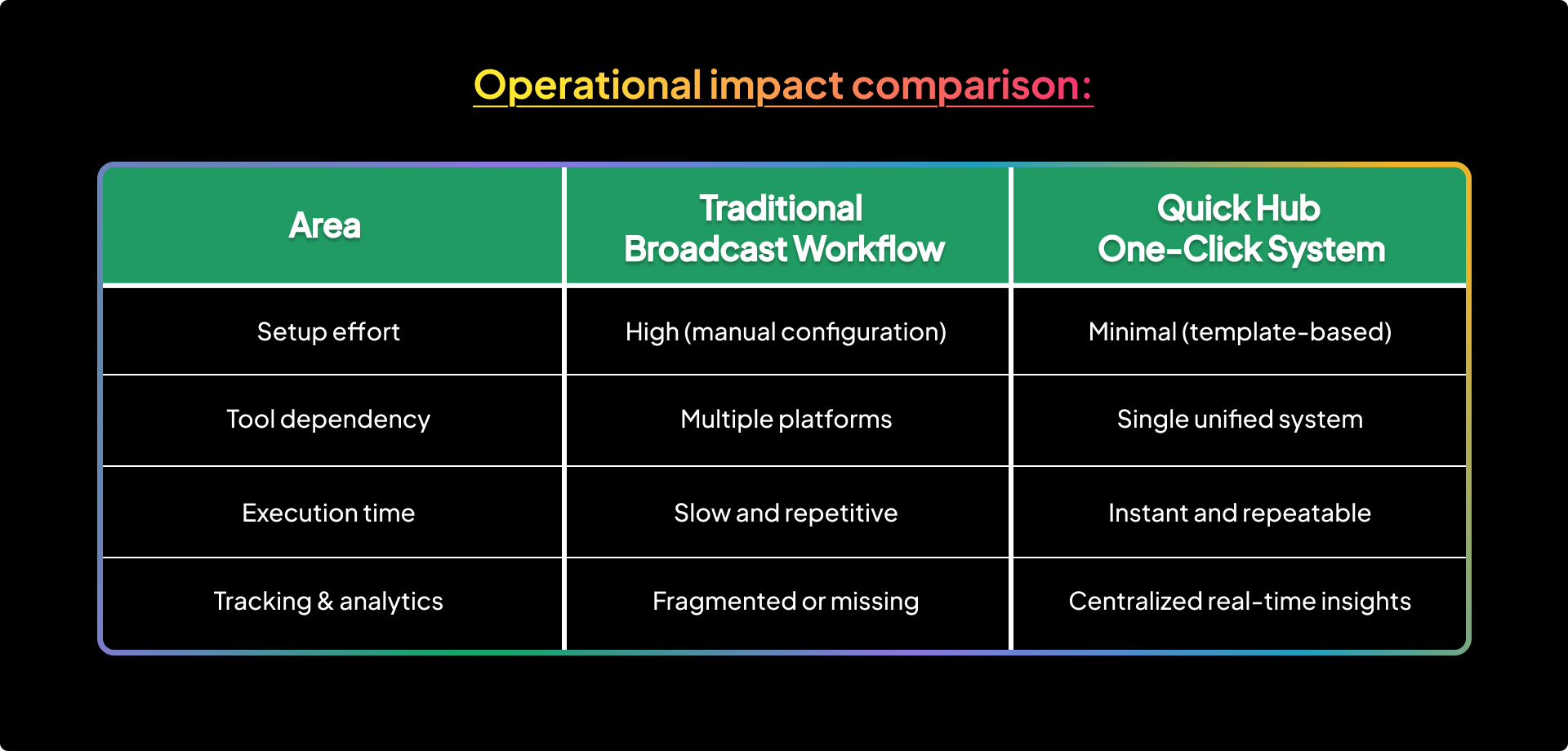
The problem with WhatsApp Broadcast was never capability, it was friction. Too many steps. Too many tools. Too many decisions. Too much manual effort every single time you wanted to send a message. Quick Hub removes that entire layer of complexity and turns broadcasting into a repeatable, one-click system instead of a fragmented task.
Inside the WhatsApp Broadcast Manager, the entire workflow collapses into just four steps:
- Choose a ready-made template.
- Customize key details.
- Attach media or CTAs.
- Send.
That’s it. No switching tools. No spreadsheets. No scattered contact lists. No guessing what worked last time. And no delays caused by decision fatigue.
From Fragmented Execution to Unified Control
What actually changes is not just speed, it’s structure. With Quick Hub, every broadcast is automatically connected to:
- Quick Chat (for real-time conversations)
- Quick CRM (for customer history and segmentation)
- Quick Campaigns (for scheduling and automation)
So instead of broadcasting into a void, every message becomes part of a connected customer journey system. Delivery is tracked. Clicks are measured. Replies are captured. Conversations are routed. And next actions are triggered automatically. Nothing gets lost in between.
Broadcast Becomes a Business Engine
This is the real shift. WhatsApp Broadcast stops being “send a message to many people.” It becomes an always-on revenue engine that powers the core functions of a business.
With Quick Hub, broadcasts directly contribute to:
- Retention — keeping customers engaged after purchase.
- Repeat purchases — bringing buyers back with timely offers.
- Reactivation — recovering inactive customers automatically.
- Flash sales — driving urgency-based conversions instantly.
- Inventory movement — clearing stock with targeted outreach.
Instead of being a one-way communication tool, it becomes a performance layer for business growth.
The Real Advantage: Enterprise Power Without Enterprise Complexity
Traditionally, this level of coordination required multiple tools, technical setup, and dedicated teams. Quick Hub compresses all of it into a single system that small businesses can actually use daily.
Final Shift
WhatsApp Broadcast is no longer a marketing add-on. With Quick Hub, it becomes part of daily business operations, where messaging, sales, follow-ups, and customer relationships all happen in one continuous flow. The result is simple: Less effort. More consistency. And a system that turns every broadcast into measurable business impact.
Conclusion
The real problem with WhatsApp Broadcast was never reach, engagement, or even conversions. It was execution. Businesses didn’t fail because the channel didn’t work, they failed because the system behind it didn’t exist.
When broadcasting depends on manual effort, creativity in the moment, and inconsistent follow-ups, it will always collapse under pressure. But when it becomes structured, repeatable, and connected to a larger system, everything changes.
That’s where the shift happens.
With a unified setup like Quick Hub, WhatsApp stops being a scattered marketing activity and becomes a controlled growth engine. Every message is no longer just sent, it is tracked, measured, and tied to outcomes. Conversations don’t disappear, they flow into structured pipelines. Interest doesn’t get lost, it gets captured and converted in real time.
This is what separates businesses that “try WhatsApp marketing” from businesses that actually grow with it. Because in the end, revenue doesn’t come from sending more messages. It comes from sending the right message at the right time, inside a system that ensures nothing falls through the cracks.
And once that system is in place, WhatsApp Broadcast stops feeling like marketing effort altogether, it starts behaving like infrastructure. A quiet, consistent, always-on revenue layer running in the background of your business. That is the real advantage.